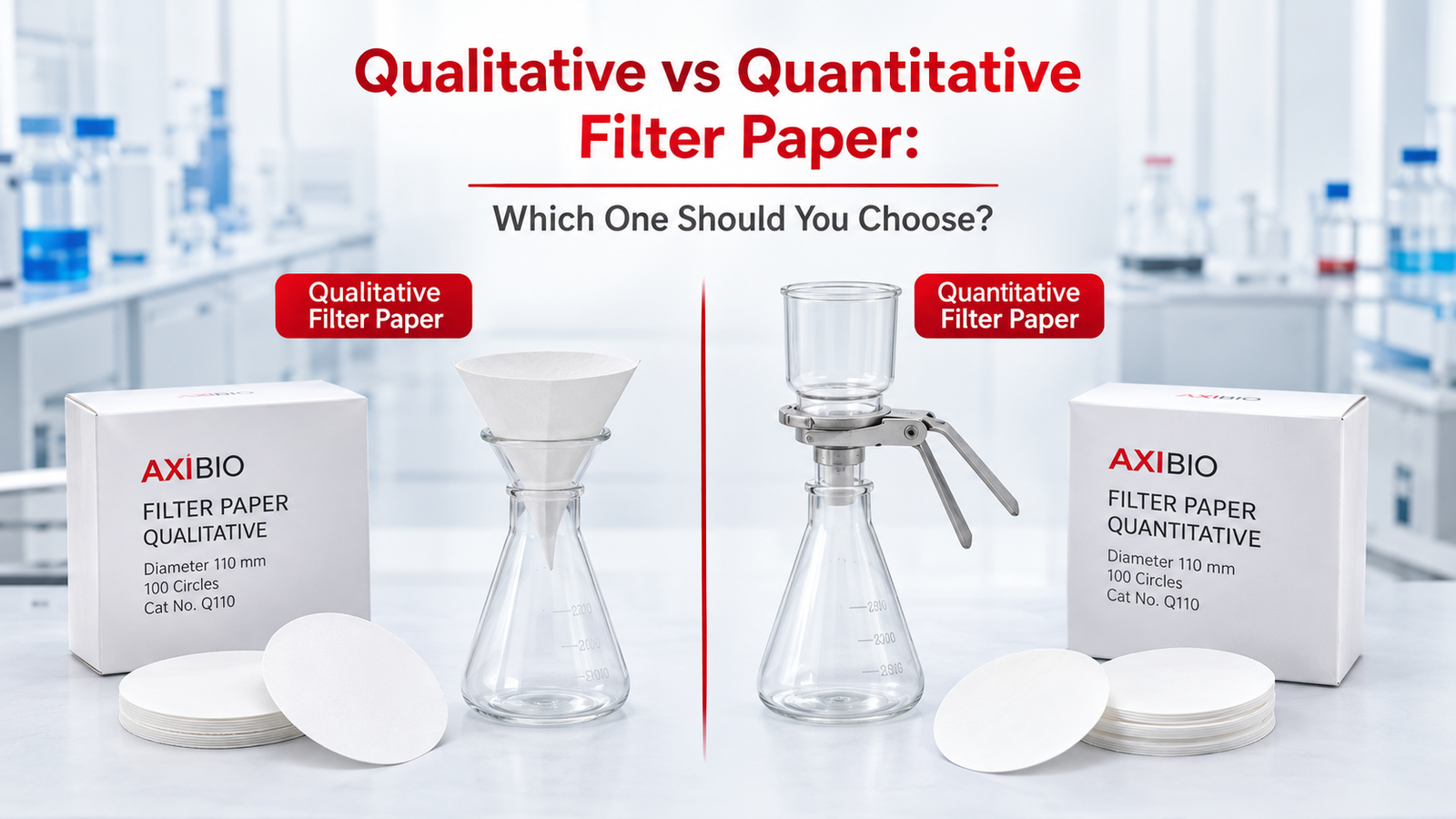
Qualitative vs Quantitative Filter Paper have you ever been in a situation where you have held two boxes of filter paper and were not sure about which one to choose? You were not alone there, because it is very difficult to deduce from the labels which box to pick. The purpose of this article is to explain to you the terms and the quality of qualitative and quantitative filter papers and to help you decide which one is suitable for your experiment.
Qualitative filter paper is used if you need to isolate solid material from a solution and not to worry about weighing the residue further. In other words, quantitative filter paper is applied in experiments where the residue of the material is required for further calculations and it is necessary to use a filter paper with minimum weight contribution.
There are several factors that can determine the choice of filter paper: is it a straightforward experiment or the weighing of the residue is needed? Are the particles big enough for separation? Can the paper withstand vacuum filtration without disintegrating? Is there any limitation by ash content in the experiment?
The following article will guide you on how to answer these questions to ensure that your paper is suitable for the task at hand.
What Is Qualitative Filter Paper?
Qualitative filter paper is a multi-use cellulose filter paper which is generally used to filter liquids and solids, where it is not necessary to know the weight of the filtered material. It is a common lab tool which is used to clarify turbid solutions or to isolate precipitates before the next procedure.
The working process is similar to that of any other cellulose filter: the liquid goes through the pores of the paper while larger particles remain on the filter. Since the quantitative papers are not produced according to the certain ash standard, they necessarily have greater amounts of minerals after burning. It suits the filtration purposes well enough, but does not fit for gravimetric analysis.
There are different types of qualitative filter paper based on their rates of filtration that are classified as either fast, medium, or slow based on the size of the particles. The individual who would be using filter paper to clarify a turbid extract prior to being used in the instrument would most likely choose a medium grade of filtration.
How it doesn’t quite work: when the same precipitate is then to be dried and weighed in order to determine the percentage or concentration, the ash content of the filter paper itself becomes a source of error. This is precisely what quantitative filter paper seeks to address.
What Is Quantitative Filter Paper?
The production of quantitative filter paper is intended exclusively for the purpose of gravimetric analysis. This means that filtration is performed with the understanding that the collected material would subsequently be dried, incinerated, and weighed. As a consequence, the paper used must burn virtually without a trace.
Manufacturers accomplish this by treating the pulp with acids during manufacture, which removes any mineral impurities and results in what is known as ashless filter paper. As stated in the filtration industry literature, qualitative filter paper results in ash content up to about 0.13%, whereas the maximum ash content for ashless quantitative filter papers is about 0.0009% or less – an order of difference of over two magnitudes. In some cases, the ash content for quantitative filters is so little that it is not measurable using an analytical balance and it is usually printed on the packet itself.
This is important since in gravimetric analysis, the filter paper is usually burnt away along with the precipitate. However, if the paper itself forms an ash which has measurable weight, then the weight will be considered in your calculations, although it shouldn’t be. This is not acceptable when performing an analysis such as determination of insoluble residue.
Quantitative filter paper is also more resistant to wetting than qualitative filter paper and this is important when it comes to recovering the precipitate from the filter surface or when performing vacuum filtration.
Which Filter Paper Should You Choose?
When time is an issue, and you just want a quick answer, then that’s it: use qualitative filter paper in situations when you don’t have to measure the amount of residue left after filtration. Use quantitative filter paper when you will dry, incinerate, or weigh the residue.
| Requirement | Better Choice | Why |
| Routine filtration or clarifying a liquid | Qualitative filter paper | Lower cost, widely available, performs well for general separation |
| Gravimetric analysis (weighing the residue) | Quantitative filter paper | Very low, tightly controlled ash content so it doesn’t distort the weighed result |
| Chloride, sulfate, or similar qualitative tests | Qualitative filter paper | No need for precise residue mass, so a standard grade is sufficient |
| Filtering fine crystalline precipitates for analysis | Quantitative filter paper (slow/fine grade) | Combines fine retention with an ashless or low-ash rating |
| Vacuum or Büchner filtration with precipitate recovery | Quantitative or hardened/wet-strengthened grade | Higher wet strength resists tearing under suction |
| Student or teaching lab exercises | Qualitative filter paper | Cost-effective and adequate for non-analytical demonstrations |
| Environmental or air pollution sample collection | Depends on the method | Some protocols specify glass fiber or quartz media instead of cellulose always check the method first |
This chart is only a guide; it is not a replacement for looking up your individual laboratory procedure or standard. Some procedures require a specific grade, which is always paramount.
Qualitative vs Quantitative Filter Paper: Key Differences
| Factor | Qualitative Filter Paper | Quantitative Filter Paper |
| Main purpose | General separation and clarification | Gravimetric analysis and precise residue measurement |
| Ash content after ignition | Higher commonly up to ~0.13% | Very low ashless grades around 0.0009% or less |
| Residue measurement | Not designed for weighing the residue | Designed so the residue mass reflects the sample, not the paper |
| Particle retention | Available in fast, medium, and slow grades; retention varies by grade | Also available in fast, medium, and slow grades, often with tighter, more consistent retention |
| Filtration speed | Generally faster for a given retention level | Can be slower for equivalent retention, depending on grade |
| Wet strength | Moderate adequate for gravity and light suction filtration | Often higher, especially in hardened/acid-washed grades used for vacuum filtration |
| Typical applications | Routine filtration, clarification, teaching labs, general sample prep | Analytical chemistry, environmental testing, pharmaceutical QC, insoluble residue determination |
| Precision requirement | Low to moderate | High used where the result depends on an accurate weighed mass |
| Cost consideration | Generally more economical | Typically priced higher due to the additional purification steps |
Remark: Specific details regarding ash content, retention levels, and flow-rates may differ from one manufacturer to another. You should always check the specifications sheet for the particular brand of paper you will be using.
How to Choose the Right Filter Paper
Instead of beginning with the product name, begin with what it is you want to do. Going through these questions will help most people reach the right answer faster.
1. What is being separated?
It could be a precipitate, a suspension, air particulates, or anything else. This limits your filter media selection right from the start.
2. Do you need to measure the retained residue?
When the dried sample will be collected, then a quantitative filter paper of low ash content is required; otherwise qualitative filter paper is adequate.
3. How fine are the particles?
Fine or colloidal solids require a slow, fine-grade filter aid, while coarser precipitates can employ a fast grade without sacrificing any necessary components.
4. Do you need fast filtration, or can you wait?
Faster grading saves time but retains less. If your grading process relies on trapping very fine particulates, do not sacrifice retention for speed.
5. Is low ash content specified in your method?
If such standards are provided with an explicit ash limitation, then your rating depends on such a condition.
6. Will the paper be used with vacuum or pressure filtration?
In case the answer is positive, then test the wet strength of the paper. Any paper that is torn by the force of suction is contaminated.
7. Does the application require handling or scraping the precipitate off the paper?
Hardened grades or wet-strengthened grades deal with it better than qualitative papers.
8. What diameter or size fits your funnel or filtration assembly?
Filter paper has specific sizes corresponding to the diameter of the funnels, and the incorrect use of the paper leads to wastage.
9. Does your laboratory method, pharmacopoeia, or internal SOP specify an exact grade?
If a written procedure refers to a grade, use it in place of substituting due to general arguments.
“If my answers make me conclude that ‘Measurements are very important, purity is very important, and the answer is a mass,’ then I am going to use the quantitative filter paper. However, if my answers make me conclude that ‘All I need to do is separate and move ahead,’ then I am going to use qualitative filter paper.”
Qualitative Filter Paper: Common Applications
- Qualitative filter paper shows up constantly in day-to-day lab work, including:
- Clearing of turbid or cloudy solutions prior to performing additional tests
- Separation of precipitates from the solution prior to analysis
- Qualitative chemical testing that includes testing for the presence of chloride or sulfate
- Preparation of the sample prior to performing instrumental analysis
- Laboratory teaching experiments performed in educational institutions
- Routine filtration procedures performed in laboratories
- None of these applications rely on measuring the weight of material collected by the paper filter.
Quantitative Filter Paper: Common Applications
Quantitative filter paper is used when quantity is important, such as:
- Gravimetric analysis when a precipitate is dried, incinerated, and weighed
- Measurement of insoluble residue or total suspended solids
- Chemical analysis techniques where a high degree of accuracy and precision is necessary
- Analytical techniques for the environment or for water which demand a low-ash filter
- Pharmaceutical and quality control industrial tests where the material held back becomes part of a calculation
- Sampling techniques before instrument analysis where filter contamination must be kept to a minimum
Why Ash Content Matters
Every cellulose filter paper will leave some ash residue when burned; however, the point is at what quantity it will do so, and will this quantity be insignificant.
To illustrate this, imagine that you weigh your precipitate in order to determine the concentration of substance, but the ash from your filter paper will contribute even a little bit of extra mass that does not belong to your result at all. This type of systematic error will affect your results and decrease their reliability in case of several samples.
This is the exact reason why ashless filter paper is produced. Thanks to the acid washing of the pulp, manufacturers make sure that mineral substances become insignificant in the final mass of the product and, therefore, will not influence the measurement result on the standard analytical balance. In cases where nothing is weighted, such a high degree of purity is unnecessary, which makes qualitative filter paper less expensive.
Filtration Speed vs Particle Retention
That is the dilemma which gets many newbies into trouble when choosing filter papers. Fast-flow papers have wider and more porous holes. The liquid will pass through very quickly, but the smaller particles will just pass right through without getting trapped by the filter. Fine-retention, slow-flow papers trap extremely small particles; however, the liquid will take time to pass through because the filter can easily get clogged up with particles.
Here’s what this practically means:
- When you are prepping a solution before running an experiment using filtration, and your particles tend to be larger, then you can get away with faster or medium grades of filtration.
- When you want to filter out fine precipitates that can sometimes be gelatinous in nature, for further testing, it would make sense to use a slower, fine retention grade.
- When a set of samples takes longer than usual to filter, it means the grade is too fine for the number of particles.
There is no perfect combination of speed and retention. It all depends entirely upon the nature of the material to be separated and its ultimate destination after filtration.
Common Mistakes When Choosing Filter Paper
Many filtration problems stem from the paper selected for use rather than the technique employed. Patterns to note include:
- Deciding solely on price. While the lowest-priced box is okay for standard procedures, the use of an unsuitably defined paper for analysis may end up costing much more from repeating the test.
- Selecting the highest speed without verifying retention capacity. While speed is desirable, failure to consider the size of fine particles that can be lost means that the filtrate is not clean even though it seems to be.
- Failing to verify ash content when using a gravimetric method. Using standard qualitative paper when the procedure demands the use of an ashless paper causes errors whose occurrence goes unnoticed until inconsistency of results is noted.
- Neglecting wet strength before vacuum filtration. Paper that is torn by suction causes contamination of the filtrate and may require redoing of the whole preparation process.
- Selecting an inappropriate diameter for the funnel. The paper that is too small fails to seal appropriately while one that is too big folds abnormally and channels liquid around rather than through the filter bed.
- Assuming that there is documentation regarding the ability to substitute. If the SOP, pharmacopeial method, or regulatory protocol specifies a certain grade, substituting “something similar” invalidates the procedure.
- Considering filter papers to be interchangeable. Two papers that have the same name but made by a different manufacturer can vary widely in retention, speed, and ash content.
Simple Decision Guide
If you just want a quick checklist in your head for most practical purposes, then this will serve the purpose:
Do you need routine separation or clarification, and do you not need to consider weighing the residue? → Think about using qualitative filter paper.
Do you need to precisely measure the weight of the residue? → Think about using quantitative (low ash or ashless) filter paper.
Are you using vacuum or pressure filtration, or do you have to recover the precipitate later? → First consider the wet strength and the manufacturer’s recommendations before choosing.
Not sure? → Select the grade according to the retention and ash requirements of your laboratory procedure rather than relying on guesswork.
However, there can be cases where the situation does not fit neatly into this list, as the laboratory procedure may require a particular grade for reasons other than those listed above.
Need Help Choosing a Filter Paper?
Choosing the appropriate grade of filter paper will depend on your particular application, your required retention, speed of filtration needed, and if there is an ash/wet-strength requirement in your method. There is no one-size-fits-all grade of filter paper for the laboratory.
AXIBIO produces several different types of laboratory filter papers as part of their full line of filters and filtration assemblies. These include not only qualitative filter papers for regular separation, but also quantitative filter papers for gravimetric and analytical use. If you are uncertain what grade is right for your application, you might want to compare the specification sheet to your laboratory’s needs.
Conclusion
The choice between qualitative and quantitative filter papers is not an issue of superiority; it depends on the compatibility of the paper with the further analysis process. In case of separation of a precipitate followed by subsequent actions, qualitative filter paper suits fine and saves money for the researcher. However, when the precipitate is further analyzed by drying, incineration, or weighing, quantitative filter paper with lower ash content prevents contamination of the result.
If you have doubts about choosing the proper type of filter paper, leave this decision to your method or SOP, and if the grade is not defined, the answers to these questions (residue, particle size, filtration rate, wet strength, ash content) from the guide above will give a clear answer. This will save your time and effort.
Frequently Asked Questions
1. What is qualitative filter paper used for?
Its use is routine in laboratory filtration when there is no need for weighing of the filtered-out material – solution clarification, precipitation separation prior to additional processing, and qualitative chemical analysis.
2. What is the difference between qualitative and quantitative filter paper?
There is a fundamental difference that lies in the ash content of the papers. Quantitative filter paper is made with very low ash content because of its purpose as gravimetric analysis paper, whereas qualitative filter paper is made with high ash content.
3. Can qualitative filter paper be used for gravimetric analysis?
This is not advisable because of its high ash content that can introduce errors in your weighed amount, making your gravimetric technique ineffective. There are quantitative and ashless grades available to prevent such an occurrence.
4. What is quantitative filter paper used for?
It is used for gravimetric analysis and other forms of analysis that involve drying and weighing the filtered precipitate. In some cases, it is even subjected to ashing in a furnace.
6. What does ashless filter paper mean?
The ashless filter paper is a grade of quantitative paper, which is made by acid washing during its manufacture, and thus gives a very low level of ash, which can be regarded as negligible when weighing on an analytical balance.
7. How do I choose a filter paper grade?
Begin by determining what you’re trying to separate, if weighing the residue is required, the particle size, and the grade of paper required in your procedure or SOP. The answers will normally point decisively either to qualitative or quantitative paper, and to a fast, medium, or slow retention grade of that type.
8. Does filter paper pore size affect filtration speed?
Yes. The greater the openness of the pores in a paper filter, the faster it will filter, but the less fine particulate matter it will trap. Filters that trap finer particulate matter are slower filters.
9. Which filter paper is best for routine laboratory filtration?
For general separation and clarification without measuring the residue, the general purpose filter paper, which is usually medium-speed, is adequate and more economical than the quantitative grade.
10. Is quantitative filter paper more expensive than qualitative filter paper?
In most cases, the answer would be yes. This is because the extra processing required to remove ash increases the cost of production.
11. Do qualitative and quantitative filter papers come in the same sizes and speed grades?
The two types are generally offered at fast, medium, and slow flow rates that are comparable as well as having similar diameter sizes.