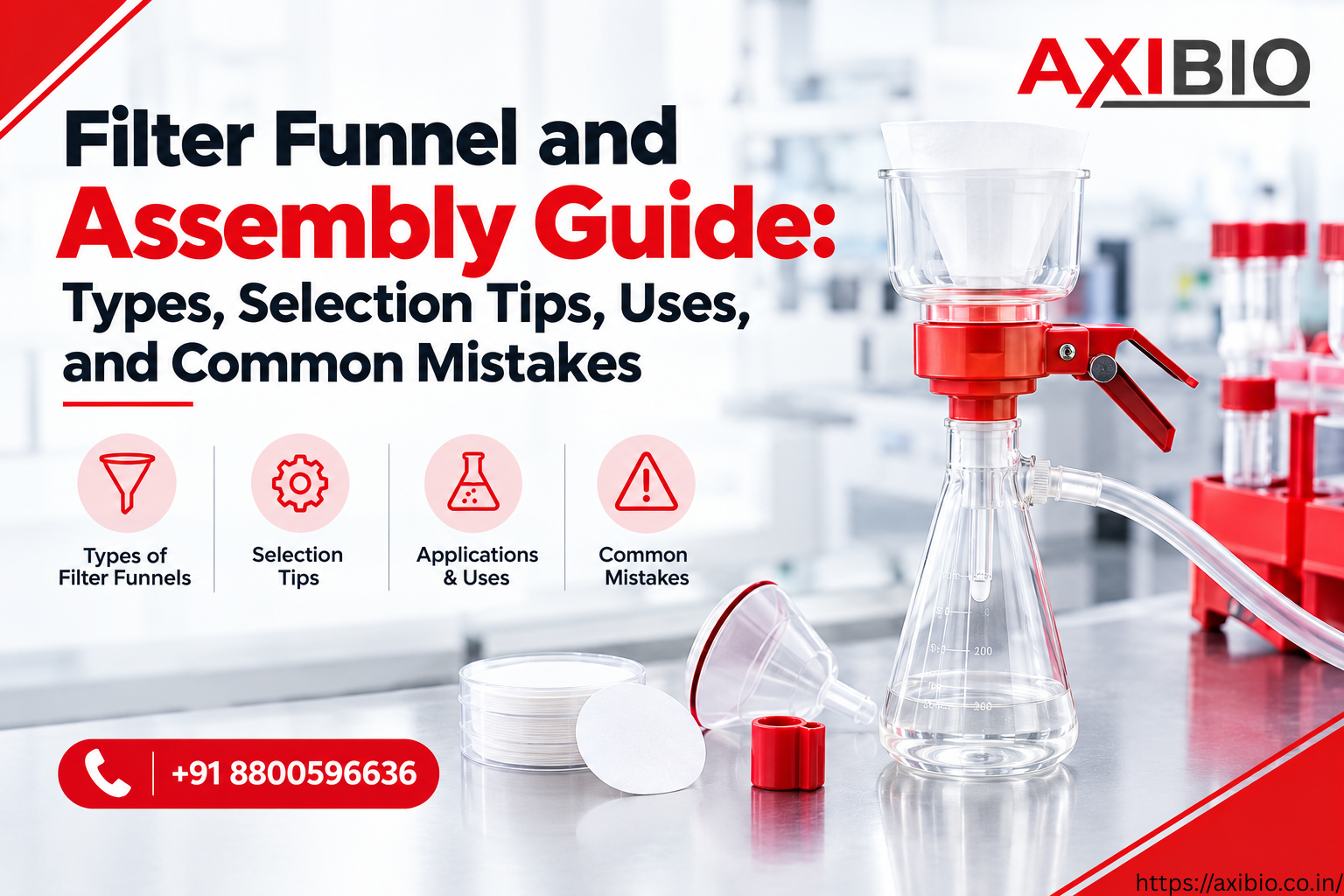
Filter Funnel and Assembly is an assembly designed for separation of solid particles from liquid samples or collection of a filtered sample in a laboratory. It usually includes a filter funnel, filter medium, supporting elements and receiving vessel creating a controlled path for filtration.
Filter Funnel and Assemblies retain a filter paper or membrane allowing liquid to pass through while retaining particles or microorganisms. Choice of the right filter funnel or filter assembly depends on many factors including sample properties, type of filter, amount of liquid and filtering method – gravimetric or under vacuum.
In this article, we will discuss what Filter Funnel and what is Filter Assembly, its types, ways to choose between them, troubleshooting common issues, and things to keep in mind prior to approaching manufacturer/supplier. Links to relevant Axibio products will be provided throughout the article.
What Is a Filter Funnel?
Filter funnel is the funnel used for filtering purposes in the laboratory where filter paper or a membrane are placed inside the funnel so that the liquid can be filtered and only solid material or microbes are retained on the filter.
The filtration is done by the filter; the funnel just keeps it at its place and directs the liquid flow. Bad compatibility between both results in leakage, bypass, and inaccurate work.
Generally, there are following components included in most arrangements:
- Funnel body/cup: used to hold the sample
- Filter support: plate, sieve/screen, or fritted disc beneath the filter paper
- Filter: filter paper, glass fiber, or membrane
- Outlet/stem: used to direct the filtrate downwards
- Receiver/collector: flask or bottle to collect the filtrate
Axibio refers to Filter Funnel and Assemblies as instruments which are used to retain filter paper or membranes during vacuum or gravity filtration. The site mentions microbiology, pharmaceutical, chemistry, and environmental laboratories as some examples of customers.
Selection is important because an unsuitable funnel size reduces the rate at which the work is done. Unsuitable materials for the solvents or sterilization technique may crack, swell or cause contamination of the samples. Proper selection of Filter Funnel and Assemblies will reduce working time.
What Is a Filter Assembly?
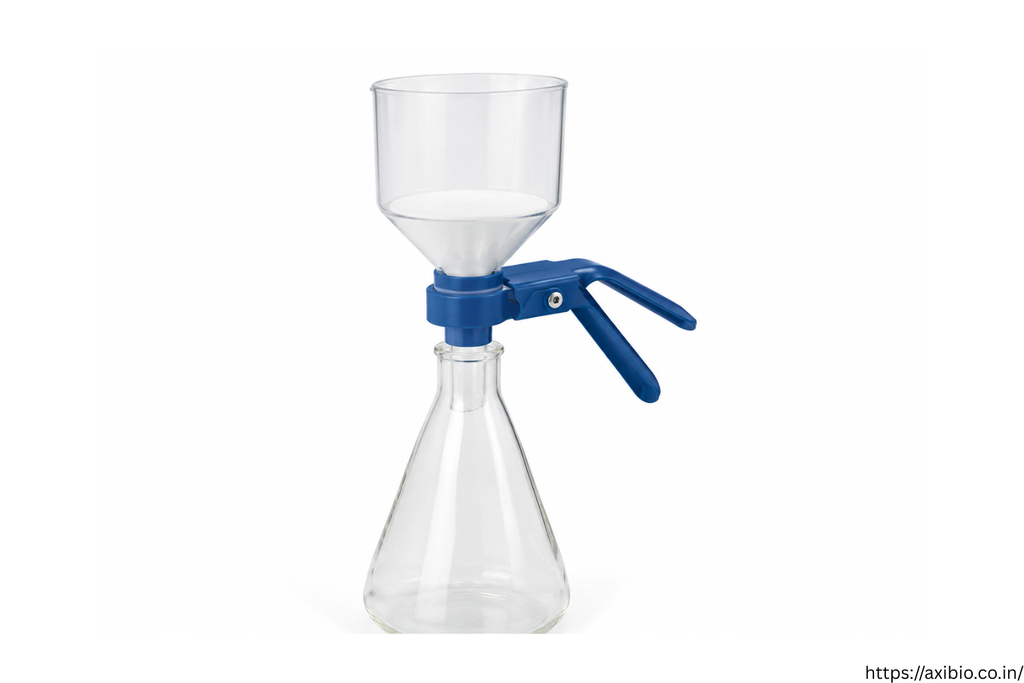
Filter apparatus is a combination of all elements required for filtration. The filter apparatus generally consists of a funnel, a filter holder, a clamp or seal, and a flask to collect the liquid.
All these parts function as one unit:
- The funnel contains the sample.
- The filter catches the particles.
- The support flattens the filter under suction.
- The clamp or seal ensures no leaks occur.
- The receiver captures the filtrate.
- The vacuum line increases the rate of filtration when it is used.
The individual funnel is one of the components. The filter assemblies are the complete functional unit. For instance, according to Axibio, a glass assembly consists of a glass funnel, clamp, cover, and a receiving flask with interchangeable joints. On the other hand, the membrane filter funnels do not come with a vacuum flask.
It is essential to verify if the clamp and receiver are included in the case of filter assemblies being searched by buyers.
Filter Funnel vs Filter Assembly
Filter funnel is a single unit used to hold the filter. Filter assembly consists of all these units, funnel, support, clamp and receiving flask. If you have your own parts that fit together, use just the funnel. If not, buy the assembly.
Choose a filter funnel alone when:
- You already have a compatible flask, stopper, and vacuum line
- The old component is damaged and needs replacement
- You require additional funnels for another lab station
Choose a complete assembly when:
- You are constructing a new filtration station.
- You require matched components that fit without adaptors.
- Leaks and mismatches in joints have created problems previously.
For both, funnel diameter, joint size, and filter size should be the same. In most cases, leaking occurs because of using incompatible parts of various systems.
Types of Filter Funnels and Assemblies
Different methods need different designs. The table below compares the common types of Filter Funnel and Assemblies. The sections after it explain each one.
| Type | Main Use | Key Advantage | Best For | Important Consideration |
| Conical gravity funnel | Routine gravity filtration with folded or fluted paper | Simple, no vacuum needed | Clarifying liquids, coarse to medium particles | Slow with fine or sticky particles |
| Buchner funnel with flask | Vacuum collection of solids | Fast, handles a solid cake well | Crystals and precipitates | Needs a tight seal and correctly sized paper |
| Fritted (sintered) glass funnel | Filtration without paper | Reusable, no paper fibres | Compatible samples where paper is unsuitable | Pores can clog and need careful cleaning |
| Membrane filter funnel (47 mm) | Retaining particles or microbes on a membrane | Defined pore size, flat filter surface | Sterility and microbiological testing | Membrane must suit the sample; vacuum flask needed |
| Glass funnel assembly with clamp and flask | Complete vacuum membrane filtration | Matched parts, quick assembly | Chemical, microbiological, and pharmaceutical labs | Check joint size and flask capacity |
| Multi-place manifold | Several filtrations from one vacuum source | Higher throughput | Routine batch testing | Needs matching funnels and valve control |
Gravity Filter Funnels
The conical funnel contains fluted or folded filter paper and uses gravity for draining the liquid. It is used for normal clarification as well as for samples containing coarse or medium particles. It is easy and does not require a vacuum, but it is slow when fine particles are present.
Buchner Funnels
A Buchner funnel is equipped with a flat plate with holes and positioned on a filter flask under vacuum conditions. A paper disc is placed on top of the plate. The filter disc traps crystals and precipitates fast. It requires proper sealing and paper covering every hole but not climbing up the walls.
Fritted (Sintered) Glass Funnels
Glass discs with pores replace the filter papers. These filters are re-usable and do not introduce any fibers of paper. Different porosities are available in these types of filters. Pores can get clogged, so cleaning is important. Strongly alkaline solutions at high temperatures may affect the glass frits.
Membrane Filter Funnels
They have a flat membrane which is usually 47 mm and are used with vacuum. Membrane traps the particles or microorganisms on the surface. According to Axibio, membrane filter funnel is made for 47 mm membrane filters and is meant for vacuum filtration in sterility testing and microbial testing.
They have stainless steel, polypropylene, polycarbonate, and glass types. They say that polypropylene and glass funnels are autoclavable. You should ensure that your membrane is suitable for the sample since sterility depends on handling as well.
Glass Filter Funnel Assemblies
They are fully equipped sets that have a funnel, a clamp, a cover, and a receiving flask. On the Axibio filter funnel set page, there are listings of the borosilicate glass sets, which range in volume capacity from 25 ml to 1000 ml, and diameter from 13 mm to 90 mm. The joint types available are I/C B-29, B-40, B-65, and screw adaptor bottle.
The glass is chemically resistant and allows visualization during filtration. However, it is fragile. Take care when handling the glass vacuumware.
Multi-Place Manifolds
The manifold ensures that multiple funnels use a single vacuum supply system. As per Axibio, there is a filtration set up with the manifold made out of stainless steel and having a PTFE valve. The available models are for 1, 3, and 6 positions. Ideal for laboratories carrying out multiple samples in a single sitting.
How Filter Funnels Work
The filter funnel holds the filter in place while liquid is poured over it. The filter catches particles bigger than its pore size, while the liquid, called filtrate, passes into the receiver. Gravity and vacuum provide the motive power.
Gravity filtration steps:
- Fold or flute the paper and fit it in the funnel.
- Moisten the paper with some solvent to make it stick to the side of the funnel.
- Add the sample solution to the glass rod or funnel wall.
- Keep the solvent level below the paper’s edge.
- Rinse the solid left behind with fresh solvent in small quantities.
Vacuum filtration steps:
- Position the funnel atop a vacuum flask.
- Place the filter paper in position and soak it.
- Attach the vacuum flask to the vacuum supply, preferably with the aid of a trap.
- Turn on the vacuum slowly and then add the sample.
- Turn off the vacuum before turning off the pump to prevent back-flow.
- Remove the filter paper carefully using clean forceps.
Vacuum is faster, but it can pull fine particles into the filter and clog it. It also needs flasks that are rated for vacuum use.
Common Uses of Filter Funnels and Assemblies
The Filter Funnel and Assemblies are applied for the separation of solid materials from liquids in microbiology, pharmaceutical analysis, chemistry, and environmental science. Depending on the field, either the solid or the clarified liquid is important.
- Uses of membrane filters in microbiology and sterility testing include keeping microorganisms on their surfaces for testing or culturing.
- Use of membranes in pharmaceuticals includes separation of particles in the sample or detection of presence of microbes in the sample.
- Chemical uses involve the separation of precipitates or crystals from a solution in order to get a clear filtrate or dryable solid.
- Suspensions of solids in water can be filtered to collect solids on the filter (glass fiber filters are commonly used).
- The filtration of samples before analysis by HPLC and similar methods.
Knowing what part of the sample to extract dictates the technique, the filter, and the funnel.
Do not know what equipment would suit your extraction technique? Check out Axibio’s Filter Funnel and Assemblies section, or get in touch through the contact page with your requirements.
How to Choose the Right Filter Funnel and Assembly
For selecting the appropriate Filter Funnel and Assemblies, begin with your sample and desired outcome, and select the proper procedure, filter type, size of the funnel, material, and flask. Consider chemical compatibility and sterilization requirements before cost and convenience.
Follow this step-by-step process:
- Set the objective. Identify which is better: the solid phase, the liquid phase, or both.
- Choose the technique. Gravity is good for basic separations; vacuum is better for efficiency, small particles, and membranes.
- Choose the filter. Select paper filter grade, glass fibre filter, or membrane porosity depending on the size of the particle.
- Match the diameter. A membrane of 47 mm needs to use the funnel meant for 47 mm membrane.
- Consider the volume. The funnel as well as receiver should accommodate the volume without any risk of spillover.
- Confirm compatibility. The funnel, gasket, support, filter, and receiver should all be compatible with the material being filtered.
- Confirm temperature and sterilization. Ensure that all components can withstand your sterilizing procedure.
- Decide reusability and cleaning. Make sure you know whether you are going to reuse components and clean them.
- Consider efficiency. Many filtrations a day would necessitate a manifold filtration system.
Filter Funnel and Assemblies Selection Table
| Laboratory Requirement | Recommended Consideration | Why It Matters | Common Mistake |
| Sample with fine particles | Vacuum setup and a suitable filter grade or pore size | Gravity may be too slow | Using a coarse filter that lets particles through |
| Microbial testing | Membrane funnel that can be sterilised, with a sterile membrane | Prevents false results from contamination | Reusing parts without proper cleaning or sterilisation |
| Strong solvents or acids | Check every wetted part, including seals and filters | Prevents swelling, cracking, or leaching | Checking only the funnel material |
| Frequent sterilisation | Heat-tolerant parts such as polypropylene or borosilicate glass | Some plastics warp under heat | Autoclaving parts not made for it |
| Large sample volume | Larger funnel capacity and diameter | Fewer refills and faster work | Choosing a small funnel and refilling repeatedly |
| High particle load | Larger filter diameter or a prefilter | Reduces clogging | Forcing a heavy load through a small filter |
| Many samples per day | Multi-place manifold | Saves time and keeps the method consistent | Running one station at a time |
Common Filter Funnel Problems and How to Fix Them
In most cases, the reasons behind the filtration difficulties arise due to inconsistencies between the sample, filter, funnel, and vacuum system. In solving the difficulty, it is necessary to determine the reasons first and avoid repeating the process.
What Causes Slow Filtration?
Slow filtration can be attributed to clogged filter pores, too much or very tiny particles, small filter size, inadequate vacuum pressure, or air leakage. Start by inspecting the filter and seals since these are relatively easy to solve.
- Most probable cause: fine particles, wrong pore size, or excessive amount of solid material relative to the filtration area.
- Solution: change to a larger filter, add a prefilter, or use smaller filtration batches.
- Prevention: let the solids settle before using the filtrate above the settled material.
Other Common Problems
Leakage and poor sealing
- Possible cause: gasket wear, misfitting joint, uneven clamp tightening, or cracked component
- Solution: replace seal, reinsert funnel, and even out clamp tightness
- Prevention: check seals prior to every test and ensure proper joint sizing
Poor vacuum connection
- Possible Cause: Loose connection, cracked hose, improper stopper, broken flask
- Fix: Check connections and listen for hissing; replace defective tubes
- Prevention: Use vacuum-tested tubing and a trap between the flask and the pump
Filter paper or membrane movement
- Probable reason: inappropriate size, a dried filter, or an improper pouring technique
- Action taken: replace the filter, moisten the filter before use, and pour slowly by the wall of the funnel
- Prevention: always match the filter to the funnel size prior to each filtration process
Common Mistakes When Using Filter Funnels and Assemblies
How can common issues with filtration be prevented? Correspond all pieces to the sample, assemble the apparatus properly, and perform a brief test run before each filtration procedure. Almost all of the following errors can easily be avoided.
- Based on size only. If the funnel fits physically, that doesn’t mean it fits the sample. Material, support, and type of the filter must also be considered.
- Missing the compatibility test. Seals and filters are usually overlooked, but they wear out even before the funnel.
- Selecting the wrong filter grade. The coarse filter allows the particles to pass, while the fine one gets clogged up quickly.
- Starting the process with maximum vacuum. Suddenly applied suction clogs the filter surface. The process should begin slowly.
- Using non-vacuum-rated glassware. Flask under vacuum may break easily. Vacuum-rated glassware should be used. Any cracks in it should be checked.
- Using dirty parts without washing. Residues from the previous sample will influence the result of the following procedure.
- Autoclaving inappropriate parts. Autoclave only appropriate parts using the appropriate method.
- Neglecting the small leakage. Small leakage is just wasting time, decreasing suction, and affecting the result of the procedure.
Filter Funnel and Assemblies Material Selection
There is no ideal material for Filter Funnel and Assemblies. The selection depends on chemical compatibility, temperature, sterilisation procedure, durability, cleanability, and sample to be analysed. It is necessary to verify the entire assembly with seals and filters with regard to your sample.
The common options each have trade-offs:
- Borosilicate Glass: resistant to many chemicals and thermal stress, allows visual observation of the filtration process. Can be fragile and requires gentle handling in vacuum.
- Polypropylene (PP): lightweight, robust, and resistant to many chemicals. Not ideal for all solvents, must be checked beforehand.
- Polycarbonate (PC): translucent, sturdy material that may get damaged by certain solvents; not suitable for autoclaving.
- Stainless Steel: robust, easy to clean. Compatibility with highly acidic environments and solutions rich in chloride ions must be checked.
How to Improve Filtration Results
In order to optimize the filtration process, the following tips will be helpful: choosing the appropriate filter according to the particle size, ensuring that everything is clean and correctly fitted, applying the vacuum in a gradual way, and not overloading the filter.
- Preparation of Sample. Allow heavy solids to settle and decant the clear supernatant first.
- Select the proper filter. Choose the grade or pore size suitable for your particle size and objective.
- Examine all parts. Examine seals, joints, and flasks for any damage prior to assembly.
- Dampen filter. A slightly dampened filter lays flat and seals better.
- Begin slowly. Increase vacuum gradually in order not to pack the filter bed.
- Pipette cautiously. Pour the liquid down the side rather than in the middle of the filter.
- Use small rinses. You will recover more samples than in a single rinse.
- Clean immediately. It is easier to clean while the residue is still wet.
How to Choose a Filter Funnel and Assemblies Manufacturer or Supplier
A good Filter Funnel and Assemblies manufacturer/supplier will give you good product specifications, suitable materials, quality and technical assistance. A supplier mostly sells and distributes the product while the manufacturer produces the product, hence he will be able to give you more technical details about the product.
The right Filter Funnel and Assemblies supplier will definitely make your choice easy. He must be able to give technical answers and give accurate information.
What Should You Check Before Buying Filter Funnel and Assemblies?
- Range of products: funnels, assembled systems, manifolds, and complementary accessories
- Materials available: glass, polypropylene, polycarbonate, or stainless steel, along with clear guidance about sterilization
- Suitability of the product to the application: whether the product is suitable for your technique, such as sterility testing or filtering
- Specifications of the product: funnel volume, filter diameter, coupling sizes, flask volume, and what comes with the product
- Testing & quality control: the description by the supplier
- Technical information: catalogs, specification sheets, and technical guides
- Availability: availability and shipping for your region
- Support: how fast and responsive the support is to inquiries
- Customizing the product: only if offered by the supplier
- Documentation: any documentation you need
- Communication: clear and concrete answers
Frequently Asked Questions
1. What is a filter funnel used for?
A filter funnel holds filter paper or a membrane so liquid can pass through while solids or microbes stay behind. Labs use it to clarify liquids, collect solids, test samples for microbes, and prepare samples for analysis.
2. What is the difference between a filter funnel and a filter assembly?
A filter funnel is one component that holds the filter. A filter assembly is the complete setup, usually including the funnel, support, clamp, and receiving flask. Check what is included before you buy.
3. How do I choose the right filter funnel?
Start with your sample, goal, and method. Then match the filter type, funnel diameter, volume, material, and sterilisation needs. Check chemical compatibility for every part that touches the sample.
4. What causes slow filtration?
Clogged pores, heavy or fine particles, a filter that is too small, weak vacuum, or air leaks are the usual causes. Changing the filter, adding a prefilter, or fixing the seal often helps.
5. Can filter funnels be reused?
Many can, depending on the material, the sample, and your cleaning method. Reuse needs thorough cleaning, and sterile work needs a validated sterilisation method. Axibio lists its polypropylene and glass membrane funnels as autoclavable.
6. What material is best for a filter funnel?
There is no single best material. Glass, polypropylene, polycarbonate, and stainless steel each suit different chemicals, temperatures, and sterilisation methods. Choose based on your sample and method.
7. When should vacuum filtration be used?
Use vacuum filtration when you need faster flow, have fine particles, work with membranes, or must collect solids quickly. Use vacuum-rated glassware and apply suction gradually.
8. How can filter clogging be prevented?
Let heavy solids settle first, choose the right pore size, use a prefilter or a larger filter for heavy loads, and avoid applying full vacuum at the start.
9. What should I check before buying filter assemblies?
Check funnel capacity, filter diameter, joint size, flask capacity, material, sterilisation method, and included accessories. Confirm that every part fits together.
10. How do I choose a Filter Funnel and Assemblies supplier?
Look for clear specifications, suitable material options, technical information, responsive support, and honest product descriptions. Ask questions about your application before ordering.
Ready to Find the Right Filter Funnel and Assemblies Manufacturer
Whether you are setting up a new filtration station or replacing parts in an existing one, clear answers on funnel size, material, filter diameter, and included accessories upfront save time and avoid costly mismatches later.
Explore Filter Funnel and Assemblies Browse Axibio’s membrane filter funnels, glass filter funnel assemblies, and manifold options, with specification tables on each product page.
Send Your Requirement to Axibio Share your sample type, filter size, volume, and material needs, and the Axibio team can guide you towards a suitable option.
Still comparing options? Download the product catalogue or read the technical guide first, then get in touch when you are ready.