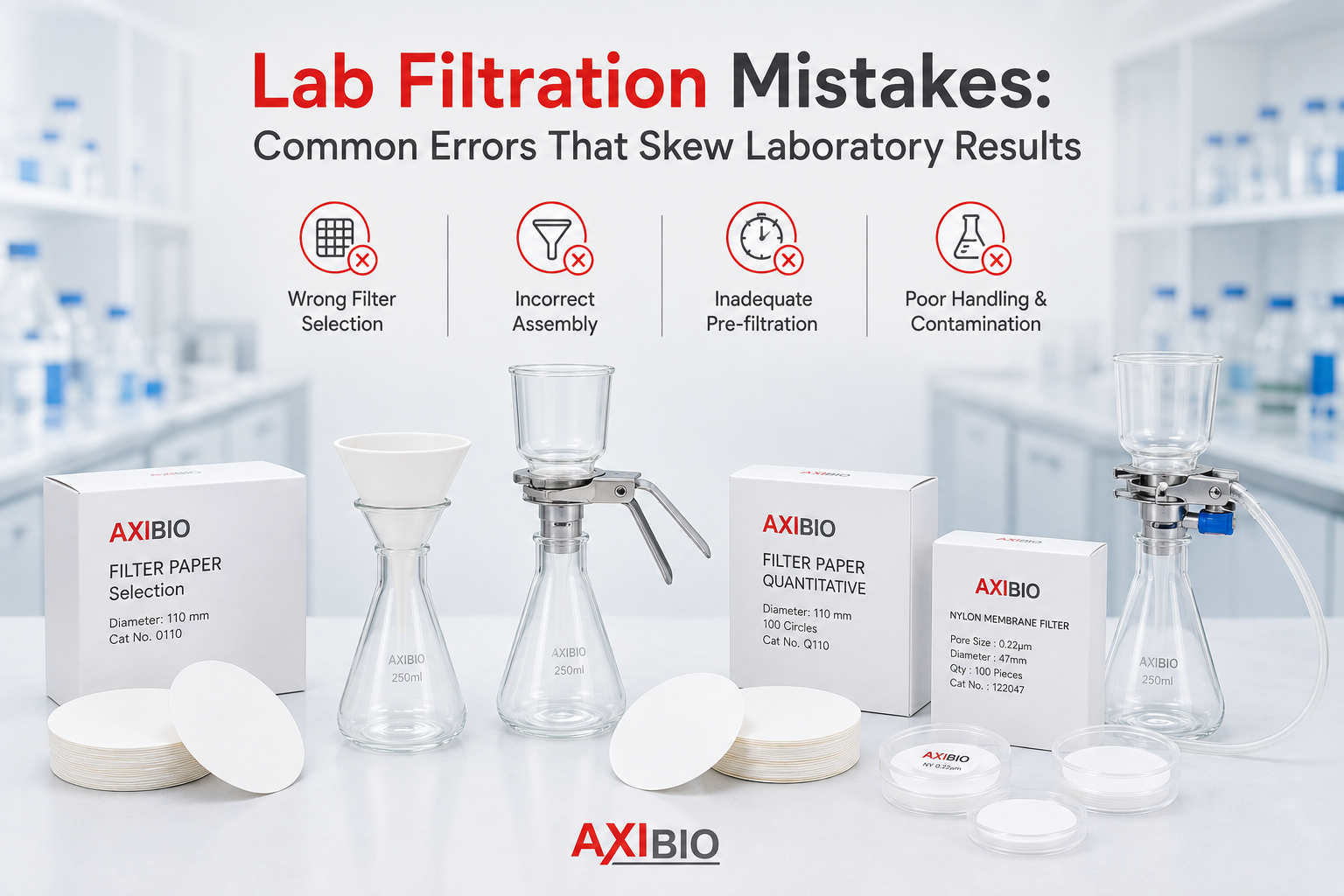
The weight, dilution and instrumentation could be right, yet the measurement would not be reliable due to filtration that takes just thirty seconds. Filtration is considered a simple task and not a high-risk procedure, but it is something that influences the composition of what goes into the analytical instrument. If the filter is wrong for the sample, gets clogged during the process or reacts with the substance to be measured, this may result in varying measurements, while all the other factors of the measurement method remain unchanged.
Lab filtrations that follow a certain filtration procedure, which includes using companies such as Axibio, notice these problems early on since filter choice is considered a documented and procedure-based step, not just something that can be added later. This article goes through some specific errors in laboratory filtration that lead to inconsistent lab results and explains why these occur and how to fix them.
What Are Lab Filtration Mistakes?
Filtration errors made in the laboratory are due to improper filtration, which modifies the composition, concentration, or purity of the samples prior to analysis. This is important in the context of filtration being a process of sample preparation. Any sample preparation procedure that introduces variations is bound to produce results that are variable even if the analytical technique used is working perfectly fine.
There are a few types of these errors, and these include use of inappropriate filter material, use of incorrect pore sizes, excessive pressure or vacuum, contamination, and neglect of analyte adsorption to filter material. All of these can happen on their own, and often all of them happen at once in one filtration procedure.
In practical terms, there may be a marked variation between the results obtained by two technicians using the same technique and equipment provided that their filtration method is not the same. This is so since it is very difficult to prove since it does not leave any traces unlike the use of a machine which can be logged.
How Filtration Mistakes Can Cause Inconsistent Laboratory Results
Variability caused by filtration is due to the fact that it alters the sample that is presented to the instrument or the following process. Inconsistency in this alteration is irrespective of the initial composition of the sample.
Sample preparation. The process of filtration is one of the final manual steps prior to the analysis. Any kind of inconsistency that may occur in this step, such as inconsistency of filter type, of technique used, or even in the volume of filtration, will cause variability in the analyzed sample.
Retention of particles. Filters are selected for retaining particles larger than a certain size. Variability in pore size leads to retaining or not retaining particles which should be retained or filtered out respectively.
Contamination. Incorrect handling of filters, funnels, and filtration systems can result in introducing contaminants (fibers, residue or trace elements) in the filtrate, which is an important issue when dealing with trace analysis.
Adsorption. There are some substances which tend to adhere to the membrane of the filter. Thus, their concentrations may decrease without leaving any trace that the filtration process took place.
Incompleteness of filtration. Incomplete filtering or termination of the filtration process without reaching equilibrium state can lead to obtaining a filtrate, which would be non-representative of the initial sample.
Clogging of filter. While the amount of particulates increases on the filter surface, the flow rate will decrease and the pressure differential will increase, which can lead to additional penetration of fine particulates through the membrane or even channeling.
Sample losses. Sample losses will occur while filtering, since a certain amount of sample will be always present in the filter, in the tubes and in the funnel. This kind of loss can vary between the samples, and it should be taken into account.
Compatibility of the Filter. The material making up the filter that reacts with, dissolves into, or leaches into the sample solvent changes both the composition of the filtrate and the measured value.
Pore Size. An excessively large pore size is unable to filter out interfering particulates while an excessively small one can clog prematurely or retain a portion of the analyte.
Problems with Handling. Contact with the filter surface, use of non-sterile materials when sterility is required, and reuse of single-use filters contribute to variability that cannot be detected after the fact.
Common Lab Filtration Mistakes That Affect Results
The errors that are likely to occur in the filtration process are listed below. All these errors have been discussed in detail as to what they are, how they occur, the effects they have, ways to detect them, and methods to avoid them.
Mistake 1: Choosing the Wrong Filter Type
What it is: Choosing a filter on the basis of habit or availability rather than according to the actual needs of the sample and analysis.
Why it occurs: Many labs adopt standard filters and use them consistently, without reassessing whether the filter will work for every new sample matrix or analysis.
How it impacts the analysis: A filter not suited for the sample will either fail to retain sufficient particulates, retain too much analyte, or react with the sample itself, altering the results.
How it can be recognized: Unusual recovery levels, inconsistent replicates, or visible material in the filtrate are good indicators.
How to avoid it: The proper filter membrane, glass fiber, or filter paper should be selected prior to analysis according to the sample matrix and particle size.
Mistake 2: Using the Wrong Pore Size
What it is: Using a pore size that does not correspond to the distribution of particle sizes in the sample and/or the needs of the downstream instrument.
Why it occurs: Pore size is often selected based on availability, as opposed to what the application requires, especially in high-throughput settings.
How it impacts your results: An overly large pore size will allow particulates to pass through that could clog HPLC columns and interfere with spectroscopic analysis; an overly small pore size will significantly retard the flow, clog, and perhaps retain some of the target substance.
How you can recognize it: Flow rate issues, visible particulates in the filtrate, and unexplained back pressure from the instrument are some signs of a pore-size issue.
How to avoid it: Be sure the pore size selected matches the requirements of the application, and not of the general method, or manufacturer guidelines for the instrument.
Mistake 3: Ignoring Chemical Compatibility
What it is: The use of filter membranes, housings, or filter paper that is chemically incompatible with the sample solvent or matrix.
Why it occurs: Not all chemical incompatibilities can be determined by physical appearance, and some may only occur when there is repeated exposure or prolonged contact time.
How it impacts results: Filter materials that are chemically incompatible can swell, degrade, dissolve, and/or release plasticizers or other compounds to the filtrate, causing contamination of the sample or bias in the result.
How to detect it: Discoloration of the filtrate, degradation of the filter material, or peaks on a chromatogram are indicators of incompatibility.
How to avoid it: Verify the filter manufacturer’s chemical compatibility chart to ensure compatibility with the specific solvent and sample matrix being used.
Mistake 4: Using an Inappropriate Filtration Method
Definition: Choosing the wrong syringe filtration, vacuum filtration, gravity filtration, or filtration unit that is not appropriate for the sample volume, viscosity, and necessary throughput.
Reason: Method choice is occasionally done based on the available equipment rather than on the nature of the sample.
Impact on results: Gravity filtration might take too much time to filtrate the viscous or particulate-rich sample causing degradation of the sample. Application of vacuum filtration to a sample sensitive to change in pressure will result in introduction of artifacts into the analysis. Filtering the large volumes by syringe filtration might cause inconsistency in case of multiple syringe filling.
How to recognize: Sample alteration, excessive filtration times, or inconsistencies between separate samples from the same batch filtered by different methods.
Prevention: Choice of the filtration method depending on sample volume, viscosity, particulates, and pressure sensitivity.
Mistake 5: Applying Excessive Pressure or Vacuum
Description: Applying excess pressure or vacuum beyond what is required by the filter and sample in order to hasten the process of filtration.
Cause: Excess pressure is sometimes applied to compensate for a clogged filter or to hasten filtration in order to save time.
Impact on data: The excess pressure or vacuum may cause particles to pass through the filter membrane, cause the filter membrane to burst, or cause the degradation of pressure-sensitive samples.
Detection: An increase in flow rate, followed by visible presence of particles in the filtrate, and damage to the filter membrane after filtration.
Prevention: Pressure/vacuum should be applied gradually and in accordance with the pressure specifications of the filter; a clogged filter should be replaced and not subjected to excess pressure.
Mistake 6: Reusing Filters When They Should Be Single-Use
What it is: The reuse of a filter, membrane, or filter paper that was intended for single use only.
Why it occurs: The reuse might be due to saving on consumables, or because the filter in question looks visually clean.
How it impacts results: Contamination with the previous sample can occur due to carryover, while the filter itself may be less efficient than a new one.
How to detect it: There will be cross-contamination evidence, in the form of an unexpected peak corresponding to the previous sample, or reduced flow through the filter.
How to avoid it: Strictly adhere to filter manufacturer guidelines on single use for all methods in which carryover may impact results.
Mistake 7: Contaminating the Filter or Filtration Setup
Definition: Introducing contaminants by way of handling, the laboratory environment, dirty apparatus, and non-inert containers.
Why it occurs: Contaminants may be introduced accidentally due to the touch of filter surfaces, contaminated funnel, or conducting work in an open laboratory environment in case of sensitive methodology.
What it does: Even the slightest amount of contaminant can have a great effect on low level analytical techniques by providing false-positive results, high baseline, and non-repeatability.
How to recognize it: Unidentified peaks, high blanks, and results that do not reproduce themselves in multiple repeats are common signs of contamination.
How to avoid it: Handle filters by the edge or housing, use clean or single-use funnels and assemblies when necessary, and conduct method blank analysis to ensure that the contamination is not coming from the filtration assembly.
Mistake 8: Failing to Account for Filter Clogging
Definition of problem: Failure to recognize the formation of clog in the filter while the filtration process is being carried out, or failure to filter while the filter is already clogged.
Reasons behind occurrence of problem: Formation of a clog takes place gradually and may be hard to recognize, especially in the case of highly particulate or viscous samples.
Effect on results: A clog lowers the effective flow rate, changes the pressure difference on both sides of the membrane and in some cases forces the fine particulates to pass through the membrane.
Way to recognize the problem: The flow rate slows down midway through the filtration or the application of increasing pressure becomes necessary.
Prevention of problem: Pretreating highly particulate samples by passing them through a coarser filter, or performing the centrifugation step prior to filtration.
Mistake 9: Losing or Adsorbing the Target Analyte
Definition: Partial loss of the target analyte through adsorption on the filter membrane or housing during filtration process.
Reason: Certain chemicals have the capability to adhere to the filter membrane and adsorb during the filtration process especially if their concentration is very low.
Impact on results: The actual amount can be under-estimated because the adsorption can vary from one lot of filters to another and even from one type of membrane to another.
Detection of error: It is identified using the recovery studies which show that there is reduced concentration during the filtration process compared to that of the unfiltered samples, especially when the concentration of analytes is low.
Prevention of error: Assessing the analyte recovery in relation to the filter membrane prior to its use in analysis.
Mistake 10: Using the Wrong Filter Paper
What is it? Using qualitative filter paper when the desired result is quantitative, or vice versa.
Why does it happen? It is not always clear how to distinguish between qualitative and quantitative filter paper and these two types of filters are sometimes confused when used interchangeably.
How does it affect the results? If the analytical method requires using quantitative filter paper but a qualitative one is used instead, residue will be introduced to the gravimetric analysis or to the trace analysis.
How can you spot it? If there are elevated levels of ash or residue obtained using gravimetry, an incorrect type of filter paper may be the reason.
How to avoid it? Check the requirements of the method regarding filter paper usage – whether qualitative or quantitative paper is needed.
Syringe Filters Common Errors to Avoid
A syringe filter is a compact and disposable filter unit attached to the syringe, which is extensively used in preparing small volumes of sample for HPLC, GC, and similar instruments which need particulate-free filtrate prior to injection.
Choosing a syringe filter based solely on its price or available pore size without verifying the compatibility of the membrane material with the sample solvent is a common mistake made while selecting a syringe filter. Pore size is important as the manufacturer of the instrument prescribes the maximum allowable particle size of the sample to be filtered. A pore size larger than this specification would not serve the purpose of filtering altogether.
Compatibility of membrane material with the sample solvent is another common mistake. Nylon, PTFE, PES, and cellulose acetate membrane material reacts differently with an aqueous solvent than with an organic solvent, and incompatible membrane material leads to swelling, degradation, or migration of the membrane material in the filtrate. Sample volume too is an important consideration as syringe filters have limited surface area and large volume sample may lead to clogging and pressure buildup.
Pressures and handling procedures are directly related. The use of steady and low pressures instead of forceful plungers helps avoid rupturing the membranes as well as driving the particulates through the membrane itself. Contamination becomes an issue with the reuse of syringe filters and also if the syringe tip touches non-sterile surfaces prior to the filtration process.
Since syringe filters are relatively cheap and utilized in large quantities, it can be tempting to rely on one kind of filter for all filtration methods. This practice is not recommended since the compatibility between pore size and membranes should be tested separately for each sample and solvent system.
Membrane Filters Common Filtration Mistakes
Membrane filters have various laboratory uses including sample clarification prior to analysis, sterile filtration, and particulate filtering and the type of membrane filter depends largely on the application at hand.
Errors in selection would mainly be due to a lack of consideration of the sample’s chemical and physical properties when choosing both the pore size and the membrane material. The pore size will determine the rate of filtration and retention capacity while an incompatibility between the two may hinder the quality of the filtrate or the filtration rate. Membrane materials depend on chemical compatibility and use of an inappropriate material will lead to leaching, swelling, or even failure of the membrane during filtration.
Viscosity, particulate load, and content of proteins/polymer of the sample affect how fast the membranes clog and pressure required respectively. High filtration pressure for certain membranes will cause particulates to pass through the membrane pores or even destroy its integrity while low pressure may lead to unreasonably slow filtration.
Filter clogging is one of the operational problems associated with membrane filtration, especially when using membranes for filtering highly contaminated samples. The problem is usually dealt with through applying pressure instead of pre-filtration or changing the filter membrane. Another concern is the process of adsorption, where some membrane materials will be more effective in adsorbing the target analyte compared to others, hence different recovery rates of the same sample after filtration depending on the filter membrane used.
Contamination of membrane filters during filtration procedures arises out of mishandling, storage, and reuse of single use filter membranes. Membrane filters differ widely in composition and use, and therefore not all membranes are applicable in laboratories.
Glass Fiber Filters Mistakes That Can Affect Filtration
The usage of glass fiber filters is mainly done for processes that have heavy particulate loads. For example, pre-filtration of turbid samples, air and pollution monitoring, gravimetric analysis, which requires weighing of the filter before and after.
Glass fiber filters play a slightly different part in retaining particles than the membrane filters. Glass fiber filters usually retain particulates through depth filtration across the thickness of the fiber mat, while membrane filters retain particulates on one defined pore size of their surface. Glass fiber filters are appropriate for the filtration of samples that have heavy particulate loads because of their ability to retain significantly more particulate mass before clogging than membrane filters.
Selection and handling mistakes when working with glass fiber filters are choosing glass fiber filters for processes that need a defined and precise pore size of the filter since glass fiber filters are usually defined by nominal retention efficiency. Another mistake when working with glass fiber filters is touching their surface with bare hand before performing gravimetric analysis. Again, application requirements are important since glass fiber filter good for coarse pre-filtration will not be good for fine prefiltration before analytical technique.
The problems that may arise due to incorrect application are the failure to completely remove fine particulates which would otherwise be trapped by the membrane filter, and unnecessary clogging of the glass fiber filter where the filtration process requires extremely fine filtration. In order to ensure consistent results during filtration, verify that the process requires depth filtration and high particulate retention, and not filtration using a defined pore size, and handle gravimetric filters in the proper way to prevent any changes in weight.
Filter Funnels and Filtration Assemblies Common Errors
The actual filtration assembly, including the funnel, flask, seals, and manifold if used, can be a source of inconsistency regardless of the type of filter media used in it.
Improper assembly is among the most frequent problems encountered, with the mismatch between the funnel and the filter size or the assembly design not compatible with the volume and filtration method. Failure to achieve a proper seal between the funnel and filter or between the funnel and the flask can result in unfiltered sample bypassing the filter media, thus compromising the filtered product without leaving any trace.
Contamination is another problem that can occur in the assembly itself due to improper cleaning of funnels, manifolds, and tubing when working with a vacuum manifold for multiple samples. The filter can be improperly positioned, meaning that it does not sit flat and centered in the support.
Applying incorrect pressure or vacuum through the assembly rather than directly to the filter can cause the problems mentioned above: forced particles, damage to the filter, or even inconsistent flow. Any leakage through joints of the assembly will either lead to a loss of a sample or air getting into the system and causing inconsistent vacuum filtration. Partial filtration might be the outcome if the assembly is taken apart prior to complete equilibration of filtration process, as a result part of the sample will remain unfiltered or not collected.
The assembly will contact each and every sample run through it, hence even small differences in assembly construction slight misalignment of filter or not entirely tight seal, etc. may lead to variability which will easily be mistaken for a sample variation.
Qualitative vs Quantitative Filter Papers
Qualitative and quantitative filter papers serve different analytical purposes, and choosing between them should be based on the specific requirement of the method rather than convenience.
| Factor | Qualitative Filter Paper | Quantitative Filter Paper |
| General purpose | Used for general filtration and particle separation where the paper’s own weight or residue is not part of the measurement | Used where the paper must contribute minimal, predictable residue because the filtrate or retained solid is being measured precisely |
| Typical analytical use | Routine filtration, clarification, and preparation steps that do not depend on gravimetric accuracy | Gravimetric analysis and applications where residual ash or fiber content must be minimal and consistent |
| Ash/residue considerations | Generally has higher and less tightly controlled ash content, which can be significant for gravimetric work | Manufactured to have very low, tightly controlled ash content, often specified by the manufacturer for gravimetric accuracy |
| Common application | General laboratory filtration, sample clarification, routine preparation | Precipitate collection, gravimetric determinations, and methods requiring quantifiable recovery |
| Selection consideration | Suitable when the paper itself will not affect the measured result | Necessary when the paper’s residual mass or purity could influence the analytical outcome |
This is particularly relevant in gravimetric and trace analysis applications, where any amount of variable ash or fiber from an incorrect type of filter paper can cause errors. In regular filtration processes where the paper does not form part of the analytical measurements, qualitative paper may be used, but this should be dependent on the method.
How to Troubleshoot Inconsistent Results After Filtration
When results vary unexpectedly and filtration is a suspected cause, work through the filtration step systematically before assuming an instrument or method problem.
- Match the filter type according to the requirement of the method
- Match the pore size according to the particle size distribution of the sample and instrument tolerance
- Chemically match the filter and sample solvent
- Sample preparation procedures carried out just before the filtration
- Pressure/vacuum requirements of the filtration as recommended by the manufacturer
- Evidence of clogging such as lower flow rate during filtration
- Contamination sources such as handling, equipment, and the environment
- Matching filter handling with the single use/reuse guidelines if any
- Filtration apparatus setup including sealing and funnel placement
- Matching of filter membrane adsorption of analyte especially when the analyte is of low concentration
- Comparing the conditions of the filtration in runs showing inconsistency to previous run with good results
Working through this list in order, starting with filter selection and moving toward setup and handling, generally isolates the source of inconsistency more efficiently than testing the instrument first.
How to Prevent Lab Filtration Mistakes
Preventing filtration related inconsistency comes down to treating filter selection and technique as a controlled part of the method, not an incidental step.
- Establish the filtration goal prior to the selection of the filter – clarification, sterilization, removal of particles or gravimetric collection require different options
- Select a filter material compatible with the matrix and solvent
- Confirm the suitability of the filter pore size according to the technique or instrument requirements
- Test chemical compatibility of the filter according to the manufacturer’s recommendations
- Apply identical filtration conditions including pressure and volume to a series of related samples
- Avoid additional pressure if flow cannot be established through the filter
- Keep filtration equipment clean and free of contamination
- Adhere to validated laboratory methods; don’t use filters or filtration techniques on the basis of convenience
- Document filtration parameters in the sample preparation log
- Inquire into the reasons for changes in flow rate and recovery instead of considering them as usual variations
- Test analyte recovery when introducing new filters and new matrices into the laboratory routine
How to Choose the Right Filter for a Laboratory Application
A structured decision process reduces the chance of selecting an unsuitable filter for a given task.
- What is to be eliminated or preserved particulate, precipitate, or particular particle sizes?
- What is the nature of the matrix aqueous, organic solvent, biological fluid, or a mixture?
- What is the target analyte, and does it react to filter materials commonly used?
- What volume has to be filtered, and is the volume suited to a syringe filter, membrane filter, or filtration assembly?
- What is the pore size demanded by the analytical technique or instrument manufacturer?
- What filter material is chemically compatible with the sample and solvents?
- Which filtration approach gravity, vacuum, syringe, or filtration assembly is suitable to the sample volume and properties?
- Is contamination control a consideration that requires single use filters and careful handling procedures?
- Is quantitative analysis desired, thus requiring materials with low or negligible adsorption and, if necessary, quantitative filter paper?
- What does the method or the instrument manufacturer specify, since this should override other considerations?
Quick Checklist for Consistent Laboratory Filtration
- Type of filter corresponds to the sample matrix and analysis objectives
- Pore size matches requirements of the technique/instrument being used
- Filter material does not react chemically with sample or solvent
- Filtration technique is appropriate for volume and viscosity of sample
- Pressure/vacuum applied remains within manufacturer recommendations
- Disposable filters should not be re-used
- Filtration equipment is clean and handled free of contamination
- Conditions for filtration are constant and documented for the batch
- Analyses of analyte recovery using a particular filter and analyte have been performed
- Filter paper can be qualitative or quantitative depending on the requirements of the technique used
Conclusion
However, good and consistent laboratory results are also determined by the way samples are prepared and filtered, and not just by the technique used. Mistakes during filtering are usually minor: wrong pore size, used filter again, a little more pressure applied than needed. However, their impact on the quality of data obtained is considerable and hard to establish afterwards.
Consideration of filter choice as a part of the method that needs to be recorded, rather than just another formality, is probably one of the most effective methods to minimize the variability in laboratory results. Laboratories who are checking their filter consumables, such as filter paper, glass fiber filter, and filtering assemblies supplied by Axibio, can apply the above-mentioned criteria for verification.
Frequently Asked Questions
1. What are some common lab filtration errors?
Some common errors include selecting the incorrect filter, pore size, neglecting chemical compatibility, applying excessive pressure, reusing single use filters, and neglecting analyte adsorption. All of these can individually lead to inconsistent laboratory results and often happen in conjunction with each other.
2. Can using the incorrect filter influence lab results?
Yes. A filter that is not suitable for your process may retain part of the analyte you want to analyze, may be contaminated, and may allow particles that can interfere with your analysis, thus changing your results.
3. How do I select the proper syringe filter?
The pore size needs to match what the manufacturer of the instrument requires, it is necessary to be sure that the membrane of the filter is chemically compatible with the solvent of the sample and to consider the volume of the sample compared to the filter surface area.
4. What is the difference between membrane filters and glass fiber filters?
A membrane filter usually retains particles by certain pore size on the surface or close to the surface of the filter, while a glass fiber filter retains particles through the entire depth of the matrix of glass fibers.
5. In what cases will qualitative filter paper suffice?
Qualitative filter paper will suffice in most cases of normal filtration and clarification procedures as long as the residues of the filter paper itself will not interfere with the final analytical result.
6. What type of filter paper will be suitable in case of gravimetric determination?
Quantitative filter paper will be applicable in cases when the gravimetric aspect of the procedure matters and low constant level of ash is required.
7. Is it possible that filter clogging could interfere with filtration results?
Yes, filter clogging interferes with filtration results by causing decreased permeability and increased pressure differences, leading to forcing of fine particles through the filter.
8. How can the problem of inconsistencies in the results of filtration be minimized in the laboratory?
The type and pore size of filters and conditions of filtration should be standardized within a certain method, compatibility and efficiency should be checked beforehand.