A filtration step that usually takes two or three minutes suddenly stretches to fifteen. The technician keeps checking the flask, the funnel keeps dripping instead of flowing, and the rest of the analysis queue starts backing up behind it. If this sounds familiar, you’re not dealing with a rare glitch: slow filtration is one of the most common bottlenecks in analytical, QC, and research laboratories, and it rarely has just one cause.
This article walks through why laboratory filtration slows down, how to troubleshoot it on the bench, and how to choose a filter paper that matches your sample instead of fighting it. It also looks at what actually separates dependable filter paper manufacturers in India from suppliers who simply sell paper by the box, since filtration speed is as much a sourcing decision as a technical one.
1. The Filter Paper Grade May Not Match the Sample
Every filter paper grade is built around a trade-off between particle retention and flow rate. A fine-retention grade meant for gelatinous or very fine precipitates will always filter more slowly than a coarse, fast-flow grade that’s by design, not a defect.
If a technician reaches for whatever grade is on the shelf instead of the grade specified for that sample type, filtration time can stretch well beyond what the method expects.
2. Very Fine Particles Can Quickly Block the Filter
Colloidal precipitates, fine soil fractions, and certain biological suspensions contain particles small enough to lodge inside the paper’s fibre matrix rather than sitting on the surface. Once enough of these particles wedge into the matrix, the effective pore size shrinks and flow drops sharply, sometimes within the first minute of filtration. This is different from a paper simply having fine retention it’s the filter paper being actively clogged by the sample it’s handling.
3. The Filter Paper May Have Too Much Retention for the Application
Not all applications call for the best grades possible. Utilizing a slowly and finely retentive grade of quantitative filter paper for a standard clarification step where a medium or fast qualitative grade would have done the job wastes time without any added advantage. The retention capability must be dictated by the requirements of the following analytical step, not the best possible.
When a large amount of sample or precipitate is placed on the filter at once, the material will become clogged in a compact cake against the paper surface. This is a problem that often occurs in gravimetric analysis when the analyst attempts to pour the entire sample through the filter at once rather than processing it in increments.
4. Sample Loading Can Affect Filtration Speed
The rate of gravity filtration depends solely on the weight of the liquid column, which makes it a relatively slower process and also very susceptible to fine particulate matter load. In vacuum filtration, the liquid is drawn out by mechanical action, making the process faster but increasing the chances of fine particulates compaction into the paper by excessive pressure difference. This may slow down the process of filtration rather than fasten it.
5. Gravity Filtration and Vacuum Filtration Behave Differently
Filter paper is not the only variable either; a funnel that has a small stem, fits poorly with the filter paper, or an incompatible filtration set up can slow down filtration even if the filter paper itself is doing a good job. Air bubbles underneath the filter paper, improper seating of the filter paper fold, or an incorrect angle of the funnel can easily be missed.
6. Filter Funnel and Filtration Assembly Can Affect Flow
Filter paper is not the only factor that affects this process. If the funnel has a small stem, poor contact with the filter paper, or an incompatibility with the filtration apparatus, there will be problems with flow even when the filter paper is functioning properly. There could be air bubbles under the filter paper, or an improper fluted fold or angle of the funnel.
7. Choosing the Wrong Filter Material Can Slow the Process
There is no interchangeability among the above-mentioned filtration mediums. For example, glass fibre media is usually preferred when high flow rates and high particulate loading capacities are of greater importance compared to fine retention. If one uses a cellulose paper for glass fibre medium work (and vice versa), it may result in filtration times that do not correlate with the expected method.
How to Troubleshoot Slow Laboratory Filtration
Match the grade to the technique. Ensure that the SOP or analytical technique requires use of a specific grade of filter paper and ensure that this is the case.
Examine the sample for fine particles. If the sample seems cloudy or colloidal in nature, then using filter paper with a finer retention rate will result in rapid clogging; think about pre-filtering or centrifuging.
Reduce the loading on each filtration step. Separate a heavy sample to filter in smaller increments instead of forcing it all at once.
Ensure that the method of filtration is compatible with the sample. If gravity filtration is not fast enough, ensure that vacuum filtration is appropriate for this particular sample.
Inspect the filtration setup. Look for air trapped in the setup, poor sealing between the paper and funnel, or narrowness of the stem of the funnel.
Consider storage problems. Paper kept under humid conditions absorbs moisture, thus affecting its structure.
Compare with a new sheet. If a new sheet from the same batch filters properly, then the paper is fine there must be something wrong with the sample or setup.
How to Choose the Right Filter Paper for Faster, More Consistent Filtration
Choice of the filter paper involves balancing of many considerations, and missing out on any one of them is the usual reason why filtration is ultimately slow again. This is also when supplier choice becomes important since the majority of Indian filter paper producers have a variety of grades in each particular type of paper. The selection criteria mentioned below can be applied in either case.
- Particle retention and pore size: Select the proper retention for the smallest particle size required for your process, not the finest retention available.
- Rate of filtration: Fast grades are suitable for routine clarification; slow, fine grades are appropriate for gravimetric work.
- Sample considerations: The viscosity, loading rate, and whether the precipitate is crystalline or colloidal will dictate the appropriate grade.
- Need for qualitative vs quantitative filter paper: It must be established early on whether the filtrate or retained sample is important to the result.
- Chemical compatibility: The filter paper or media should have been verified that it is compatible with the solvents, acids, or reagents used in the sample.
- Required purity: Trace analysis work typically requires low ash quantitative filter paper.
- Vacuum/pressure compatibility: Some grades have been formulated to withstand vacuum or pressure due to their high wet strength.
Qualitative vs Quantitative Filter Paper: Which Should You Use?
Qualitative filter paper is used whenever separation of the precipitate from the solution or clarification of the liquid is required, sample preparation, or general filtration in the laboratory. These filter papers usually have higher amounts of ash compared to quantitative filter papers after ignition, making them unsuitable for gravimetric analysis but good for general purposes.
Ashless filter papers, otherwise known as quantitative filter papers, are processed and acid washed in such a way that they possess an exceedingly tiny amount of ash after being heated small enough that its weight can be assumed to have negligible value on an analytical balance. Hence, this is the kind of filter paper to use for gravimetric analysis.
| Factor | Qualitative Filter Paper | Quantitative (Ashless) Filter Paper |
| Typical use | General filtration, clarification, routine sample prep | Gravimetric and quantitative analysis |
| Ash content after ignition | Comparatively higher | Very low, considered negligible |
| Manufacturing | Standard cellulose processing | Acid-washed for high purity |
| Wet strength | Often lower (wet-strengthened grades available) | Generally higher, suited to vacuum/pressure filtration |
| Cost | Lower | Higher, due to purification steps |
Why Choosing the Right Filter Paper Manufacturers in India Matters
The issue of filtration time is not always caused by a grade selection sometimes it is because of inconsistencies among different batches. The paper that shows a reliable filtration time one month and slower time the next month is usually an example of inconsistency in the quality of the material itself rather than a mistake made by the lab technician.
When evaluating different suppliers of filter paper in India, you should consider:
- Consistency in retention, thickness, and flow rate from one batch to another
- Quality of the raw materials, because the source and process of manufacturing can affect purity and structure
- Selection of different grades and sizes, so that the correct paper will be available and not just a close approximation
- Technical specifications for each grade, such as retention, ash percentage, and thickness
- Guidance on proper application in situations like pharmaceutical, environmental, and food analysis
- Quality control in the manufacturing process
- Technical assistance in the selection of the right grade when required by a lab
- Reliability of supply, because lack of a certain grade is almost as bad as poor filtration performance
Although none of these elements will necessarily produce faster filtration on its own, any inconsistency in these elements is an often overlooked factor which causes inconsistent filtration speeds without any identifiable cause.
AXIBIO Laboratory Filtration Solutions
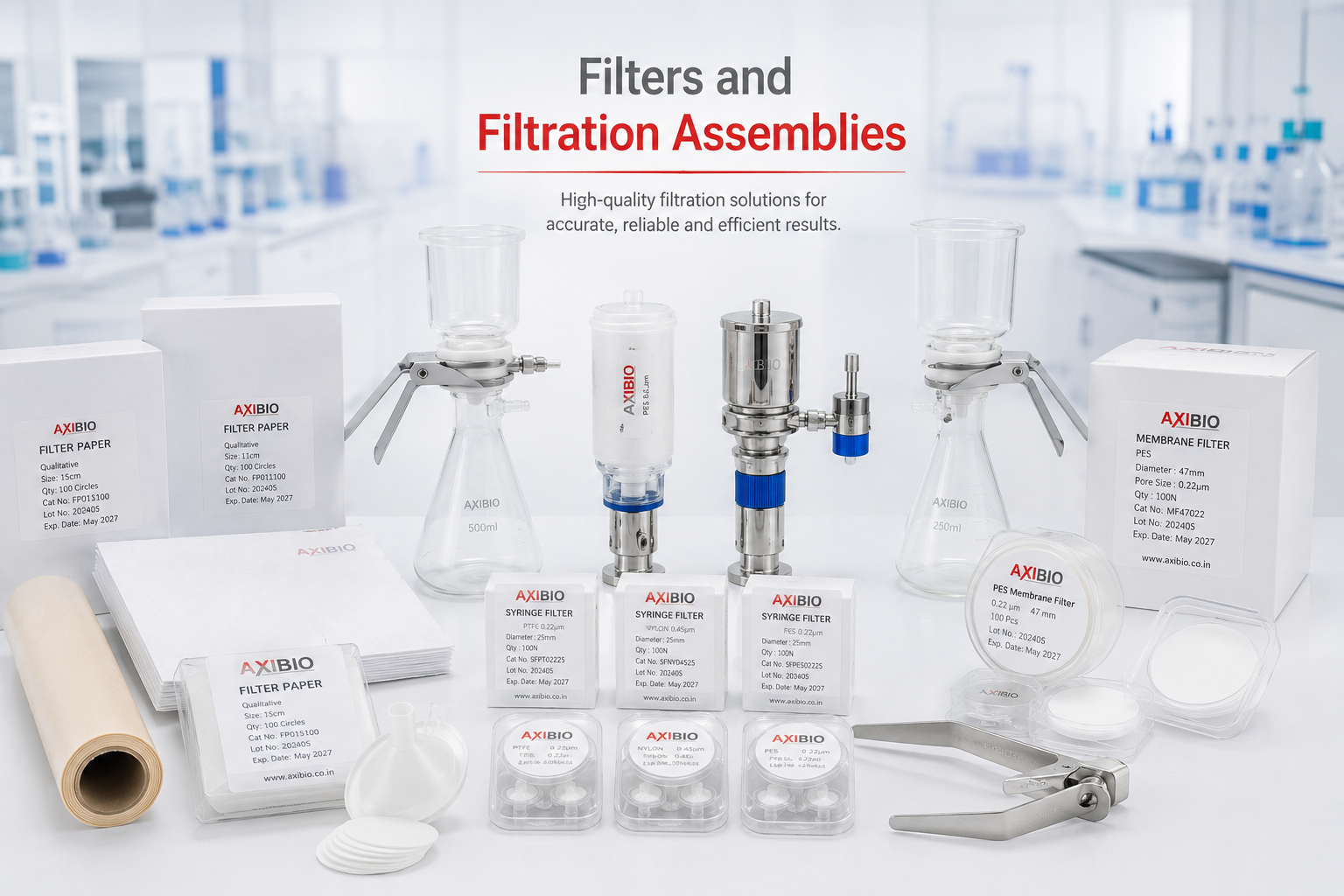
AXIBIO supplies filtration laboratory consumables that are widely employed in research, pharmaceutical, environmental, and industrial testing labs, including qualitative filter papers and quantitative filter papers in several different grades, and also glass fiber filters and quartz microfiber filters where the flow rate and particle loading capacity take precedence over retention capability.
AXIBIO also offers filters for environmental tests along with filter funnels, filter funnel kits, and filtration kits with manifolds to laboratories performing analysis using multiple samples on a common vacuum source. The range of filters and filtration kits can be accessed by category on the AXIBIO website, from where the specifications of each product grade can be seen prior to purchase.
In terms of filtration speed, choosing the correct filter paper grade, filtration unit, and sample type remains the determining factor; however, having the correct manufacturer makes this task simpler.
Quick Checklist Before You Blame the Filter Paper
- Is the proper grade of filter paper used for this technique the right one being used?
- Was the sample pre-treated in case of heavy load, i.e., settled, centrifuged, or diluted?
- Are gravity and vacuum filtration suited for this type of precipitate?
- Is the funnel set without any air underneath the filter paper?
- Has the filter paper been stored in appropriate conditions free from moisture?
- Does the new filter paper from the same box filter normally?
- Is this a persistent problem observed with several lots, indicating supplier consistency problem?
Conclusion
There are many reasons why slow filtration in the laboratory could occur, but almost all of them can be pinpointed to one cause – wrong sample grade, the blockage of the matrix due to the fine particulates, the use of an overloaded filter, and incompatibility between the use of gravity and vacuum filtration. In this way, the identification and elimination of the problems will take less time than changing product brands randomly without knowing the cause of the problem.
Frequently Asked Questions
Why is my laboratory filter paper filtering slowly?
Slow filtration is usually caused by a mismatch between filter paper grade and sample type, fine particles clogging the paper’s fibre matrix, an overloaded sample, or an issue with the funnel or filtration assembly rather than a defect in the paper itself.
Does filter paper grade affect filtration speed?
Yes. Filter paper grade determines the trade-off between particle retention and flow rate finer-retention grades are inherently slower than coarse, fast-flow grades, regardless of manufacturer.
How do I choose the right filter paper for laboratory filtration?
Correlate the paper’s retentive capacity and grade to the particle size in your sample, determine if your technique requires either qualitative or quantitative filter paper, consider the chemical compatibility, and choose a grade appropriate for either gravity or vacuum filtration.
What is the difference between qualitative and quantitative filter paper?
Qualitative filter paper is used for general filtration and clarification and has a comparatively higher ash content after ignition. Quantitative (ashless) filter paper is acid-washed to leave a very low, well-defined ash residue, making it suitable for gravimetric analysis.
Can fine particles clog filter paper?
Yes, that is true because colloid particles may settle in the fiber structure of the paper and not on the surface. This will make the pores smaller and reduce the flow rate.
When should I use glass fibre filters instead of filter paper?
Glass fiber filters are generally preferred when high flow rate and high particulate loading capacity are more important than fine retention, such as in air and water particulate monitoring and applications involving heavily loaded samples.
How can laboratories improve filtration without compromising sample quality?
Select the right grade of filter paper according to the specifications of the method, do not overfill the filter, select the right mode of filtration, and use filter paper whose specifications are the same throughout the batches by the manufacturer.