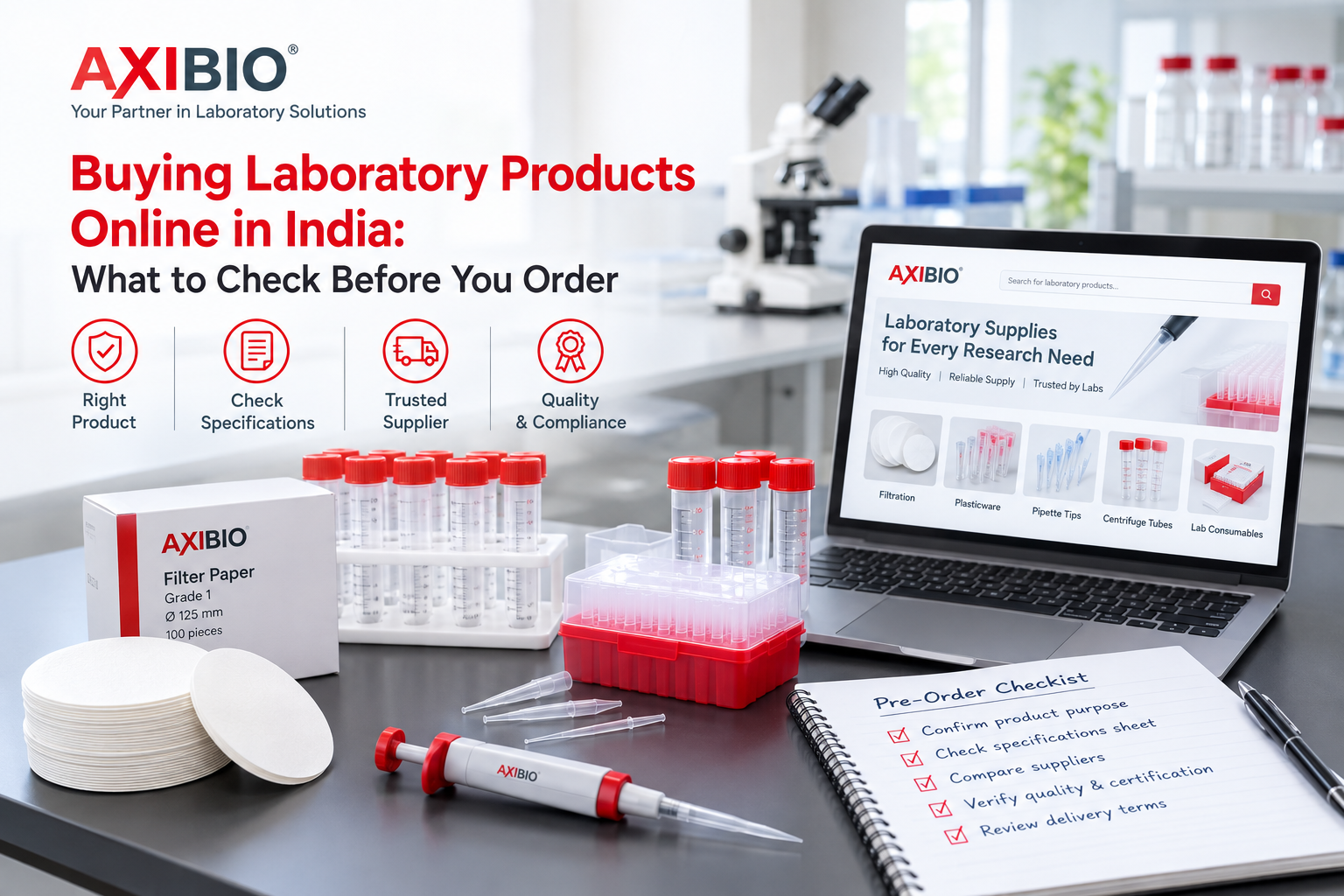
A few things are required to be ensured before purchasing any kind of laboratory supplies online in India and all this comes to a person’s attention only when he or she does it wrongly at least once. Typically, it is not the common laboratory devices, which cause trouble; the matter is those little but critical things that one may ignore at the beginning. The wrong grade of filter paper. The pipette tip that cannot fit into the pipettor that the buyer already has. The filter labeled “quantitative,” which upon examination appears to be qualitative. Purchasing laboratory supplies online in India is quite an easy and quick thing, but the process of checking things prior to ordering them is not.
This buyer’s guide by Axibio will take you through what you should check before ordering, how to understand a specification sheet even without being a chemist, how to compare laboratory equipment suppliers in India, and most importantly, what are the common mistakes made during the purchasing process especially when it comes to filtration products.
What Should You Check Before Buying Laboratory Products Online in India?
Always begin with the purpose, not the product name. Clearly define what the product is supposed to do (filter the particular sample, contain the particular volume, resist particular chemical or temperature) and match it with the technical specification sheet provided by the manufacturer, not with the picture and the price of the product. Make sure the material is suitable, whether the particular grade or type is required by your SOP or pharmacopoeia, consider the total cost instead of the unit price and confirm that the supplier can respond to your technical questions before placing the order. Examine the product against the packing slip and the specification sheet upon arrival.
Why Buying Laboratory Products Online Requires More Than Comparing Prices
However, most general shopping behaviors do not work in laboratory purchases. If you buy a kettle on the web, “cheaper and looking almost the same” is usually ok. But if you use some laboratory material that looks almost the same as the one that you are supposed to use the same shape, almost similar name, slightly different grade number its behavior in the experiment will be absolutely different.
Filter paper marked as “Grade 1” of one manufacturer does not necessarily mean that it will be equivalent to the Grade 1 of another manufacturer. Centrifuge tubes with lower relative centrifugal force than required by your protocol may explode during rotation. Membrane filters with inappropriate pore size may not just filter slower but allow particles that have to be retained pass through or clog while processing the volume of your sample.
That is why laboratory shopping can greatly benefit from an organized approach instead of impulsive purchase. Below is the detailed description of this approach.
Step-by-Step Guide to Buying Laboratory Products Online in India
Step 1: Identify Your Laboratory’s Exact Requirement
Before creating an Internet tab, list out what the product should do for you. In the case of a filtration product, this would include: What are you filtering? What size range of particles? Is your sample aqueous or solvent based? Does it matter more what passes through, or what is left behind? In the case of plasticware, this would include volume, sterility of the product, and whether the product would be autoclaved, frozen, or in solvents. “We need filter paper” will generally result in a bad choice.
Step 2: Create a Laboratory Equipment List
Instead of ordering individual supplies when you need them, create an ordered list based on their categories such as filtration accessories, plastic ware, centrifugation accessories, culture accessories, and so on. In this way, it will be easy for you to make a comparison between the specs of different suppliers in one attempt without leaving out any accessories (such as filter holder without the right diameter).
Step 3: Check Technical Specifications
Each category of lab products has a few key specifications that really count. For filter paper, that would be pore size or retention rating, filtration speed grade, thickness, and ash content (in case the filtrate or residue needs to be analyzed by gravimetry). For plasticware, it would be material, max temperature and RCF rating, and whether or not it is sterile. Look at the specification sheet, not just the description on a product page, which might call something “premium quality.”
Step 4: Verify Material and Product Compatibility
Incompatibilities are one of the most frequent and easiest to avoid purchasing blunders. If the material is not chemically inert with respect to the solvent used, it will break down, leach, or simply fail. The wrong filter paper will be too weak when subjected to vacuum filtration. Ensure that the material composition and specifications match the reality of what is being done before placing an order.
Step 5: Compare Laboratory Equipment Suppliers in India
Having identified what you require, compare more than just the price of the laboratory equipment you wish to purchase from two to three suppliers in India. Consider whether they release detailed specifications, whether they manufacture or just sell the item, how they deal with orders for bulk purchase, and whether the website is detailed enough to allow a purchase without making a phone call.
Step 6: Check Quality, Documentation and Standards
If the item is to be used in any type of controlled or analytical environment, verify if there is a certificate of analysis, specification sheet, or other documents issued by the manufacturer. When using a product in an accredited laboratory like ISO/IEC 17025 or a pharmacopoeial procedure, make sure that the specifications of the product fulfill the requirement of that particular procedure.
Step 7: Compare Total Cost, Not Just Product Price
The unit price is just one of the cost factors. The cost associated with minimum order quantity, shipping charges for large or breakable merchandise, and cost of repurchasing the incorrect specification of the merchandise all contribute to the actual cost of buying something. In many cases, an item that is slightly more expensive but is the correct specification the first time will prove to be cheaper.
Step 8: Check Availability, Packaging and Delivery
Laboratory consumable products may be susceptible to packaging methods as well, where filter papers and membranes should be shipped flat and dry, sterile plastics must be shipped with sealed packages, and glassware should be packed with cushioning. Before placing your order, make sure you understand the shipping method by checking the product description or asking the supplier.
Laboratory Equipment List: What Should You Check Before Ordering?
Rather than an exhaustive catalogue, here are the categories where buyers most often need to verify specifications carefully before ordering.
- Filtration consumables – filter paper grade, membrane pore size, filter funnel, and assembly compatibility
- Filter paper – qualitative/quantitative grade, particle retention capacity, ash value in case of gravimetry
- Membrane filter and glass fiber filter – pore size, type of filter (cellulose, glass fiber, quartz), compatibility with the nature of the sample
- Filter funnels and filtration units – filter diameter compatibility, vacuum/gravitational filtration setup
- Plasticware for laboratory use – material, sterilization compatibility, resistance to chemicals and temperatures
- Centrifugation consumables – RCF ratings, tube material, cap sealing type
- Microcentrifuge tubes – volume, precision in the volume gradation, autoclaving capability
- Consumables for cell and tissue cultures – surface treatment, sterilization certificate, growth surface area
- Consumables for PCR reactions – thermal precision, DNase/RNase free certificate if needed
- Consumables for microbiology – sterilization, petri dish/plate specification
- Consumables for cryopreservation – temperature resistance down to the temperature required for storage (liquid nitrogen vapor phase, -80°C, etc.)
It is important only to order that which is specified in your procedure or SOP. It can seem easy enough to purchase a “good enough” substitute when the desired product is not available, but for laboratory purposes, it should be reviewed with the procedure prior to being used.
How to Choose the Best Laboratory Products Online
Evaluating “best” for a laboratory product isn’t about the highest-rated listing it’s about fit. Work through these factors in order:
- Application: How is the product actually being used, and in what conditions?
- Specifications: Is the published spec sheet suitable for the particular application?
- Chemical/thermal compatibility: Is it compatible with your sample materials?
- Compatibility: Does it fit into your current lab setup (funnel diameter, pipettor type, centrifuge rotor)?
- Consistency: Is it consistently made batch to batch and has the documentation that you need?
- Documentation: spec sheets, certificates of analysis, safety data sheets
- Supplier reliability: manufacturing history, ability to provide technical support when needed
- Price: relative to total cost and not just price
- Consistency of availability: Is the supply consistent enough so that you do not have stockouts repeatedly?
- Technical support: Is there someone to contact when a product is acting unexpectedly?
Laboratory Product Purchasing Considerations
| Buying Factor | What to Check | Why It Matters | Common Mistake |
| Application fit | Whether the product is designed for your sample type and process | A product can be well-made and still be wrong for your use case | Choosing by product category alone, without matching to the actual application |
| Technical specifications | Pore size, retention, RCF rating, temperature/chemical resistance | Determines whether the product will physically perform as needed | Reading only the product title, not the spec sheet |
| Material compatibility | Chemical resistance, autoclave/solvent tolerance | Wrong material can degrade, leach, or fail under process conditions | Assuming “lab-grade plastic” is universally chemical-resistant |
| Documentation | Specification sheets, certificates of analysis where relevant | Needed for regulated, analytical, or accredited lab work | Ordering without checking if documentation is even available |
| Supplier reliability | Manufacturing background, technical support availability | Affects consistency and problem resolution after purchase | Choosing solely on the lowest listed price |
| Total cost | Unit price, shipping, minimum order quantity, risk of reordering | The cheapest unit price isn’t always the cheapest outcome | Ignoring the cost of a repeat purchase from a wrong first order |
| Packaging and delivery | How fragile or sensitive items are packed and shipped | Poor packaging can damage or contaminate consumables in transit | Not checking packaging standards for filter papers, membranes, or glassware |
| Post-delivery inspection | Match against packing slip and spec sheet on arrival | Errors caught early are far cheaper than errors caught mid-experiment | Storing items without checking grade/size against the original order |
Lab Filtration Mistakes That Can Increase Filtration Time
Filtering difficulties are hardly ever purely accidental. In most cases, the cause of difficulty lies in one of several predictable errors made either in the purchasing stage or in the preparation process.
Selection of an improper pore size or grade of filtration device for the particular particle size. A filter that is too small for the task will get clogged instantly with particles blocking the pores; one that is too big allows smaller particulates to pass, resulting in an uncharacteristically cloudy filtrate. This can be fixed easily through the process of comparing the specifications of the filter with respect to retention rate against those of the actual particles in the sample.
Use of the filter with too large a load of solids. A filter designed for a light suspension sample will fail quickly when loaded with too much particulate matter. When the sample contains more solids, the solution is to increase the surface area of the filter, or use a pre-filter.
Filter paper wet strength not considered for vacuum. Filter paper not designated for vacuum or pressure filtration may tear during the filtration process and release the trapped particle back into the filtrate. This contamination is hard to spot since the filtrate will still appear visually clean.
Filter diameter does not match funnel size or assembly size. If the filter paper is smaller than the funnel, then it will not create a seal and will allow the sample to bypass the filter. If the filter paper is larger, it folds irregularly allowing liquid to flow around it.
Assuming that filter papers are equivalent across brands. Two papers with the same grade name from two different manufacturers will have different retention, flow rate, and ash content properties. In cases where the method prescribes a specific grade of filter paper, using a filter paper from another manufacturer that is considered to be similar may lead to invalid test results despite having good filtration properties.
Using the wrong type of filter media for the method. There are some methods that require glass fibre or quartz fibre as the media rather than cellulose. Using a cellulose filter paper instead of a glass fibre one due to its availability or low cost results in non-compliant test results despite having proper filtration.
Why Is Laboratory Filtration Taking Longer Than Expected?
The solution for filtration slowing down does not have one formula, because this issue is connected with the exact reason why this happens. In general, it is better to go through the possible causes one by one, rather than try to guess:
Problem: Filtration slows down significantly during the process, rather than starting slowly. Possible reason: the filter gets clogged with particulate, which collects on its surface (the phenomenon is known as “filter blinding”). Solution: try to use a coarser pre-filtering step, use a bigger filter, or dilute an overloaded sample before the filtration.
Problem: Filtration starts to go slowly from the first drop. Possible reason: the pore size or retention grade is too fine, or the vacuum/pressure difference is too low to overcome resistance of the selected grade. Solution: maybe it would be enough to choose a medium or fast flow grade, which will retain your target particles; check that the vacuum pump/pressure is working up to its rated capacity.
Problem: There is a noticeable difference in the rate of filtration of similar samples. Possible reason: difference in sample preparation (particles’ sizes, solids’ concentration, or temperatures between samples) and not the filter itself. Solution: Prepare samples similarly before the filtration process, either by pre-treating them, diluting, or adjusting the temperature of the samples.
Problem: A newly purchased lot of filter paper is slower in filtration compared to the previous lot. Possible reason: Batch-to-batch variation or the newly purchased lot may be a different grade compared to the one being used before. Solution: Compare the grade number and specification sheet of the newly purchased lot with the old one.
Problem: Filtration takes too long even though the filtration device has been provided with the right filter grade. Possible cause: lack of adequate power for vacuum filtration or leakages at the source of the vacuum or in the filtration assembly. Practical solution: Test whether the vacuum filtration device produces the required vacuum in terms of the manufacturer’s specifications.
The efficiency of filtration is determined by the sample, filter, and operating conditions together and not any one of these factors alone. A supplier knowledgeable in filtration technology is able to determine what is causing poor filtration performance and this is why technical support is important for filtration consumables more than most others.
Qualitative vs Quantitative Filter Paper: Which Should You Buy?
If the filtered material will not be subsequently dried, incinerated, or weighed for a gravimetric analysis, use qualitative filter paper. On the other hand, when performing such gravimetric analyses, it is important to use quantitative filter papers because they are produced with a much lower controlled amount of ash.
Qualitative filter paper refers to general purpose cellulose filter paper that is intended for routine separation of materials, clarification of cloudy solutions, collection of precipitates for further operations, and preparation of samples before instrumental analysis. They are not made to any defined ash specification and therefore cannot be used when the filtered material needs to be dried or weighted.
On the contrary, quantitative filter paper is made to be used specifically in gravimetric analysis, where the residue must be dried and possibly incinerated and weighed. This is possible because the process of production involves washing of the pulp with acids to remove any mineral content; thus, the paper produced is called ashless. According to Whatman/Cytiva, ash content of ashless quantitative filter papers is generally reduced below 0.01%.
Both kinds can be obtained in fast, medium, and slow (fine) retention grades, so the selection is not just between qualitative and quantitative; it also concerns matching the retention grade with the fineness of the particles that are being separated.
Qualitative vs Quantitative Filter Paper
| Feature | Qualitative Filter Paper | Quantitative Filter Paper |
| Primary purpose | General separation and clarification | Gravimetric analysis where the residue is weighed |
| Ash content | Not manufactured to a defined ash standard | Acid-washed to a low, controlled ash content (commonly below ~0.01% in ashless grades) |
| Typical use case | Clarifying solutions, routine precipitate separation, teaching labs, sample prep before instrumental analysis | Determination of insoluble residue, analytical chemistry, pharmaceutical and environmental testing |
| Retention grades | Available in fast, medium, and slow (fine) grades | Also available in fast, medium, and slow (fine) grades |
| Suitability for weighing residue | Not designed for it ash content can distort the weighed mass | Specifically designed so the ash contribution is negligible on an analytical balance |
| Relative cost | Generally lower, due to simpler processing | Generally higher, due to the additional acid-washing step |
It doesn’t really matter which type is “better” because it depends solely on whether you need to take into account the weight of what is filtered out in your process. It is better to follow the procedure specified in your SOP or Pharmacopeia than substituting one for another.
How to Avoid Buying Cheap Laboratory Products That Cost More Later
Price comparison may be the first filter but it doesn’t tell the whole story. The less expensive consumable will prove more expensive after accounting for the effects of its failure to meet requirements.
Let’s consider the consequences when a product of lesser specification is used in a situation where a product of greater specification is required – the filter paper just below what is required will allow fine particulates to pass, requiring reanalysis of the samples using the proper grade, while losing the samples themselves. The centrifuge tubes rated below the RCF (relative centrifugal force) required will cause equipment failure and loss of samples and perhaps damage to the equipment. Plasticware of lesser rating will degrade during storage when exposed to certain solvents.
This does not imply that inexpensive items are bad in all cases; sometimes they are inexpensive but still correct for a particular application, so their use is justified when the application fits. The thing here is the differentiation between “inexpensive but correct” and “inexpensive due to under-specification of the product”. It is the latter that hides the real costs of testing in the form of repeating the test procedure, losing samples, stopping the equipment and having inconsistencies in the results of a batch of work.
One could say that the cost of ownership comprises not only the acquisition cost but also the probability-adjusted cost of the lack of performance from the product. In case of regular and relatively inexpensive tests, the latter is very low, so the inexpensive product will do just fine. When it comes to analysis and regulation, things get more complex, since the cost of the failed test is much higher than the difference in the consumables’ cost.
Online vs Local Laboratory Equipment Shop: Which Is Better?
The search for “lab equipment shop near me” remains relevant in certain circumstances when you need something immediately and don’t have the time for delivery, when you need to examine the equipment physically prior to making the order, or when your lab has a good relationship with a distributor who can deliver equipment from its store.
Ordering the equipment online may be preferred in the situation when it is necessary to choose between several equipment with different specifications or suppliers, when it is a regular consumable item rather than an equipment that requires examination, when your lab doesn’t operate within a city where there are many suppliers of laboratory equipment, or when it is necessary to buy a lot of items.
Neither of these options should be considered superior to the other since it is always important to consider the urgency and type of the equipment in question.
How Axibio Can Help With Laboratory Product Requirements
Axibio produces laboratory filtration supplies, plastic ware and other molecular biology consumables in India that include filter papers in both qualitative and quantitative forms, glass fiber filters, filter funnels and filtration units, and a larger array of laboratory plastic ware and consumables for centrifugation, cell and tissue culture, PCR, and cryopreservation applications.
When trying to make sense of the choice of filter paper above, it makes sense to evaluate your method’s requirements in terms of retention grade, ash content and wet strength against the specification sheet of the product you are purchasing, regardless of what supplier you choose. Where a specification is not stated clearly in a product description, it would be more efficient to contact the supplier’s technical department than guess and reorder later.
Laboratory Product Buying Checklist
- Identify the precise application and process parameters (material type, solvent, temperature, pressure/vacuum)
- Determine if your SOP/pharmacopeia method calls for a precise product grade
- Refer to the technical specification sheet, not just the name or picture of the product
- Ensure compatibility with your process, both chemically and physically
- Ensure dimensional and fitting compatibility with your equipment
- Evaluate at least two or three vendors on specification and technical support, not just price
- Ensure availability of supporting documents (spec sheets, certificate of analysis) if required by your process
- Total costs include shipping, minimum order quantities, and re-ordering risks
- Assess suitability of packaging for sensitive or fragile consumables
- Evaluate the delivered product relative to the packing slip and spec sheet before storage
Conclusion
Online shopping for laboratory consumables in India turns out to be quite successful if one starts with the application instead of the item itself. Indeed, the specification card is what tells if the consumable will meet the requirements for your experiment, rather than any other data such as its price or photos of the item, including such features as filter paper retention class and ash content, RCF of the centrifuge tube or the chemical resistance of plasticware.
This does not mean that the whole procedure is hard to follow – it simply means that spending a few minutes to check specifications, comparing suppliers and testing your shipment is worth a lot of effort in the long term. Use the list above as a handy reference in the future whenever you have to place an order online, and consider it just a starting point, not a replacement for your SOP or experimental methods.
Frequently Asked Questions
What should I check before buying laboratory products online?
Refer to the technical specification to see whether it meets your product needs: the size of the pores or the retention grade for filters; materials and RCF ratings for plastics; whether or not the product is sterile; material compatibility; and costs, including shipping costs and risk of reordering.
How do I choose a laboratory equipment supplier in India?
Compare whether the supplier manufactures or distributes the item, whether their specifications for the product are real, whether they can be contacted about technical assistance before placing an order, and whether they have the capability of handling the volume and documentation of your institution’s order.
Is it safe to buy laboratory products online?
Purchasing laboratory consumables and equipment online is an everyday occurrence for research organizations, drug manufacturers, and educational institutions in India. Safety in this case means making sure of the quality and authenticity of the items prior to purchase and not an issue that pertains exclusively to online purchases.
How do I compare laboratory products from different suppliers?
Arrange the technical sheets of the products next to one another, not the marketing information, based on what is needed in your particular application, considering documentation, support, and cost.
What should be included in a laboratory equipment list?
A good list would be sorted by type (filtration, plasticware, centrifugation, culturing, etc.), where there is an identification of what level or size is required for each type of product, as opposed to just a list of names.
Why is laboratory filtration slow?
Sluggish filtering may result from a too-small pore size or retention level with regard to the particle loading, too many solids in the liquid being filtered, insufficient suction power or a leaky vacuum system, partial clogging of the filter during the process, or an improper ratio of filter size to the size of the funnel. Each problem depends on the application.
What is the difference between qualitative and quantitative filter paper?
General qualitative filter paper is one that is not made to any specific standard of ash. It is used only when the residue need not be weighed. Ashless filter paper, also known as quantitative filter paper, is made to a definite standard of ash content so that it may be used for weighing the residue collected by filtration.
How do I choose the right filter paper?
Consider first whether it is necessary to quantify or qualify the residues, then see that the retention class corresponds with the particle size, test for wet strength when using vacuum filtration, ensure that the diameter matches your funnel, and determine if your technique requires an exact retention class.
Are cheap laboratory products worth buying?
The higher cost is justified only when the specification of the product suits your needs. The lower cost becomes economically non-viable when the product is under-specified for your requirements, resulting in retesting, waste of sample materials or unreliable data – all of which normally cost more than the saving itself.
Is an online laboratory equipment store better than a local shop?
Neither method is absolutely superior to the other. Online order methods tend to be more convenient in comparing specifications and making orders for consumables in general, but physical stores are more convenient when immediate delivery or hands-on inspection is needed.