
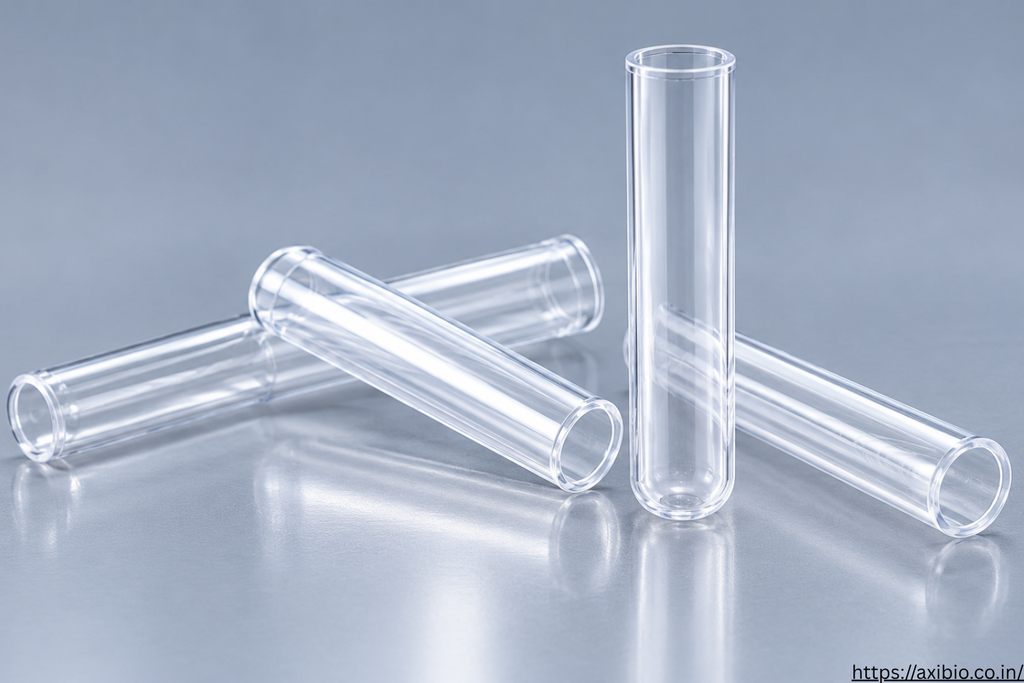
RIA vial is a small tube of plastic designed to contain samples and reagents within the procedure of Radioimmunoassay (RIA), a laboratory technique used to quantify minute quantities of a substance like hormone. An RIA vial does not carry out any measurement on its own. Rather, it is designed to facilitate the reaction to allow the assay and counting equipment to work.
Selecting the wrong RIA vial may result in bad fitting into racks, cracks in the tubes during centrifugation, and reagent’s reactions with the plastic. For these reasons, laboratory personnel pay close attention to the material, dimensions, closure type, and documentation before placing an order for the products. A good RIA Vial Manufacturer always provides this information publicly.
The following guide provides comprehensive information about what is an RIA vial, how it is used, the types and materials of RIA vials, and how to evaluate an RIA Vial Manufacturer. Quality control procedures, mistakes in ordering, storage issues, and frequently asked questions are covered as well. All of the information presented here is taken from publicly available technical descriptions, scientific literature, and the website of Axibio, and all unverifiable claims are marked.
What is an RIA Vial?
RIA vial is an abbreviation for a small, round-bottom plastic tube used for holding samples and reagents during the process of radioimmunoassay and other laboratory procedures. Most RIA vials described by different suppliers have the following dimensions 12 mm width and 75 mm height with a capacity of 5 ml. Most often, such vials are made of polystyrene (PS) or polypropylene (PP).
Some of the suppliers specify RIA vial only as a plain tube with a separate cap. For instance, Fisher Scientific describes the United Scientific RIA vial in its listing as a plain tube with a separate cap. Some other suppliers offer a cap as a part of a RIA vial set. This is another reason to read carefully the description of the products.
What is an RIA Vial Used For?
The RIA vial is employed for storage of the test sample, antibody, and labeled reagent when undergoing the process of radioimmunoassay. In addition, other laboratories employ the same type of tube for coagulation tests and bacteriology tests.
Common uses include:
- Holding serum/plasma samples while the assay is running.
- Holding the reaction mixture during the binding of antibodies/antigens.
- Centrifuging the tube to separate the bound and unbound fractions.
- Reading the tube in a counting device for measuring radioactivity.
- Holding of samples generally for a short time when the tube material is compatible with the sample.
The right RIA vial depends on the assay protocol, the instrument, and the sample. A vial that works well in one laboratory may not suit another. Always compare the vial specification with your own protocol.
How Does an RIA Vial Support Radioimmunoassay?
The RIA vial helps in conducting the radioimmunoassay because the reaction takes place in a safe and consistent manner right from the pipetting process to the counting process. It does not play a role in the actual measurement process.
Here are the basic scientific facts about radioimmunoassay. Radioimmunoassay makes use of a radiolabeled antigen and this antigen competes with an unlabeled antigen from the sample for the antibody binding sites. This technique was discovered by Rosalyn Yalow and Solomon Berson. The radioactivity measured is inversely proportional to the antigen concentration present in the sample according to Microbe Online. A gamma counter usually measures the radioactivity, particularly in cases where the radiolabel is iodine-125.
The RIA vial plays four supporting roles in this workflow:
- Containment. The vial holds the reaction mixture together and prevents any loss of sample.
- Compatibility. The plastic should not react with, or be absorbed by, the reagents used in the assay.
- Manipulation. The vial should be able to tolerate the manipulation process of the assay.
- Fit. The vial should fit properly in the racks and counters of the laboratory.
If any of these fail, results can be affected. That is why vial selection is part of good assay planning, not an afterthought.
What Are the Main Types of RIA Vials?
RIA vials classification varies based on materials, colors, closures, and grades. The most crucial difference in RIA vials is based on materials since polystyrene and polypropylene vials act in a different way.
There is no unified industry classification of RIA vials categories. The classifications listed below are made according to the information provided by manufacturers of vials.
| Type or configuration | What it means | Buyer note |
| Polystyrene (PS) RIA vial | Transparent tube, lower centrifugal limit | Suppliers state about 1400 RCF and no organic solvents |
| Polypropylene (PP) RIA vial | Clear or translucent tube, higher centrifugal limit | Suppliers state about 3000 RCF and autoclavable |
| Clear RIA vial | Standard visibility | Suitable when light is not a concern |
| Amber RIA vial | Tinted tube | Listed by some suppliers for light-sensitive samples |
| RIA vial with separate cap | Tube and cap sold apart | Confirm the cap fits the 12 mm tube |
| RIA vial with cap included | Supplied as a set | Confirm the cap material and fit |
| DNase/RNase-free grade | Listed by some suppliers | Needed only if your protocol requires it; verify the claim |
| Sterile grade | Listed by some suppliers | Not all RIA vials are sterile; check the listing |
Every line describes the configuration according to the individual supplier. Do not presume that a single RIA Vial would have all these qualities. Contact the individual RIA Vial Manufacturer about the configurations it has, and refer to the datasheet of the product.
Which Materials Are Used to Make RIA Vials?
Polystyrene or polypropylene is predominantly used for manufacturing RIA vials. Caps can be made of polyethylene (HDPE). The choice of material depends on the reagents, temperature, and centrifugations you have in your protocol.
| Material | Reported strengths | Reported limits | Selection note |
| Polystyrene (PS) | Transparent; accepts mild bases and weak acids | Not for organic solvents; not autoclavable; about 1400 RCF as listed | Good for clear viewing in aqueous work |
| Polypropylene (PP) | Handles common acids, alkalis, and solvents at room temperature; autoclavable; about 3000 RCF as listed | More translucent than polystyrene | Good when stronger chemical or heat handling is needed |
| HDPE (caps) | Listed as the cap material in some catalogs | Confirm fit and seal on your tube | Check the cap before ordering in bulk |
What this means for sample integrity
Plastics may interact with the samples. Certain types of proteins and small compounds may adhere to particular kinds of plastics, while some chemicals may soften and damage them. Your assay protocol or the kit’s user manual is the best source about the compatibility of the materials. In case of any mention of tube material in the protocol, you should go by it.
The Axibio RIA vial has two material options – polystyrene and polypropylene. It says that the clear tube is resistant to 1400 RCF and that the tubes can handle moderate bases and mild acids but not organic solvents. There is no mention of a separate centrifugation resistance value for the polypropylene tube on the product page.
What Features Should an RIA Vial Have?
A suitable RIA vial should match your protocol on size, volume, material, closure, and documentation. These features matter more than appearance or price.
Check the following:
- Dimensions. The usual specification is 12 mm x 75 mm. Make sure it fits your racks and counting equipment.
- Volume. Commonly listed as 5 mL. Verify there will be adequate headspace in your reaction volume.
- Material. Choose between polystyrene and polypropylene depending on your reagents and requirements for centrifugation.
- Closure. Find out if a cap is provided with the tube, what type of material the cap is made of and its tightness.
- Clarity or color. For clarity to check your sample and color that can protect from light, choose clear or amber tubes.
- Grade of cleanliness. Inquire about sterility, DNase/RNase free or non-sterility, depending on your specific requirements.
- Package size. Axibio provides 500 pieces per package. Other manufacturers list either 100 or 500 pieces.
- Traceability. Catalog number, batch or lot number.
A responsible RIA Vial Manufacturer lists these details on the product page. A feature only counts if the RIA Vial Manufacturer states it. If a listing is silent on a point, ask before you buy.
How to Choose the Right RIA Vial
To choose the right RIA vial, start with your assay protocol, then match the instrument, material, closure, and documentation. Work through the steps in order, and keep notes so you can show why the RIA vial was approved.
- Refer to your protocol or kit manual. Observe the specifications about tube material, size, and volume that it mentions.
- Inspect your equipment. Determine the tube size that is compatible with your racks and counting machine.
- Determine the material. Consider your requirements against the material’s limitations regarding your reagents and centrifugation speed.
- Choose the closure. Select the cap type that offers a good seal and is compatible with your procedures.
- Determine the grade. Ascertain whether you require the sterile or nucleic acid free tubes.
- Request documents. Request the datasheets, catalog number and lot number.
- Trial run. Try out a sample pack before purchasing in bulk.
- Observe supply. Inquire about package sizes and supply availability.
Treat the trial as a normal part of RIA vial selection. A small test often reveals fit or handling problems before they reach your full workflow.
How to Select a Reliable RIA Vial Manufacturer
An effective RIA Vial Manufacturer offers specifications, quality products, technical answers, and is able to prove his claims. Cost is important, however, it should not be the only criterion to follow.
Use these criteria to evaluate an RIA Vial Manufacturer:
- Specs for Product and Technical Documentation. A good RIA Vial Manufacturer always provides specs including tube size, material, volume, and pack info.
- Uniformity. All tubes that you get must match the approved specs in all orders.
- Information on Quality Control. Inquire what quality control measures does a given RIA Vial Manufacturer perform and what records are maintained.
- Compatibility with Material/Instrumentation. The RIA Vial Manufacturer must assist you in matching its tubes with your instrumentation.
- Availability of Supply. Ask about availability of stock and scheduling of repeated orders.
- Package and Identification Info. All packages must be marked with the correct catalog number and batch info.
- Technical Assistance. The RIA Vial Manufacturer must respond promptly to your questions.
- Ability to Clarify Application Needs. The RIA Vial Manufacturer must be ready to say when the product is inappropriate for your assay.
Why price alone is a weak guide
The cost for the RIA vial becomes higher when the tubes break or the cap leaks. Failing tests mean wasted reagents, samples, and labor hours. Consider the entire cost for buying RIA vials instead of comparing their prices alone.
How to verify a claim
Write down each significant claim that you hear from the RIA Vial Manufacturer. Ask for a datasheet, samples, and batch data. Check these against the product description. If the RIA Vial Manufacturer cannot back up the claim, consider it unsubstantiated.
Documents to request from an RIA Vial Manufacturer
A short document request shows quickly how well an RIA Vial Manufacturer supports its customers. Consider asking for:
- Datasheet showing size, volume, and material composition of each RIA vial.
- Centrifuge capacity and chemical resistance properties of the particular RIA vial you wish to purchase.
- Information about cleanliness grade if it is required by your analysis.
- Lot number for each delivery of RIA vials.
- Certificate issued by the RIA Vial Manufacturer if applicable to the product.
Manufacturer, trader, or distributor?
A number of sellers can be seen on the Internet who claim that they are both manufacturers, exporters, and traders. Check whether the supplier manufactures the item or acts as a reseller. This will reveal who will be responsible for maintaining the quality of the product and for solving the issue. An authentic RIA Vial Manufacturer would know about the manufacturing process of the product and an authentic trader could identify the source of RIA vials.
Questions to Ask Before Purchasing RIA Vials
Asking specific questions to your RIA Vial Manufacturer prior to ordering ensures that any problems that might arise are covered by written answers in case they should occur.
Dimensions and volume
- What is the outer diameter and height of the RIA vial?
- What is the stated volume, and is there a recommended working volume?
Material and closure
- Is the RIA vial polystyrene or polypropylene?
- Is a cap included? What material is it, and does it fit the 12 mm tube?
Compatibility
- What is the stated centrifugation limit for this exact product?
- Which chemicals does the RIA vial material tolerate, and which does it not?
Grade and documentation
- Is the RIA vial sterile, DNase/RNase-free, or non-sterile?
- Can the RIA Vial Manufacturer supply a datasheet and batch details?
Packaging and supply
- What is the pack size, and how is it packed for transport?
- Can the RIA Vial Manufacturer supply repeat orders from the same specification?
Common Mistakes to Avoid When Buying RIA Vials
The most common mistakes come from assuming that all RIA vials are the same. Avoid these problems with simple checks.
- Neglecting to consider the material. Polystyrene and polypropylene vary in solvent resistance and centrifugation. Match the material to your protocol.
- Neglecting to check the cap. Not all RIA vials have caps. Make sure the cap is included and fits.
- Choosing only based on price. The least expensive RIA vial may lack documentation needed, while the least expensive RIA Vial Manufacturer lacks technical assistance.
- Neglecting to check for proper instrument fit. Check that the tube will fit into your racks and counter before making a bulk purchase.
- Assuming sterility. Some product descriptions mention that the tubes are non-sterile. Read each description carefully.
- Neglecting to trial a few. A trial sample run can catch problems with fit and handling ahead of time.
- Neglecting batch information. Without batch numbers, you won’t be able to track down what’s causing problems.
- Neglecting to ask for proof. If an RIA Vial Manufacturer provides a certificate or test results, ask for the documentation.
RIA Vial Storage and Handling
Keep and manage all RIA vials following the product datasheet, the assay protocol, and your laboratory’s safety protocols. No standard temperature or management practice is applicable for every RIA vial.
Some best practices may be common sense. Contact the RIA Vial Manufacturer for any storage recommendations for its RIA vial. Store unused tubes in their original and sealed package to maintain sterility. Store away from any direct sunlight, heating, and solvents unless stated in the datasheet. Wear clean gloves when handling the tube and do not touch the inside of the tube or cap.
Radioimmunoassay involves using radioactive substances; hence safety practices are important. Follow the radiation safety procedures for labelling, handling, and disposal of used tubes provided by your institution’s radiation safety officer. The information comes from your radiation safety officer and not from the tube manufacturer.
When an RIA vial is indicated to be autoclavable, observe the limitations indicated in the datasheet. Some manufacturers indicate that polypropylene RIA vials are autoclavable while others state that polystyrene RIA vials are non-autoclavable.
Frequently Asked Questions
1. What is an RIA vial?
RIA vial refers to a plastic tube of size 12 × 75 mm holding a volume of 5 ml and containing sample and reagents used in radioimmunoassay process. It can be made of polypropylene or polystyrene material.
2. What is an RIA vial used for?
The RIA vial is where the reaction takes place and which is used in the process of radioimmunoassay. Some of the suppliers of these items also refer to them as coagulation/bacteriological tubes.
3. How does an RIA vial differ from a standard laboratory vial?
The RIA vial is a simple, round-bottomed tube that fits into an assay rack and counting machine. A typical chromatography vial is a small glass or plastic tube fitted with a septum cap and designed for use with an autosampler.
4. Which materials are used for RIA vials?
The materials used are Polystyrene and Polypropylene. The suppliers say that Polypropylene is autoclavable and also has a higher centrifugation capacity than Polystyrene which is clear but does not tolerate organic solvents.
5. How do I choose the right RIA vial?
Begin with the assay procedure. Then find the tube specifications that correspond with the instrument and reagents you will be using and request a datasheet and sample.
6. How can I check RIA vial compatibility?
Check for compatibility between the datasheet and your protocols, racks, counter and centrifugation speed. Conduct a test before placing a bulk order. Not all RIA vials can be used for each assay.
7. What should I ask an RIA Vial Manufacturer?
Ask about the dimensions, material, cap specifications, maximum speed for centrifugation, cleanliness class, batch documents, packaging, and availability. Get the answers in writing.
8. Why are product specifications important when purchasing RIA vials?
Specifications determine if the RIA vial will be suitable for your instruments and able to withstand your protocol. Specifications can also be used to make comparisons between RIA Vial Manufacturers and verify later purchases against the original specification.
9. How should RIA vials be stored?
Proceed with caution by following the product datasheet and laboratory guidelines. It is advisable to store unused tubes in their unopened original packages, in an area free of moisture and direct sunlight.
10. What information should I confirm before placing an order?
Check on the capacity, volume, material type, cap specifics, grade, maximum speed of centrifugation, packing quantity, batch number, documentation, and mode of shipment. The RIA Vial Manufacturer should confirm all these in writing.
Looking for the Right RIA Vial for Your Laboratory?
Explore Axibio RIA Vials to review the available polystyrene and polypropylene options and find the right fit for your counting and assay workflows. Each material suits different sample types, handling conditions, and laboratory protocols, so comparing them side by side makes it easier to choose with confidence. For detailed product specifications, current availability, bulk order requirements, or technical documentation, contact Axibio to discuss your laboratory needs. The team can help you select RIA vials that match your application, volume, and quality expectations.