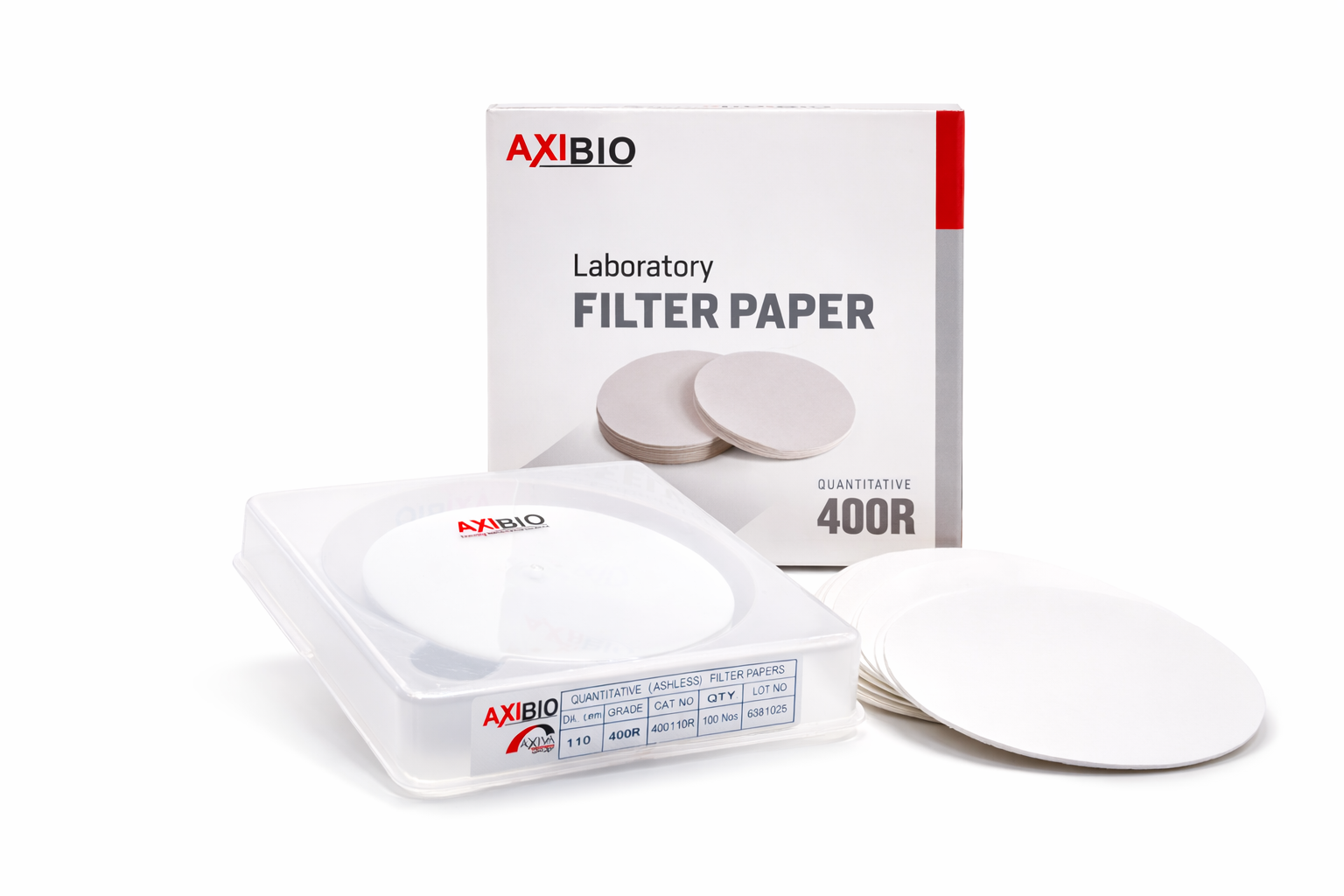
In selecting a quantitative filter paper manufacturer India, it is important that laboratories, research centers, education institutes, and industries choose manufacturers that can provide high-quality products that meet performance criteria. High-quality filter papers are required for proper analytical testing, gravimetric analysis, and laboratory filtration. The selection of a reliable laboratory filtration products manufacturer India not only ensures reliable filtration but also keeps in line with the quality standards maintained by the lab.
Quantitative filter papers are generally compared to known reference filters such as Whatman (Cytiva), Ahlstrom-Munksjö, Sartorius, and Advantec, who have published specifications for their products regarding ash content, retention, and filtration time. Indian filter papers are nowadays also manufactured following similar ashless criteria, which is why one should always demand a certificate of analysis (CoA) from the manufacturer.
What Is Quantitative Filter Paper?
Quantitative filter paper is a highly purified laboratory filter paper meant for use in analyses wherein the requirement of having minimal amount of ash should be met after filtration. Such filters are prepared from specially processed cellulose and have undergone a special treatment to give them uniform pore sizes, good retention and filtration performance.
They are utilized in gravimetric analysis, precipitation collection, chemical analysis, environmental analysis and quality control laboratories, among others.
Technically speaking, “quantitative” means that the paper is ashless after filtering the precipitate and drying and burning it, no ash will be left from the paper and thus only the weight of the sample will be left to measure and not that of the filter paper. Typical ashless papers have industry standard ash contents of 0.004%-0.01%, hence gravimetric chemists always turn to ashless papers because of their specific requirements compared to other qualitative papers that contain noticeably larger amounts of ash.
Quantitative filters are typically divided into three main classes based on their speed and retention, reflecting those found throughout the industry:
Quick-filters nominal particle retention in the region of 20–25 microns, which are best suited to coarse or gelatinous precipitates like aluminum hydroxide and ferric hydroxide, where fast filtration is a priority rather than capture of small particles. Mid-speed filters nominal particle retention in the region of 7–8 microns, and the most commonly used type, which are useful for routine gravimetric analysis, soil extracts and sample cleanup prior to instrumental analysis such as atomic absorption spectrometry. Slow-filters nominal particle retention as low as 2 — 2.5 micrometres, which are best for extremely fine crystalline precipitates such as barium sulfate and calcium carbonate.
All ashless quantitative filter papers are made from more than 98% alpha cellulose (cotton linters) and have basis weights typically in the 85-100g/m2 range and thickness of 0.17-0.22mm although actual values will vary between manufacturers. It pays to ask suppliers of quantitative filters for these figures directly.
Why Quality Matters in Laboratory Filtration
Laboratory filtration directly affects the accuracy of experimental and analytical results. Poor-quality filter papers may lead to contamination, inconsistent particle retention, or inaccurate measurements.
A reliable manufacturer follows strict quality control procedures to ensure:
- Uniform thickness and pore size
- High particle retention efficiency
- Excellent wet strength
- Low ash content for analytical testing
- Consistent filtration performance across every batch
These characteristics help laboratories achieve dependable and repeatable results.
Benefits of Choosing an Indian Manufacturer
India has become a preferred manufacturing destination for laboratory filtration products because of its advanced production capabilities, skilled workforce, and competitive pricing. Many Indian manufacturers supply filtration products to laboratories, healthcare organizations, universities, and industrial sectors across domestic and international markets.
Key advantages include:
- High manufacturing standards
- Cost-effective bulk production
- International quality compliance
- Reliable delivery schedules
- Technical support for product selection
- Custom manufacturing solutions for specialized applications
Working with an experienced manufacturer also ensures better product availability and long-term supply reliability.
Applications of Quantitative Filter Paper
Quantitative filter papers are widely used across numerous industries and laboratory environments, including:
Quality control laboratories for pharmaceuticals for gravimetric analysis, residue-on-ignition analysis, and preparatory sample filtration before instrumental analysis. Testing laboratories for chemicals for collection and purity test of precipitates using wet chemical analysis techniques. Analyzing foods and beverages such as moisture, ash and sediment analysis in dairy and processed food products. Environmental testing laboratories for air pollution particulates sampling and soil pollutants extraction, where the fastest ashless filters are usually preferred. Water quality testing laboratories for total suspended solids (TSS) analysis and sample preparation related to turbidity.
Ore assay labs and metallurgy for ore assay and analysis of metals after acid digestion. Educational and research institutes for demonstration of gravimetric analysis techniques and research projects. Biotechnology laboratories for clarification of samples before further analysis. High accuracy makes them ideal for precise analytical measurements, while ashless filters make them the first choice for all procedures where burning or combustion of filtered material is required.Their high accuracy makes them suitable for applications requiring precise analytical measurements.
Choosing the Right Laboratory Filtration Products Manufacturer
Before selecting a manufacturing partner, businesses and laboratories should evaluate several important factors.
Product Quality
Choose a manufacturer with proven quality control systems and consistent manufacturing processes.
Product Range
A dependable supplier should offer various grades of filter papers along with complementary laboratory filtration products to meet different laboratory requirements.
Custom Solutions
Some laboratories require specialized sizes or filtration specifications. Manufacturers capable of offering customized products provide greater flexibility.
Technical Expertise
Experienced manufacturers can recommend the most suitable filtration products based on laboratory applications, improving both efficiency and accuracy.
The Value of Complete Laboratory Filtration Solutions
The leading suppliers typically offer an extensive range of products comprising quantitative filter paper, qualitative filter paper, membrane filters, syringe filters, filtration units, lab accessories, and other filtration consumables. The purchase of products from the same supplier will make the acquisition process simpler and at the same time ensure consistency in the quality of the products used in the laboratory.
It is also worth noting that buying filter consumables from one manufacturer will reduce the number of vendors’ qualifications that a laboratory’s procurement department has to handle because in a regulated setting each new vendor requires a qualification and audit trail.
Final Thoughts
It is important to have the right quantitative filter paper manufacturers in India if you are looking for accuracy, consistency, and effective analytical results from the product. An experienced laboratory filtration products manufacturer in India provides filtration solutions that facilitate accurate test results and ensure improved efficiency in compliance with international laboratory standards. The following are some important tips that you should follow when choosing the right quantitative filter paper manufacturers in India.
Frequently Asked Questions
What makes a filter paper “quantitative” rather than “qualitative”?
Quantitative filter papers are ash-free, i.e., they have a minimal residue upon burning, making them useful in gravimetry because the filter paper cannot interfere with the mass of the sample being determined. On the other hand, qualitative filter papers are not produced with such a minimal ash content as quantitative filter papers; they are used in general filtration operations.
What ash content should I look for in a quantitative filter paper?
The ashless quantitative grades generally have an upper limit for ash percentage of about 0.004% to 0.01%, which varies with each grade. Do not use the general description to find the value of this figure but get the information from the manufacturers’ specification sheets or certificate of analysis.
Which quantitative filter paper grade should I use for gravimetric analysis?
The proper grade will depend on the nature of the precipitate being filtered. Coarse or gelatinous precipitates would need to be filtered using a rapid grade with coarse retention (approximately 20–25 microns), while general gravimetric procedures use a medium grade (7–8 microns), and crystalline precipitates like barium sulfate would need a slow grade with fine retention (2–2.5 microns).
Are Indian-manufactured quantitative filter papers comparable to imported brands?
There are currently many Indian producers that manufacture ashless quantitative filter papers that meet standards that are equivalent to those of internationally established reference companies at a lesser cost since they manufacture locally. There is no better way to ascertain that the papers are equivalent than by comparing the ash content, retention, and filtration rate that are stated by each manufacturer along with requesting a certificate of analysis.
What should I ask a manufacturer before placing a bulk order?
In all cases, at least request information on the ash content, particle retention, filtration (Herzberg) rate, basis weight, and availability of the certificate of analysis per shipment. For regulated labs, also verify whether the filter paper manufacturer follows an accredited quality assurance program, like the ISO 9001 system.