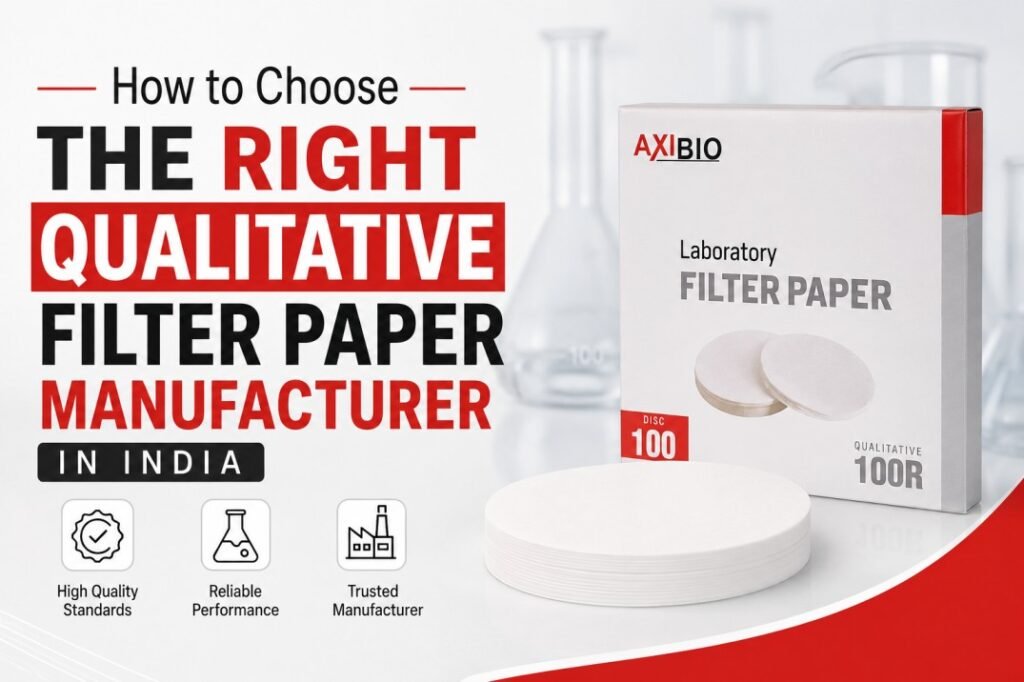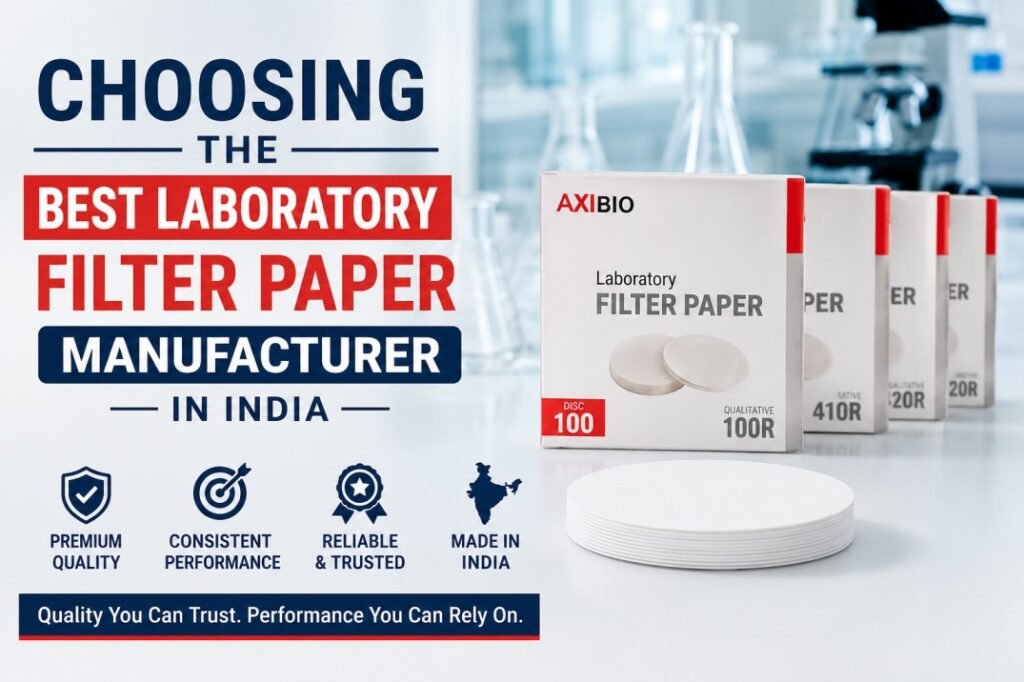
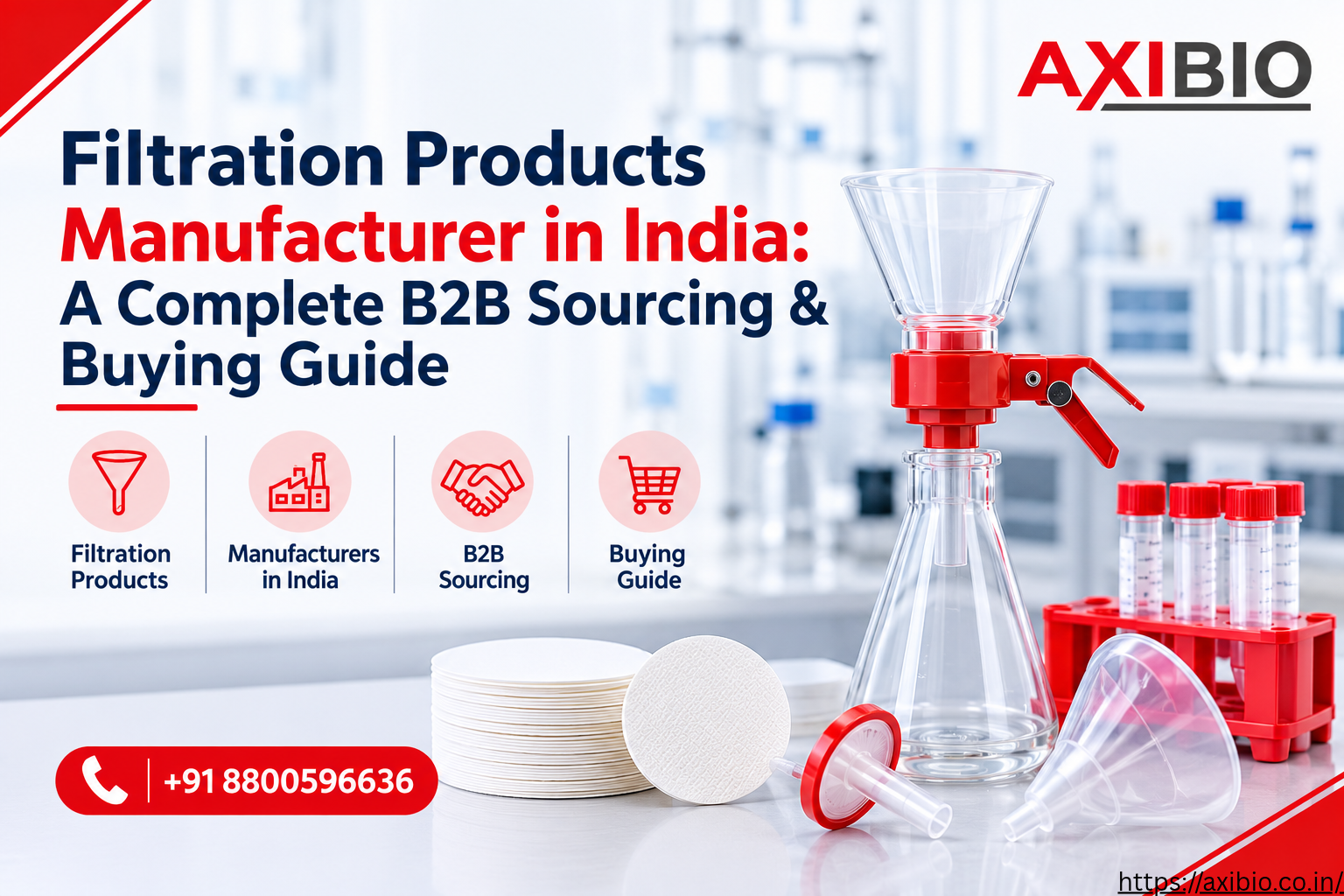
Most laboratory buyers do not struggle to find filtration products. They struggle to find a source that supplies the right grade, every time, in the quantity they need. One wrong batch of filter paper or one late shipment of membranes can stop a test line, delay a report, or force a costly re-run.
What should you look for in a filtration products manufacturer in India? Choose a manufacturer that offers a complete range across filter papers, glass fibre filters, pollution monitoring filters, thimbles, blotting membranes and filter funnel assemblies. It should share clear specifications for each grade, handle bulk orders, confirm lead times in writing, and give you direct access to its sales and technical team.
AXIBIO is a Delhi-based laboratory products manufacturer. It supplies filtration products in all six of these categories, along with chromatography essentials, laboratory plasticware and bench top instruments.
This guide is written for purchasing managers, lab heads, distributors and bulk buyers. It covers what each filtration category is used for, what to check before you order, how to compare suppliers, and how to get a quotation.
What Are Filtration Products and Why Do Laboratories Need Them?
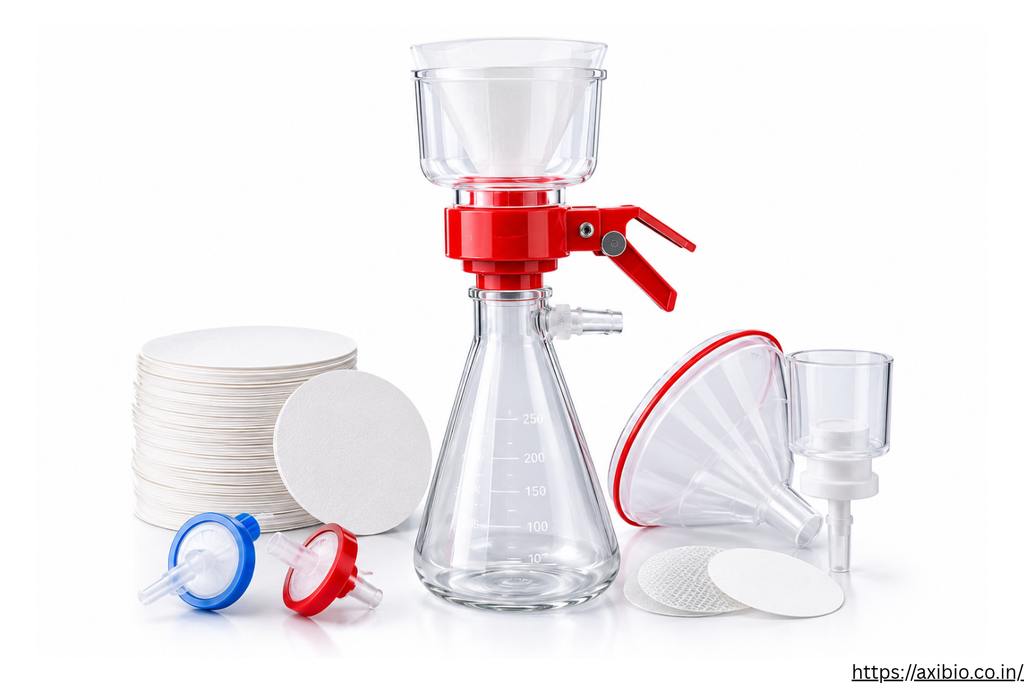
Filtration products are lab consumables and hardware that separate solids from liquids or gases, or hold a sample during extraction or transfer. They include filter papers, glass fibre and quartz filters, air sampling filters, extraction thimbles, blotting membranes, and the funnels and manifolds that hold them.
For a buyer, these are repeat-purchase items.
Laboratories depend on filtration products for:
- Sample preparation before instrumental analysis such as AAS, ICP or HPLC
- Gravimetric analysis, where the filter is weighed or ashed after use
- Air and stack emission monitoring for particulate matter
- Water and wastewater testing for suspended solids and contaminants
- Solvent extraction of fats and oils in food and feed testing
- Protein and nucleic acid transfer in western, Southern and Northern blotting
- Microbiological testing using vacuum filtration setups
The main buyers in India are pharmaceutical QC labs, chemical and testing laboratories, environmental monitoring agencies, food and beverage plants, research institutes, universities, and the distributors who supply them.
Because usage is high and constant, procurement teams care about three things: the correct grade, steady quality from batch to batch, and stock that arrives on time.
Types of Filtration Products Available for Laboratory Requirements
AXIBIO lists six filtration categories on its Filters and Filtration Assemblies page. The specifications below are taken from the official product pages. Always confirm the final specification and catalogue number in your quotation.
1. Filter Papers (Qualitative and Quantitative)
What it is: Porous cellulose sheets that separate solids from liquids. AXIBIO supplies filter papers in qualitative, quantitative (ashless) and hardened grades, as circles and sheets.
Where it is used: Routine filtration, gravimetric analysis and sample preparation in chemical, pharmaceutical, food, microbiology and environmental labs.
What AXIBIO offers:
- Qualitative filter papers (R series): Grades 100R, 102R, 103R, 104R and 105R, with retention from about 2.5 µm to 25 µm. Grade 100R comes in circles from 90 mm to 320 mm. All grades are offered as 460 × 570 mm sheets.
- Quantitative filter papers (R series): Ashless grades 400R, 410R, 420R, 540R and 541R. Ash content is stated as below 0.007%, which suits gravimetric work where the filter is burned off.
What buyers should check before ordering:
- Qualitative or quantitative: use ashless grades only when the residue will be ignited and weighed
- Retention (µm) and filtration speed: finer retention means slower flow
- Circle diameter that matches your funnel, or sheet size for cutting
- Pack size: most circles are packed 100 per packet
If your SOP names an international grade number, compare it with the equivalent grade stated on the product page and confirm it with the sales team.
2. Glass Fibre Filters (GF/1F, GF/3F, GF/5F and Quartz)
What it is: Filters made from fine glass fibres. The glass fibre filters are described as fast-flowing, with high dirt-holding capacity and resistance to heat and most chemicals.
Where it is used: Pre-filtration, water testing (suspended solids), air sampling, emission measurement and gravimetric analysis.
What AXIBIO offers:
- GF/1F: 1.6 µm, binder-free, maximum temperature 500 °C. Circles from 25 mm to 150 mm and 203 × 254 mm sheets.
- GF/3F: 1.2 µm, binder-free, maximum temperature 500 °C. Circles from 25 mm to 150 mm, strips and sheets.
- GF/5F: 0.7 µm, binder-free, maximum temperature 500 °C. It is listed for fine protein precipitates, aggressive solutions and TCLP (EPA Method 1311) work.
- Quartz micro fibre filters: Made from quartz fibres for precision air sampling, gravimetric analysis and stack emission monitoring. Available in 25, 37, 47 and 81 mm circles and 203 × 254 mm sheets.
What buyers should check before ordering:
- Retention rating your method requires (1.6, 1.2 or 0.7 µm)
- Whether your method needs binder-free media
- Temperature exposure: quartz is the usual choice for high-temperature stack sampling
- Diameter that fits your sampler or filter holder
3. Filters for Pollution Monitoring (PM 2.5 and ENV 2000)
What it is: Filters that capture particulate matter from air for environmental testing. See the range of pollution monitoring filters.
Where it is used: Ambient air quality monitoring, emission monitoring and gravimetric particulate measurement.
What AXIBIO offers:
- PM 2.5 filter: PTFE filter media with a polypropylene support ring. 46.2 mm diameter, 2 µm pore size, 40 µm thickness, packed 50 per packet.
- ENV 2000: Borosilicate glass fibre filter for air sampling. It has a stated efficiency of 99.95% at 0.3 µm and is listed for PM-10 sampling. Available as 47 mm circles and 203 × 254 mm sheets, sequentially numbered.
What buyers should check before ordering:
- Whether you are sampling PM 2.5 or PM 10
- Filter diameter required by your sampler model
- Whether sequential numbering is needed for traceability
- Pack quantity versus your monthly sampling schedule
4. Thimbles (Cellulose and Glass Fibre)
What it is: Cylindrical porous cups that hold a solid sample during Soxhlet or similar solvent extraction. AXIBIO’s laboratory thimbles come in cellulose and glass fibre versions. Glass fibre thimbles give better chemical and temperature resistance.
Where it is used: Extraction of fats and oils in food testing, environmental analysis, pharmaceutical research and QC labs.
What AXIBIO offers:
- Cellulose thimbles: 10 sizes from 22 × 80 mm to 43 × 123 mm (internal diameter × external length), wall thickness about 1.5 mm, packed 25 per packet.
What buyers should check before ordering:
- Internal diameter and length that fit your Soxhlet or automated extractor
- Cellulose for general work, glass fibre for higher temperature or harsh solvents
- Monthly consumption, since thimbles are often single-use
5. Blotting Membranes
What it is: Membranes that receive and hold proteins, DNA or RNA transferred from a gel, so they can be detected with antibodies or probes. See the range of blotting membranes.
Where it is used: Western, Southern, Northern and dot blotting in molecular biology, biotech, pharma and research labs.
What AXIBIO offers:
- Nitrocellulose blotting membrane: 0.2 µm and 0.45 µm. Precut sheets (100, 200 and 300 mm square, 10 per pack) and 3 m rolls (100 mm and 300 mm wide).
- Supported nitrocellulose membrane: Same pore sizes and formats, with an inert support built into the membrane. The support is stated to improve wet strength and reprobing.
- Pure cellulose blotting sheet: 0.8 mm thick, in 150 × 150 mm and 200 × 200 mm sheets, 50 per pack.
- PVDF blotting membrane: 0.2 µm and 0.45 µm, protein binding stated at 170–200 µg/cm². It needs pre-wetting in methanol before use.
What buyers should check before ordering:
- Pore size: 0.2 µm is generally preferred for small proteins and peptides, 0.45 µm for most routine work
- Nitrocellulose versus PVDF, based on your detection method and whether you strip and reprobe
- Sheet or roll format, based on gel size and batch volume
- Storage conditions and shelf life
6. Filter Funnels and Assemblies
What it is: Hardware that holds a filter paper or membrane for vacuum or gravity filtration. AXIBIO supplies filter funnel assemblies as single units and manifold setups.
Where it is used: Membrane filtration, sterility testing and microbiological analysis in pharma, chemistry, microbiology and environmental labs.
What AXIBIO offers:
- Filter funnels: For 47 mm membrane filters, in stainless steel, polypropylene, polycarbonate and borosilicate glass, with 250 ml to 500 ml capacity. Supplied without a vacuum flask.
- Filter funnel assembly: Borosilicate glass funnel, clamp, cover and receiving flask. Funnel capacity 25 ml to 1000 ml, filter diameter 13 mm to 90 mm, flask capacity 250 ml to 5000 ml.
- Filtration assembly with manifold: Stainless steel manifold with PTFE valves in 1, 3 and 6 place versions.
What buyers should check before ordering:
- Filter diameter the assembly accepts (13, 25, 47 or 90 mm)
- Material: autoclavable PP and glass, or stainless steel for heavy daily use
- Joint size (B-29, B-40, B-65) to match your existing flasks
- Number of manifold places needed for your daily sample load
Filtration Products Category and Application Comparison
Use this table to match each filtration category to its main use and the key point to confirm before you order.
| Product Category | Available Types | Primary Application | Important Buyer Consideration |
| Filter Papers | Qualitative (100R–105R), Quantitative ashless (400R, 410R, 420R, 540R, 541R) | Routine filtration, gravimetric analysis, sample preparation | Ashless grade for ignition work; retention (µm) and speed; circle diameter |
| Glass Fibre Filters | GF/1F (1.6 µm), GF/3F (1.2 µm), GF/5F (0.7 µm), Quartz micro fibre | Pre-filtration, suspended solids, air sampling, stack emission monitoring | Retention needed by your method; quartz for high-temperature sampling |
| Pollution Monitoring Filters | PM 2.5 (PTFE, 46.2 mm), ENV 2000 (borosilicate, 47 mm and sheets) | Ambient air and particulate monitoring, gravimetric PM measurement | PM 2.5 vs PM 10 sampling; diameter for your sampler; sequential numbering |
| Laboratory Thimbles | Cellulose thimbles (22 × 80 mm to 43 × 123 mm), Glass fibre | Soxhlet extraction of fats, oils and soluble compounds | ID × length to fit the extractor; glass fibre for harsher conditions |
| Blotting Membranes | Nitrocellulose, Supported nitrocellulose, Pure cellulose sheet, PVDF | Western, Southern, Northern and dot blotting | Pore size 0.2 or 0.45 µm; NC vs PVDF; sheet or roll format |
| Filter Funnel Assemblies | Filter funnels, Glass filter funnel assembly, SS manifold (1, 3, 6 place) | Vacuum membrane filtration, sterility and microbiology testing | Filter diameter accepted; material and autoclavability; joint size; manifold places |
How to Choose the Right Filtration Products Manufacturer in India
The right manufacturer supplies the exact grades you use, proves their specifications, and keeps supplying them at your volume. Shortlist on these factors:
- Product range: One source for filter papers, glass fibre filters, pollution monitoring filters, thimbles, membranes and assemblies means fewer vendors, approvals and invoices.
- Published specifications: Retention, thickness, basis weight, ash content, pore size and dimensions should be on product pages or in a catalogue. Without them you cannot verify fit with your method.
- Manufacturing capability: Ask which products the company makes itself and which it sources. This affects batch control and bulk response time.
- Quality documentation: Ask for a Certificate of Analysis (CoA) and batch numbers. The qualitative filter paper page, for example, states a CoA is available on request. For ISO or other certifications, ask for a valid copy.
- Batch-to-batch consistency: Ask whether large orders can be supplied from a single lot, so flow and retention stay the same.
- Technical support: A responsive team helps you choose between, say, GF/1F and GF/5F without trial and error.
- Bulk handling and packaging: Check bulk box options and moisture-safe packing.
- Quotation process: A written quote with catalogue numbers, prices, taxes and lead time speeds up approval.
Why Buy Filtration Products Directly from a Manufacturer?
Buying direct shortens the chain between the people who make the product and the people who use it. This matters most for bulk and repeat orders.
- Direct communication: Grade and compatibility questions go straight to the product team.
- Full selection: You see every grade, size and pack format, not only a dealer’s stock.
- Bulk planning: Annual or quarterly volumes and scheduled deliveries can be agreed upfront.
- Source documents: Spec sheets, catalogue numbers and batch documents come from the maker.
- Long-term supply: Standard grades and pack sizes make reordering simple.
The trade-off: manufacturers may set minimum order quantities, and a local distributor may be faster for small urgent top-ups. Compare written quotations rather than assuming direct is always cheaper.
Key Factors to Check Before Placing a Bulk Order
A bulk order locks in a large quantity of one specification. Check these points before you issue the purchase order.
- Product grade: Confirm the exact grade and catalogue number, for example 420R quantitative paper or GF/5F glass fibre.
- Dimensions and specifications: Match circle diameter, sheet size, thimble ID × length, or membrane pore size to your equipment and method.
- Quantity requirements: Work out monthly consumption and order enough to cover your planning period without exceeding shelf life. For example, the product pages state a 3-year shelf life for its PVDF membrane and 5 years for 100R filter paper under recommended storage.
- Intended application: Tell the supplier what the product is for.
- Compatibility: Check that filters fit your funnels, samplers and extractors. Check that membranes suit your transfer method and detection system.
- Packaging: Confirm pack quantity (100 per packet, 50 per packet, 25 per packet) and outer carton packing for safe transport.
- Documentation: Ask which documents ship with the order, such as a CoA, invoice with HSN code and batch details.
- Quotation and lead time: Get the price, taxes, freight and delivery time in writing before approval.
If you are switching from another brand, order a small trial quantity first. Run it against your current product before you commit to the full volume.
How to Compare Filtration Products Suppliers in India
Many online listings for filtration products come from marketplaces, resellers and city-specific landing pages. A listing does not show whether the seller makes the product or resells it. Compare suppliers on facts:
- Verify the manufacturer: Check the website, registered address, GST details and whether it has its own product series and catalogue numbers.
- Get documents: Request spec sheets and a sample CoA for the exact grade.
- Compare specs line by line: Two “Grade 1 equivalent” papers can differ in thickness and flow time.
- Test communication: How fast and clearly a supplier answers a technical question previews its after-sales support.
- Quote on the same basis: Same grade, pack size, quantity, delivery location, taxes and freight.
- Request samples for new suppliers or critical methods.
The checklist below works as a ready score sheet.
Manufacturer and Supplier Evaluation Checklist for B2B Buyers
Procurement teams can use this checklist to score each filtration products supplier before approval.
| Evaluation Factor | What Buyers Should Check | Why It Matters Before Purchasing |
| Technical specifications | Retention (µm), pore size, thickness, ash content, dimensions for each grade | Confirms the product fits your test method and equipment |
| Quality documentation | Certificate of Analysis, batch/lot numbers, valid copies of any certifications | Supports audits, traceability and regulatory reviews |
| Product range | Coverage across filter papers, glass fibre, pollution monitoring, thimbles, membranes, assemblies | Fewer vendors, simpler approvals and combined orders |
| Manufacturing status | Whether the supplier makes the product or resells it | Affects batch control, response time and technical support |
| Batch consistency | Single-lot supply for large orders; consistent flow and retention | Prevents result drift between batches |
| Bulk order capacity | Ability to supply your annual or quarterly volume; bulk pack options | Avoids stock-outs during peak testing periods |
| Packaging | Pack quantity, moisture protection, outer carton strength | Prevents damaged or unusable stock on arrival |
| Quotation clarity | Catalogue numbers, unit price, taxes, freight, payment terms in writing | Allows like-for-like comparison and faster approval |
| Lead time and delivery confirmation | Written dispatch date and delivery timeline to your location | Supports production and testing schedules |
| Technical and after-sales support | Speed and quality of answers to grade or compatibility questions | Reduces trial-and-error and handles issues after delivery |
Looking for a Reliable Filtration Products Manufacturer in India?
If your lab or business buys filtration products every month, a single dependable source saves time on every order. AXIBIO manufactures and supplies filter papers, glass fibre and quartz filters, PM 2.5 and ENV 2000 pollution monitoring filters, cellulose thimbles, nitrocellulose and PVDF blotting membranes, and filter funnel assemblies with manifolds.
- Procurement teams: Share your grades and specifications, and ask for technical data and documentation.
- Bulk buyers and distributors: Request a quotation for your annual or quarterly volumes.
- Lab managers switching suppliers: Ask about samples so you can test before you commit.
Explore the full range on the AXIBIO Filters and Filtration Assemblies page, then contact the sales team at sales@axibio.co.in or +91 8800596636 with your requirement.
Frequently Asked Questions
1. Who is a filtration products manufacturer in India?
A filtration products manufacturer in India is a company that produces and supplies lab filtration consumables and hardware, such as filter papers, glass fibre filters, membranes, thimbles and filter funnel assemblies. AXIBIO is one such Delhi-based manufacturer and supplier. It covers all six of these filtration categories.
2. How can I find a reliable filter paper manufacturer in India?
Look for a filter paper manufacturer that publishes grade-wise specifications such as retention, ash content, thickness and sizes, and that can share a Certificate of Analysis. Check that it offers both qualitative and quantitative (ashless) grades. Compare written quotations for the same grade and pack size.
3. What should I check before selecting a glass fibre filter supplier?
Check the retention rating (for example 1.6, 1.2 or 0.7 µm), whether the media is binder-free, the maximum operating temperature, and the diameters on offer. For stack or high-temperature sampling, ask whether quartz micro fibre filters are a better fit.
4. Where can laboratories source filtration products in bulk?
Labs can source bulk filtration products directly from manufacturers or through authorised distributors. AXIBIO accepts bulk enquiries through its website, email and phone.
5. How do I choose the right laboratory filtration products?
Start with your test method. It usually defines the filter type, retention or pore size, and diameter. Finally, check pack size against your monthly use.
6. What factors should I compare when selecting a filtration products supplier?
Compare published specifications, quality documents, product range, manufacturing status, batch consistency, packaging, lead time and quotation clarity. The evaluation checklist table above covers each factor in detail.
7. How can I purchase laboratory filtration products from AXIBIO?
Browse the Filters and Filtration Assemblies page, note the grade and catalogue number you need, and send an enquiry. The sales team confirms availability, price and order details.
8. What should buyers check before ordering filtration products in bulk?
Confirm the exact catalogue number, quantity against shelf life, equipment fit and written lead time. With a new supplier, test a trial quantity first.
9. Are laboratory filtration products available in different grades and specifications?
Yes. For example, AXIBIO lists five qualitative and five quantitative filter paper grades, three glass fibre grades plus quartz, and blotting membranes in 0.2 µm and 0.45 µm.
How to Request a Quotation from AXIBIO
You get a faster and more accurate quotation when your first message has complete details. Follow these steps.
- Pick the product category from the filtration products page.
- Note the grade or model and catalogue number from the product page, for example GF/1F 47 mm or 0.45 µm PVDF 300 mm × 3 m roll.
- Prepare your enquiry with these details:
- Product category
- Required grade, model or catalogue number
- Quantity (packs or boxes) and whether it is a one-time or repeat order
- Application or test method
- Required specifications such as diameter, pore size or sheet size
- Delivery location (city and PIN code)
- Documents needed, such as a CoA
- Send the enquiry to sales@axibio.co.in or call +91 8800596636, the contact details listed on its product pages. You can also use the quote request option on the website.
- Review the quotation for price, taxes, freight, pack size and lead time. Clarify anything open before you issue the purchase order.
Distributors and wholesalers should also mention expected monthly volumes and the regions they serve.