
Filter papers are vital laboratory consumables that are used to separate solid materials from liquids through the process of filtration. The type of filter paper is important because it affects how fast filtration occurs and the quality of the filtrate and even the accuracy of the analytical processes. Filter paper that is very coarse will allow the passage of finer materials.
This article will discuss what filter papers are, how they function, and the types available. The various uses of filter papers, important specifications, factors that affect filter paper pricing, and guidelines on choosing a trustworthy filter paper manufacturer will also be discussed. At the end of this article, you will know what to look out for when purchasing filter papers.
What Are Filter Papers?
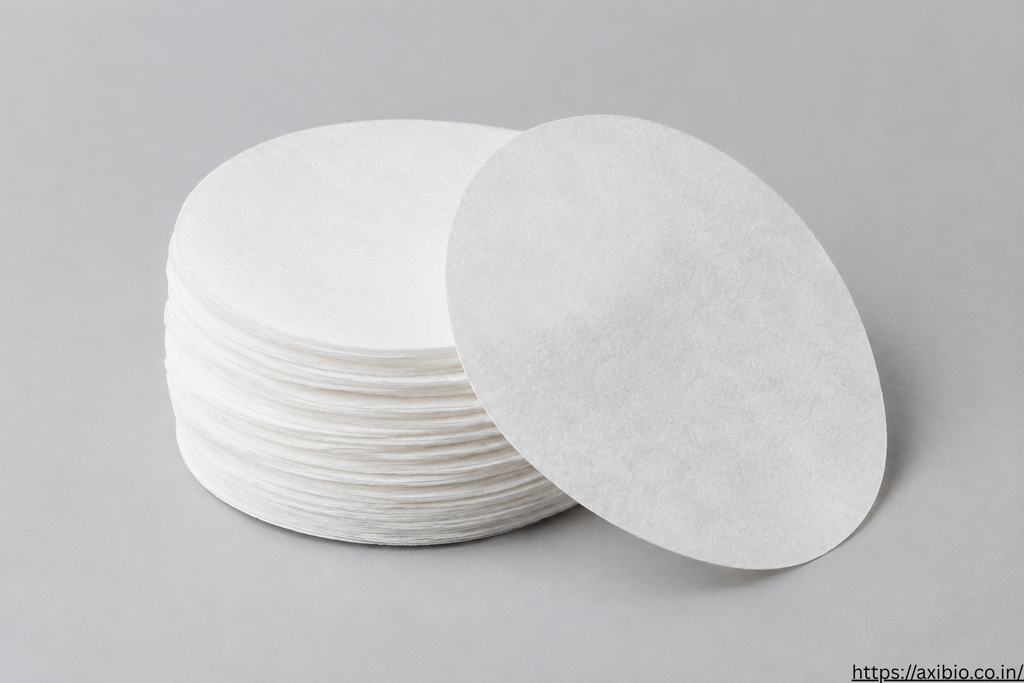
A filter paper is a sheet that has small pores and is made of cellulose and used to separate solid particles in a liquid or gas. The liquid flows through the paper while the solid particles remain trapped.
In laboratory settings, filter papers come in three basic shapes; circular, big sheets, or folded papers. Laboratory papers have the advantage of being made of pure cellulose fibers such as cotton linters. The arrangement of the fibers in filter paper creates small openings through which only certain particles will pass.
Lab papers have a variety of uses and different filter papers are suited for different purposes. A filter paper that is suitable for clarifying a water sample may not be ideal for weighing the sample.
Axibio’s filter paper page describes these products as cellulose sheets used to separate solids from liquids or gases. It lists use in chemical, pharmaceutical, microbiological, food, and environmental laboratories. You can see the range on the Axibio filter papers page.
How Do Filter Papers Work?
Filter papers function by allowing the liquid to pass through the interconnecting cellulose fibers as the solids remain deposited on the surface or within the paper.
When you add the sample to the filter paper, it will go through the spaces between the fibers under the influence of either gravitational force or vacuum. Solids that are larger in size than the spaces cannot pass through; even smaller solids may remain deposited due to their sticking ability. The resultant clear fluid is known as filtrate, and the solid remaining is called the residue or precipitate.
Some factors affecting this process include:
- Pore size and structure: Tighter paper holds back finer particles but slows the flow.
- Particle size and shape: Gelatinous or very fine precipitates can clog a paper quickly.
- Sample properties: Thick, viscous, or very concentrated samples flow slowly.
- Filtration method: Vacuum filtration is faster than gravity filtration but can stress thin paper.
- Paper thickness: Thicker paper can hold more solids but may drain more slowly.
For vacuum work, many labs pair filter papers with a funnel and a pump. Axibio also lists filter funnels and filtration assemblies and vacuum pumps. Our guide to filter funnel and assembly types explains how to match them.
What Are the Different Filter Paper Types?
There are three main kinds of filter papers, which are qualitative, quantitative (ashless), and special filter papers like wet strength or hard grade. Each of these is suited for different applications in the lab. Not all suppliers have each kind available.
Qualitative Filter Paper
Qualitative filter paper is a common grade of paper. It is applied when you have to filter a liquid without the necessity to weigh it afterwards, as well as in the case when you do not need the weight of the residue. It normally contains more ash than quantitative paper. Qualitative filter paper is applied on an everyday basis.
Features: high speed and retention variability, less expensive than ashless paper, and applicability to everyday laboratory filtering. Use it when your method does not require low ash.
Quantitative Filter Paper
Quantitative filter paper is intended for analytical applications that involve weighing or incineration of the residue. The paper is acid washed during its production to eliminate mineral impurities, thus resulting in the formation of little ash only. Ashless filter paper is frequently referred to as such.
Characteristics: low ash content, high purity, and reproducible results in each sheet. Select this filter paper if your method requires ashless or low ash paper (gravimetric analysis).
Ashless Filter Paper
Ashless filter papers result in a negligible amount of ash when they are burned. This is important in gravimetric analysis where the filter paper and the precipitate are burned to measure the residual ash. The additional ash caused by the burning of the filter paper would be included in the analysis.
General-Purpose Cellulose Filter Paper
Filter papers used in laboratories are mainly made from cellulose because it is inexpensive, easy to cut, and good for many types of solutions. However, cellulose filter paper is not ideal for all samples since some samples might dissolve or destroy it.
Fast, Medium, and Slow Grades
Paper is also categorized according to the rate at which liquids flow through the papers. Fast paper has bigger spaces while slow paper has smaller spaces. Fast paper is suitable for coarse and gelatinous particles while slow paper restricts fine crystals.
Wet-Strengthened and Hardened Papers
Some papers are reinforced for added strength when wet. Toughened papers are manufactured to be tear resistant and withstand vacuum or repeated washing. This is important in cases where tough filtration and precipitation steps are necessary. Please check the datasheet of each manufacturer as grades vary.
Other Filtration Media
If your work needs finer retention or chemical resistance beyond cellulose, other media may be better. Glass fibre and quartz fibre filters are examples. See Axibio’s glass fibre filters and cellulose thimbles for related products.
What Are Filter Papers Used For?
Filter paper is employed to separate the solid and liquid parts of solutions in filtration, chemical analysis, gravimetric analysis, and other similar laboratory practices.
Common filter paper uses include:
- Routine laboratory filtration: Clearing solutions, removing debris, and general clean-up of samples.
- Chemical analysis: Separating a precipitate from a solution before further testing.
- Gravimetric analysis: Collecting a precipitate, then drying or igniting it and weighing the result.
- Precipitate collection: Capturing crystals or solids after a reaction.
- Sample preparation: Preparing liquids before instrumental analysis.
- Educational and research laboratories: Teaching experiments and routine research work.
- Industrial quality-control laboratories: Testing raw materials and finished products.
Qualitative vs Quantitative Filter Papers
Ash content and use are the distinguishing factors. Qualitative filter paper is used for filtering purposes. Quantitative filter paper is ash-free and used for analysis work where the residue is weighed.
| Feature | Qualitative filter paper | Quantitative filter paper |
| Main purpose | Routine separation and clarification | Analytical work where residue is weighed or ignited |
| Ash content | Higher; not controlled for weighing | Very low; often called ashless |
| Typical uses | Sample clean-up, beverage and water sample filtration, general filtration | Gravimetric analysis, trace analysis, preparation for instrumental analysis |
| Purification | Standard cellulose processing | Usually acid-washed to remove minerals |
| Cost | Usually lower | Usually higher |
| Selection rule | Choose when ash does not affect the result | Choose when the method asks for low-ash or ashless paper |
It doesn’t necessarily mean that one is always better than the other. Quantitative research paper is useless for simple identification purposes. Qualitative research paper will ruin the gravimetric measurement. Quantitative analysis usually demands low ash or ash free paper; however, the analytical method will indicate when this is necessary.
Understanding Filter Paper Grades and Specifications
The properties of filter papers are basically determined by how the paper performs. The main properties include speed of filtration, particle retention, thickness, weight, ash, size, chemical resistance, and wet strength.
Pore Size, Filtration Speed, and Particle Retention
Particle retention gives information about the size of particles that the paper will retain. This is usually given in terms of size expressed in microns (µm) or described as fine or coarse crystals. Speed of filtration gives information about how fast the fluid will flow through.
The two properties are related, but different. Generally speaking, the finer the particles that the paper will retain, the slower the speed of filtration. However, the speed of filtration depends also on other properties of the filter paper. You should not evaluate filter paper based only on its pore size.
Key Properties to Check
- Filtration speed: Fast, medium, or slow. Match it to how fine your particles are and how long you can wait.
- Particle retention: The smallest particle the paper reliably holds. Confirm how the manufacturer defines it.
- Thickness: Measured in micrometres. Thicker paper usually holds more solids.
- Basis weight: Grams per square metre (gsm). It shows how heavy the paper is for its area.
- Ash content: The residue left after burning, shown as a percentage. Critical for gravimetric work.
- Diameter and format: Circles, sheets, or folded filters. Match the funnel size.
- Chemical compatibility: Whether the paper survives your solvents, acids, or alkalis.
- Wet strength: Resistance to tearing when soaked. Important for vacuum and washing.
Example: Specifications Published by Axibio
The table below shows values published on Axibio’s product pages for its R Series. Treat it as an example of how specifications are presented. Confirm current values with Axibio before ordering.
| Grade | Type | Filter speed | Ash content | Note on page |
| 100R | Qualitative | Medium fast | Below 0.1% | Described as closely similar to grade 1 |
| 103R | Qualitative | Slow | Below 0.06% | Described as closely similar to grade 3 |
| 104R | Qualitative | Fast | Below 0.06% | Described as closely similar to grade 4 |
| 400R | Quantitative | Medium | Below 0.007% | Described as closely similar to grade 40 |
| 410R | Quantitative | Fast | Below 0.007% | Described as closely similar to grade 41 |
| 420R | Quantitative | Slow | Below 0.007% | Described as closely similar to grade 42 |
The phrase closely similar is not a guarantee of identical performance. Grade numbers belong to each manufacturer’s own system. One maker’s grade 1 is not automatically the same as another’s. Compare datasheets, not just numbers.
How to Choose the Right Filter Papers for Your Laboratory
To choose the right filter papers, define your purpose, decide between qualitative and quantitative, then match retention, speed, compatibility, size, and documentation. Work through these steps in order.
- Identify the purpose of filtration. Are you clearing a liquid, collecting a precipitate, or preparing a sample? The goal decides everything that follows.
- Decide whether qualitative or quantitative paper is needed. If the residue will be weighed or ignited, use low-ash or ashless paper as the method requires. If not, qualitative paper is usually enough.
- Check the required particle retention. Fine crystals need a tighter paper. Coarse or gelatinous solids need a more open one. Use the method’s guidance when available.
- Consider filtration speed. A slow paper gives clearer filtrate but takes longer. A fast paper saves time but may let fine particles pass. Pick the best balance for your work.
- Confirm chemical compatibility. Check that your solvent or solution will not weaken or dissolve the paper. Ask the supplier when unsure.
- Select the diameter and format. The paper should fit the funnel with the edge sitting just below the rim. Sheets can be cut to size; circles are ready to use.
- Verify specifications and documentation. Ask for a datasheet that lists retention, speed, ash, thickness, and weight. Ask what quality documents are available.
- Compare quality, availability, packaging, and total cost. The lowest price is not always the lowest cost if the paper clogs or fails.
If you are still unsure, test two grades on a small sample and compare results. Many suppliers can advise on this.
What Affects Filter Paper Price?
The cost of filter papers varies depending on the kind of paper, grade, size, quantity, and standards needed. Prices fluctuate frequently; thus, they cannot be provided here. Request for quotations from all suppliers.
Main price factors:
- Paper type and grade: Quantitative and hardened papers usually cost more than general-purpose qualitative paper because of extra processing.
- Material and manufacturing quality: Higher purity fibre and tighter process control cost more.
- Diameter, thickness, and dimensions: Larger and thicker papers use more material.
- Filtration speed and retention: Specialised speed or fine retention can add cost.
- Ash content and special performance: Very low ash or high wet strength requires extra treatment.
- Pack size and quantity ordered: Larger orders often lower the cost per sheet.
- Brand, supplier, and availability: Stock levels, shipping, and brand all play a part.
- Documentation and quality needs: Batch records or certificates may affect the quote.
How to Compare Quotations Fairly
Ensure that you clearly distinguish between pack prices and sheet prices. Axibio shows product descriptions with quantities such as 100 circles per pack for many products; hence, the pack prices should be divided by the quantities to get the comparative prices. The grade, diameter, and pack sizes must be consistent for all the quoted prices.
How to Choose a Reliable Filter Paper Manufacturer
A reliable filter paper manufacturer or supplier gives clear specifications, consistent batches, useful documents, and dependable delivery. Check these points.
- Clear product specifications: Datasheets should list retention, speed, ash, thickness, and weight.
- Consistency between batches: Ask how the supplier keeps performance steady from one lot to the next.
- Relevant quality documentation: Ask which certificates or test reports can be provided for the grade you need.
- Availability of grades and sizes: Confirm that the exact grade and diameter you use are available.
- Technical support: A knowledgeable team can help you pick a grade or solve clogging problems.
- Product traceability: Where offered, batch numbers help you track problems.
- Packaging and storage standards: Paper should arrive clean, dry, and well protected.
- Lead times and supply reliability: Ask about typical delivery times and stock.
- Transparent quotations and order terms: Pricing, minimum orders, and delivery terms should be clear.
How to Compare Filter Paper Suppliers
Compare suppliers on the same specifications, the same grade and size, and the full cost of delivery. A simple method is to build a side-by-side sheet.
List for each supplier:
- Grade, retention, speed, and ash percentage
- Size, form, and pack quantity
- Documents for quality supplied
- Stock status and delivery time
- Shipping conditions and freight charges
- Cost per pack and cost per sheet
- Technical assistance and after-sales service
Ask for samples if you are changing supplier. Run them against your current paper on the same sample. Check flow time, clarity of filtrate, and any tearing. Keep notes so the decision rests on data. If you order other items together, such as funnels or vials, ask whether delivery can be combined. Axibio’s product catalogue can help you see related items.
Common Mistakes to Avoid When Buying Filter Papers
Avoid these common errors:
- Choosing based on cost alone. An inexpensive paper that jams or breaks slows down work and wastes samples.
- Neglecting filtration rate. A slow paper causes delay. A fast paper allows passage of particles.
- Choosing an improper retention grade. Choose appropriate retention depending on particle size.
- Using common qualitative filter paper where ashless paper is required by the procedure. This can affect gravimetric analysis.
- Neglecting chemical resistance. Some fluids cause deterioration or degradation of cellulose paper.
- Choosing an improper diameter. Papers that are either too small or too big will not fit the funnel.
- Comparing different papers without considering specifications. Similar brand names do not necessarily imply similar quality.
- Improper storage of paper. Wet or dusty paper may lead to inaccurate results.
Filter Paper Storage and Handling
Store filter papers flat, dry, and clean, in their original packaging, away from moisture, dust, and chemical fumes.
Cellulose absorbs moisture from the air. Damp paper can change weight, which matters in gravimetric work. Keep packs closed until you need them. Store them in a cool, dry cabinet away from solvents and acids, whose fumes can affect the paper.
Good handling habits:
- Wear clean gloves or use clean forceps.
- Do not touch the filtering area with bare hands.
- Keep the pack flat so edges do not curl or crease.
- Take out only what you need and reseal the pack.
- Follow the manufacturer’s storage guidance on the label or datasheet.
If a method needs dry paper of known weight, follow its drying and conditioning steps.
Frequently Asked Questions
1. What are filter papers used for?
These filter papers are used for separating solids from liquids and gases. These are used in various ways like filtration processes in laboratory practice, chemical analysis, gravimetric analysis, precipitate separation and sample preparation.
2. What are the main filter paper types?
Types include qualitative filter paper, quantitative or ashless filter paper, as well as special varieties like wet strength or hardening filter paper. There is also classification according to speed fast to slow. Not all manufacturers offer all types.
3. What is the difference between qualitative and quantitative filter paper?
Use qualitative filter paper when you need to filter in a general process without worrying about the ash content. For quantitative filtration, use low-ash or ashless filter paper since the analysis requires weight measurement of the residue.
4. What is ashless filter paper?
Ashless filter paper is a highly purified type of paper which results in negligible ash upon combustion. It is used for gravimetric analysis where additional ash from the paper may interfere with the outcome. It is usually available in quantitative form.
5. How do I select the correct filter paper grade?
Begin with your goal, then confirm that the method requires an ashless filter paper. Ensure that the retention capacity and filtration rate suit your sample. Check for chemical compatibility and particle size.
6. What affects filter paper price?
The price varies based on paper type, grade, material quality, size, thickness, ash content, pack size, amount, brand, availability, and documentation. Compare the price per sheet instead of price per pack and ask for quotes of similar grade and size.
7. How does filtration speed affect filter paper selection?
Fast papers are fast runners but retain large particles. Slow papers retain fine particles but take longer to filter out the solution. Select the fastest paper that is capable of retaining your particles.
8. What does filter paper retention mean?
Retention is the largest size of particle that a sheet of paper can retain. It can be stated in microns or coarse or fine. Different manufacturers define it differently; therefore, one should find out how each manufacturer defines it.
9. How do I choose a filter paper manufacturer?
Check for proper specifications, batch consistency, quality-related documentation, required grades and sizes, technical assistance, and delivery. Request datasheets and samples, and also make sure to request quotations on the same specification.
10. Can the same filter paper be used for every laboratory application?
Not really. Various techniques require varying degrees of moisture content, reaction rate, ash content, and strength. A paper filter that is appropriate to use when clarifying a solution will not work in gravimetry.
Looking for the Right Filter Papers for Your Laboratory?
Find filter papers that match your laboratory’s filtration needs, sample type, and required specifications. Explore Axibio’s range of filter papers to review available options for your application.
Need help selecting the right grade, size, or pack quantity? Contact Axibio to discuss your requirements and request a quotation.