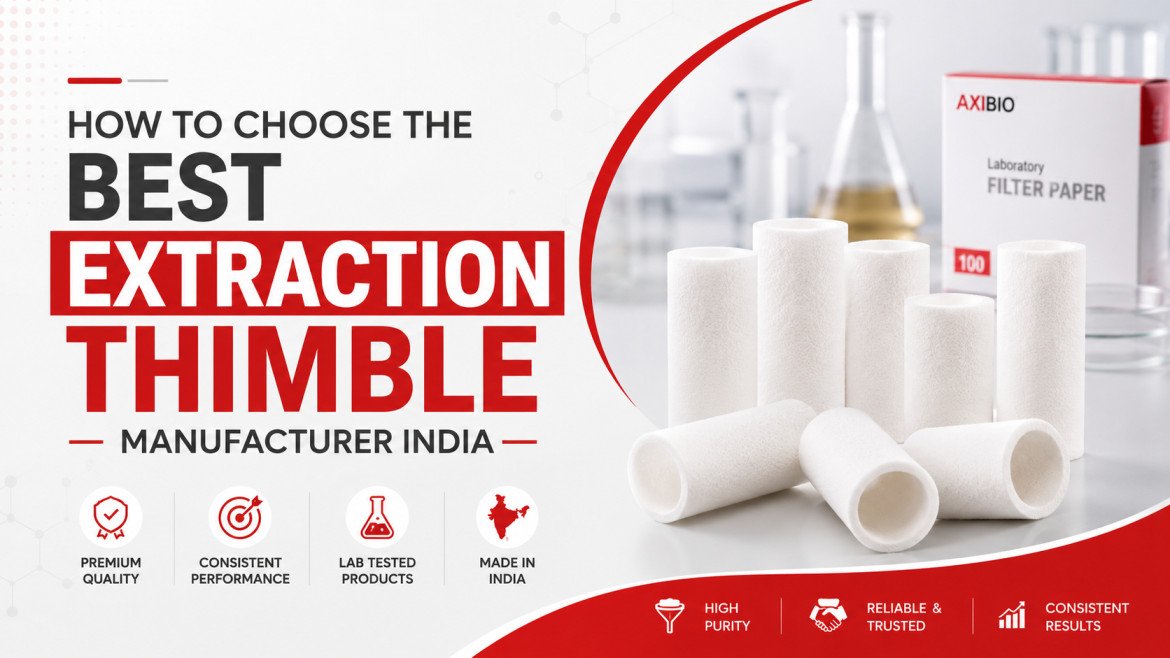
It is necessary to consider the choice of a reputable extraction thimble manufacturer in India in case laboratories, research institutes, pharmaceuticals, or testing organizations use accurate extraction procedures. Extraction thimbles of good quality are used in such areas as Soxhlet extraction, chemical analysis, food testing, environment research, and pharmaceutical labs. A trustworthy cellulose extraction thimble supplier in India guarantees excellent filtration results, purity, and accuracy of laboratory results.
What Is an Extraction Thimble?
The extraction thimble is basically a cylindrical filter that is usually made of high purity cellulose or another material specially designed. An extraction thimble serves to contain the solid samples during the process of solvent extraction but allows the solvent to flow freely through the filter. They are most often used in the Soxhlet extraction system to extract analytes from solids.
They have certain advantages such as strength and proper porosity.
Why Do Extraction Results Go Wrong?
Failure in extraction processes has been linked to the solvent, temperature, or sample preparation, although a thimble can also be the cause that is often overlooked. Some of the most common problems arising from bad thimbles are:
- Fibers falling off cellulose fibers from the thimble can get into the extract and alter the results of gravimetric and chromatographic tests
- Rupture of the thimble during processing because of abrasive or heavy samples
- Irregularity of pores that lead to the inconsistency of solvent flow and incomplete extraction
- Inadequate wet strength the thimble disintegrates under prolonged reflux conditions
- Variability of batches that prevents reproducibility of results in subsequent tests
In laboratories that conduct regulatory, pharmaceutical, or QC testing, any one of these problems would make the test invalid and lead to expensive retesting, making thimble quality as important as solvent purity and equipment calibration.
How Extraction Thimbles Work in Soxhlet Extraction
The sample is held within the thimble in the Soxhlet apparatus, which is contained in the extractor chamber. The solvent steam condenses and trickles down into the sample several times, thereby dissolving the desired analyte, but the solid particles are held back by the thimble pores. An ideal thimble should:
- Withstand multiple wet-dry cycles without deteriorating
- Maintain constant porosity for predictable solvent flow rate
- Resist chemical reaction with usual solvents (hexane, ethanol, toluene, dichloromethane)
- Generate zero or very low amounts of fiber waste in the extracted product
This explains why the purity of raw materials used and the process of production have an effect on whether a laboratory obtains good results.
Applications of Cellulose Extraction Thimbles
Extraction thimbles are widely used across multiple industries and research sectors, including:
- Pharmaceutical laboratories
- Chemical analysis
- Food and beverage testing
- Environmental testing
- Agricultural research
- Biotechnology laboratories
- Academic institutions
- Petrochemical laboratories
- Quality control departments
Their versatility makes them an essential laboratory consumable for sample preparation and solvent extraction.
Cellulose vs. Glass Fibre vs. Quartz Thimbles: Which One Do You Need?
| Thimble Type | Best For | Key Strength | Limitation |
| Cellulose | General Soxhlet extraction, food & agricultural testing | Cost-effective, widely compatible with organic solvents | Not suitable for strong acids/alkalis |
| Glass Fibre | High-temperature extraction, environmental testing | Excellent thermal stability, low fibre shedding | Higher cost than cellulose |
| Quartz | Extreme temperature or highly corrosive applications | Superior chemical and thermal resistance | Most expensive, used for specialized applications only |
Applications of Cellulose Extraction Thimbles
Extraction thimbles are commonly employed in various fields, such as:
- Pharmaceutical laboratories
- Chemical analysis
- Food and beverage testing (fat content, oil extraction)
- Environmental testing (soil and sediment analysis)
- Agricultural research
- Biotechnology laboratories
- Academic institutions
- Petrochemical laboratories
- Quality control departments
Their versatility makes them an essential laboratory consumable for sample preparation and solvent extraction.
How to Choose the Right Supplier
Before selecting a manufacturing partner, laboratories should evaluate product quality, manufacturing standards, and technical expertise.
High-Quality Cellulose
Choose suppliers that manufacture extraction thimbles using premium cellulose to ensure purity, durability, and consistent filtration performance.
Product Consistency
Uniform dimensions, thickness, and porosity are essential for achieving repeatable laboratory results.
Wide Product Range
A manufacturer offering multiple sizes and specifications can better support different laboratory extraction requirements.
Reliable Technical Support
Experienced suppliers can recommend the most suitable extraction thimble based on solvent type, sample characteristics, and laboratory procedures.
Complete Laboratory Filtration Solutions
Most prominent suppliers also offer an extensive variety of filtration products for laboratories, such as filter papers, membrane filters, glass fiber filters, syringe filters, filtration assemblies, extraction thimbles, as well as other laboratory consumables. The cooperation with one supplier facilitates the process, guarantees the same quality of the goods, and increases laboratory effectiveness, eliminating the inconvenience associated with dealing with several suppliers, whose specifications do not match and who do not have their own quality certificates.
There are several parameters that determine the choice of a proper filter: what exactly is being filtered (particulates, microorganisms, or solid substances for extraction), the required pore size according to the technique (usually 0.45 µm for clarification and 0.22 µm for sterilization), chemical compatibility of the material of the filter with the solvent (PTFE for aggressive organics and nylon/PES for aqueous samples), as well as the sample volume. If any of these parameters are chosen incorrectly, contamination of the sample, clogging of the filter, or incorrect results may occur. That is why choosing a company that offers assistance and advice together with a wide range of filtration products can be helpful.
Final Thoughts
Choosing the right extraction thimble manufacturer India is essential for laboratories that require reliable and accurate extraction processes. A trusted cellulose extraction thimble supplier India delivers high-quality products that support precise analytical testing, efficient sample preparation, and consistent laboratory performance. By partnering with an experienced manufacturer, organizations can improve testing accuracy, maintain quality standards, and ensure dependable results across pharmaceutical, chemical, environmental, food, and research applications.