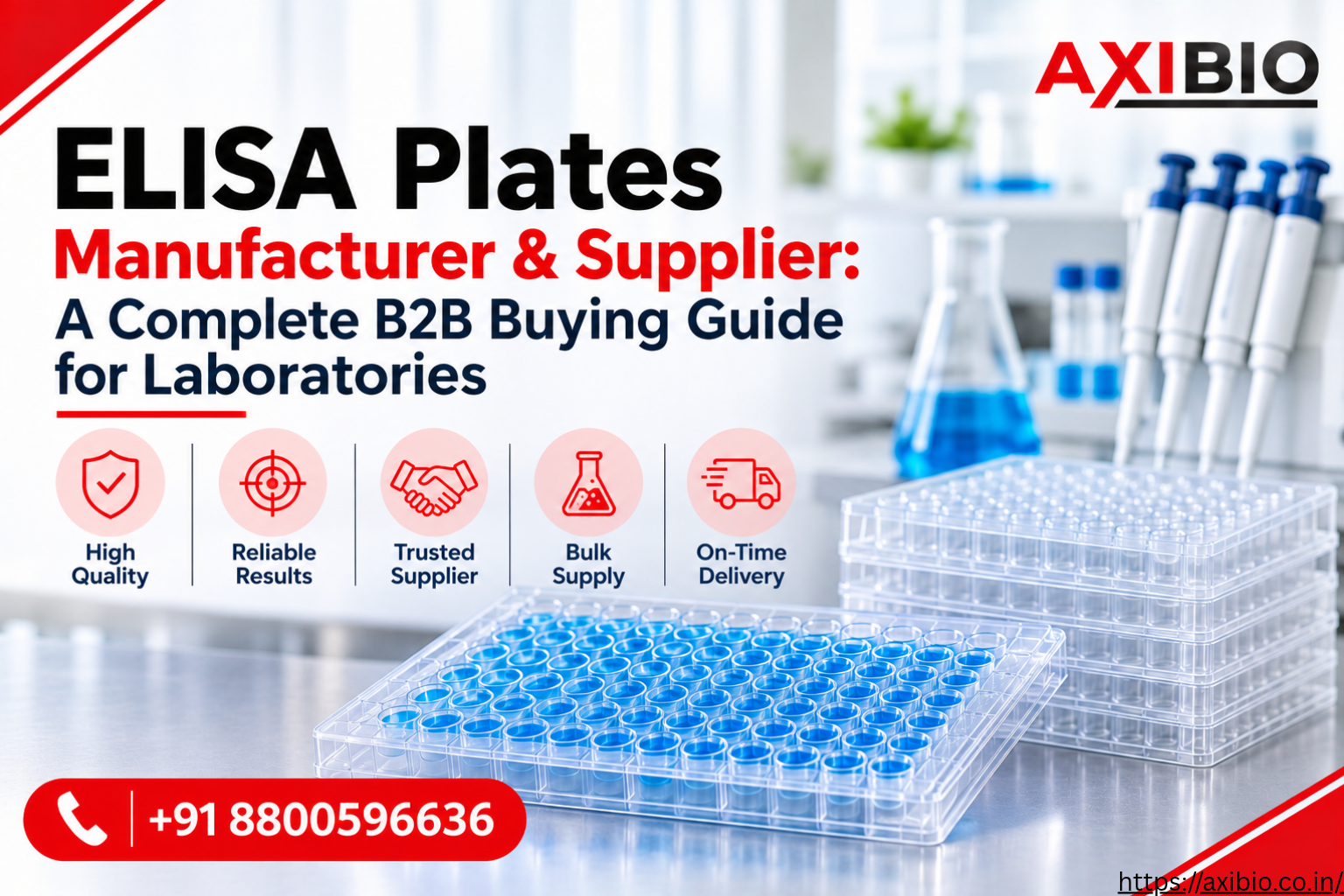
Elisa Plates form the core of any ELISA Assay. The antigen or antibody gets attached to the well plate initially, and all subsequent stages will depend upon the effectiveness and evenness of this process. An ineffective plate translates into high background, uneven wells and re-runs.
The factors considered while procuring ELISA Plates include binding properties, specifications, compatibility with lab equipment and trustworthiness of manufacturer/supplier. This Buying Guide details each of these in simple language. It has been compiled for procurement professionals, laboratories and distributors evaluating any ELISA Plates Manufacturer or ELISA Plates Supplier in India.
Axibio, a Delhi-based laboratory products company, offers ELISA Plates in high binding and moderate binding versions. The buying advice below applies to any supplier you evaluate.
What Are ELISA Plates?
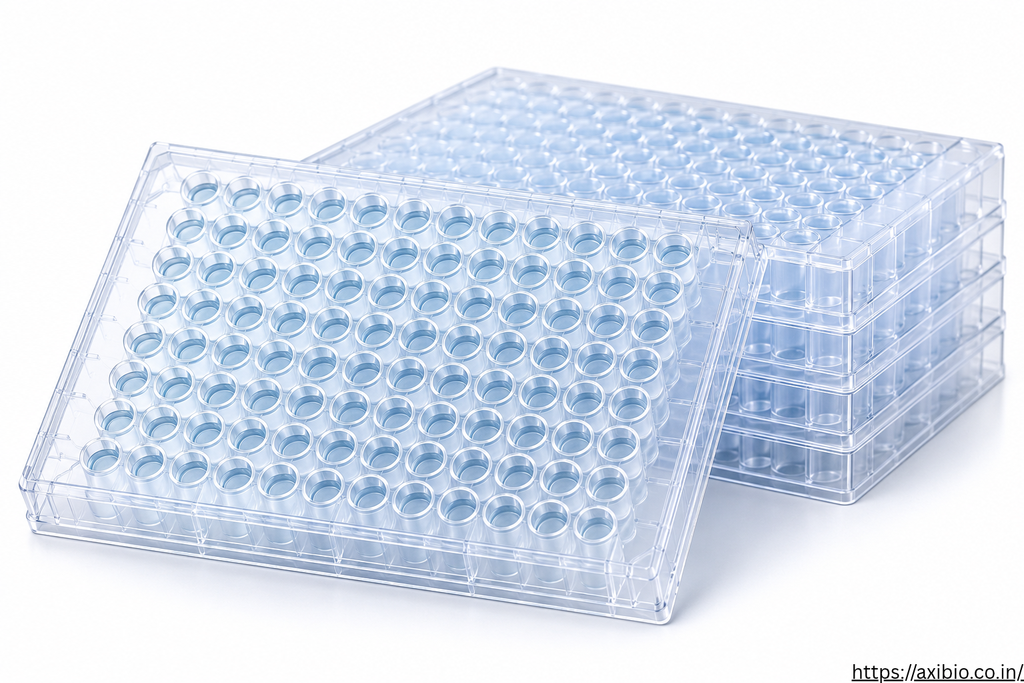
Elisa Plates are microplates made from polystyrene with 96 wells used to conduct ELISA. The wells act as miniature reaction vessels where a particular protein is adsorbed to the surface and detected.
Polystyrene is used because of its inherent ability to adsorb proteins passively and its optical clarity. Elisa Microplate Protocol:
- Coat: the antigen or capture antibody binds to the well.
- Block: BSA, skim milk or a similar agent covers the empty surface.
- Detect: samples and enzyme-labelled antibodies are added, with washes between steps.
- Read: a substrate creates a colour or light signal that a plate reader measures.
The plate affects both the first step (binding) and the last (reading). That is why laboratories need plates that bind evenly across wells and stay consistent from batch to batch.
Types of ELISA Plates
ELISA Plates differ by binding level, format, bottom shape and colour.
- High Binding ELISA Plates: treated surface that holds more protein. Suited to small or medium proteins and sensitive assays. Needs good blocking to control background.
- Moderate Binding ELISA Plates: also called medium binding. Holds less protein and suits larger proteins such as antibodies. Often gives lower background.
- Low Binding plates: designed to stop protein sticking. Used for sample preparation and dilution, not as the coated ELISA surface.
- Fixed vs detachable: fixed plates are one piece and suit automation. Detachable plates use removable strips, so you use only the wells you need.
- Flat bottom: the standard for ELISA, as it gives an even light path for readers.
- Colour: clear for colorimetric assays (such as TMB read at 450 nm), white for chemiluminescence, black for fluorescence.
High Binding vs Moderate Binding ELISA Plates
Higher binding plates have more protein capacity, even small molecules, because of their unique surface. Medium binding plates use the hydrophobic property of polystyrene surface only, and are ideal for large proteins.
| Factor | High Binding ELISA Plates | Moderate Binding ELISA Plates |
| Surface | Treated polystyrene | Little or no extra treatment |
| How proteins bind | Hydrophobic plus ionic/hydrophilic | Mainly hydrophobic |
| Binding capacity | Higher | Lower to medium |
| Best suited to | Small to medium proteins, weak binders | Large proteins such as IgG |
| Background risk | Higher if blocking is weak | Usually lower |
| Typical use | Sensitive, low-abundance targets | Routine assays, antibody coating |
How to choose: follow your kit or protocol first, as changing the surface may need revalidation. For a new assay, test both surfaces before buying in bulk, and ask the supplier for stated binding capacity (in ng IgG/cm²).
Why 96 Well ELISA Plates Are the Standard
96 Well ELISA Plates are used almost everywhere because nearly all readers, washers and multichannel pipettes are built for them. The wells sit in an 8 × 12 grid (rows A–H, columns 1–12), so every well has a clear address.
One plate holds standards, controls, blanks and samples in duplicate. Strip formats help when daily sample numbers change; fixed plates suit high-throughput and robotic work.
Before ordering, confirm the format, binding level, colour, clear well markings, standard footprint and that strips stay level during washing.
ELISA Plate Specifications Buyers Should Check
Always ask for a technical data sheet. If a supplier cannot provide these details, treat it as a warning sign.
| Specification | What to check |
| Material | Polystyrene grade; certifications such as USP Class VI (biocompatibility) |
| Binding capacity | Stated in ng IgG/cm²; surface treatment type |
| Format | 96 wells; fixed or strip |
| Bottom shape | Flat bottom for optical reading |
| Optical uniformity | Low variation in light transmittance across wells (CV) |
| Dimensions | SBS/ANSI standard footprint (about 127.76 × 85.48 mm) |
| Sterility and purity | Sterile or non-sterile; DNase/RNase-free; non-pyrogenic |
| Packaging | Sealed packs, pack size, storage conditions |
| Documentation | Lot number, data sheet, certificate of analysis |
Applications of ELISA Microplates
ELISA Microplates are used wherever proteins, antibodies or antigens must be measured:
- Diagnostic and pathology labs, hospitals: infectious disease markers, hormones and other clinical tests.
- Pharmaceutical research: biomarkers, anti-drug antibodies and binding studies.
- Biotechnology: antibody screening, protein expression and purity checks.
- Immunology and life sciences: cytokines, antibody titres and immune responses.
- Academic and clinical research: teaching labs and study sample analysis.
- ELISA kit manufacturers: plates are a core kit component, so batch consistency is critical.
How to Choose an ELISA Plates Manufacturer
Choose an ELISA Plates Manufacturer that can prove its quality with data, not just describe it. Check these points:
- Specifications: binding capacity, material, format and dimensions clearly stated. Listings that say only “plastic, different sizes” are not enough.
- Quality control: what is tested per batch: binding, optical uniformity, sterility, dimensions.
- Batch-to-batch consistency: critical for kit makers and validated assays.
- Documentation: data sheets, material certificates and lot numbers on every pack.
- Supply capacity: can they meet your yearly volume, not just a trial order?
- Technical support: can they advise which surface suits your assay?
- Fulfilment: typical dispatch times and how delays are communicated.
A manufacturer makes the plates; a supplier may resell them. Either can work well, as long as you know the source and the specifications are documented.
How to Evaluate an ELISA Plates Supplier in India
A good ELISA Plate Supplier in India offers clear product data, steady stock and responsive support. When comparing any ELISA Microplate Supplier, look at:
- Product range: high and moderate binding, fixed and strip formats from one source.
- Pricing transparency: written quotes with taxes, freight and pack sizes.
- Bulk and repeat orders: clear pack sizes and scheduled supply options.
- Packaging and delivery: plates packed to travel safely across India.
- Support: a named contact, phone and email for sales and technical queries.
- Traceability: a verifiable business address and registration details.
Buying Bulk ELISA Plates: Factors and Checklist
Bulk ELISA Plates involve a long term investment; hence you should be sure about the type of product and the manufacturer before placing your order. The important considerations include format of the plates, binding, volume, compatibility, documentation, storage and delivery.
Buyer checklist:
- Binding level confirmed for each assay
- Fixed or strip format decided
- Plate colour matches detection method
- Samples tested on your own assay
- Technical data sheet and lot documentation received
- Fit with reader and washer checked
- Pack size and order quantity confirmed
- Storage conditions planned
- Price, taxes, freight and delivery time agreed in writing
How to Compare ELISA Plates Manufacturers in India
Ask every shortlisted supplier the same questions and compare the answers side by side.
| Comparison point | A good answer looks like |
| Product specifications | Clear figures on a data sheet |
| Quality documentation | Certificates and lot traceability shared on request |
| Availability | Regular stock of the variants you need |
| Bulk supply | Confirmed capacity for your yearly volume |
| Communication | Quick, specific replies from a named contact |
| Technical help | Practical advice linked to your assay |
| Commercial terms | Written quotation with full pricing and payment terms |
Run the same assay on samples from each supplier, and compare cost per usable well rather than price per plate.
Common Procurement Mistakes
- Ignoring binding properties: match high or moderate binding to your protein and protocol.
- Skipping compatibility checks: confirm colour, bottom shape and format against your method and kit.
- Buying on price alone: failed runs and repeats cost more than a better plate.
- Not asking for specifications: avoid listings without binding capacity or material details.
- Poor storage: keep plates sealed and away from dust and moisture.
- Not confirming stock: check availability before planning a large project.
- Not verifying the supplier: confirm address, contacts and registration first.
Why Supplier Reliability Matters
ELISA Microplate Supplier is what you need for reliable assays and smooth lab work. This way, you have the same quality each time, reduced risks of stockouts, traceability of lots for any audit requirements, and stable pricing for budgeting purposes. Any change in the type of plate halfway through your research may require revalidation.
Why Consider Axibio
Axibio is a Delhi-based laboratory products company offering filtration products, chromatography essentials, laboratory plasticware, general lab products and benchtop instruments. The company states it has over 30 years of industry experience and has served clients in more than 50 countries.
According to its ELISA Plates product page, Axibio’s plates are 96 well and flat bottomed, made from USP Class VI GPPS and HIPS material, with alphanumeric well markings and SBS-standard dimensions. They are irradiation-sterilised to SAL 10⁻⁶ and are DNase/RNase-free and non-pyrogenic.
| As stated by Axibio | High Binding | Moderate Binding |
| Binding capacity (IgG) | 300–400 ng/cm² | 200–300 ng/cm² |
| Transmittance CV | < 5% | < 5% |
| Suggested samples | Proteins > 10 kD | Proteins > 20 kD |
| Formats | Detachable or fixed | Detachable or fixed |
| Pack size | 100 plates | 100 plates |
The product page also lists catalogue numbers, pack pricing and recommended blocking agents.
Sourcing ELISA Plates for your lab, kit production or distribution? Review the ELISA Plates variants, then submit an enquiry, call +91 8800596636 or email sales@axibio.co.in for specifications, bulk quantities and a quotation.
Frequently Asked Questions About ELISA Plates
1. What are ELISA Plates used for?
ELISA Plates are used to run enzyme-linked immunosorbent assays that detect and measure proteins, antibodies, antigens and hormones. They are used in diagnostic labs, pharma and biotech research, immunology and academic labs.
2. What are 96 Well ELISA Plates?
They are microplates with 96 wells in an 8 × 12 grid. This is the standard ELISA format and fits most plate readers, washers and multichannel pipettes. They come as fixed plates or detachable strip plates.
3. What is the difference between High Binding and Moderate Binding ELISA Plates?
High Binding ELISA Plates have a treated surface that holds more protein and suits smaller or weakly binding molecules. Moderate Binding ELISA Plates hold less protein, suit larger proteins such as antibodies, and often give lower background.
4. How do I choose the right ELISA Plates for my laboratory?
Follow your assay protocol first. Then match binding level to your protein, plate colour to your detection method and format to your sample numbers. Test samples before buying in bulk.
5. What specifications should buyers check before purchasing ELISA Microplates?
Check material, binding capacity, format, bottom shape, optical uniformity, SBS dimensions, sterility and lot documentation.
7. Where can I buy ELISA Plates in India?
From laboratory product manufacturers, authorised distributors and scientific suppliers that publish clear specifications. Axibio lists its high and moderate binding ELISA Plates on its product page and accepts enquiries online.
8. How do I find a reliable ELISA Plates Manufacturer in India?
Shortlist manufacturers that share technical data, explain their quality control and offer lot traceability. Test their samples in your own assay and confirm supply capacity in writing.
What should I check before ordering Bulk ELISA Plates?
Confirm binding level, format, yearly quantity, pack size, storage needs, delivery time and documentation. Test a sample batch first.
9. Are all ELISA Microplates suitable for every ELISA assay?
No. Target size, detection method and protocol all affect which plate works best. Revalidate if you change plate type.
10. What is the difference between fixed and detachable ELISA Plates?
Fixed ELISA Plates are moulded as one solid piece. They suit full-plate runs, high-throughput testing and automated systems. Detachable ELISA Plates have removable 8-well strips held in a frame, so you can use only the wells you need and save the rest for later. Choose fixed plates for large, regular batches and detachable plates when sample numbers change from day to day.
Looking for a Reliable ELISA Plates Supplier in India?
Finding the right ELISA Plates for your laboratory starts with choosing a supplier who understands your product and procurement requirements. Whether you need 96 Well ELISA Plates, High Binding ELISA Plates, Moderate Binding ELISA Plates, or bulk quantities, Axibio can help you explore suitable laboratory product options.
Visit the ELISA Plates product page to review the available products. For product specifications, pricing, bulk orders, or supply enquiries, connect with the Axibio team.