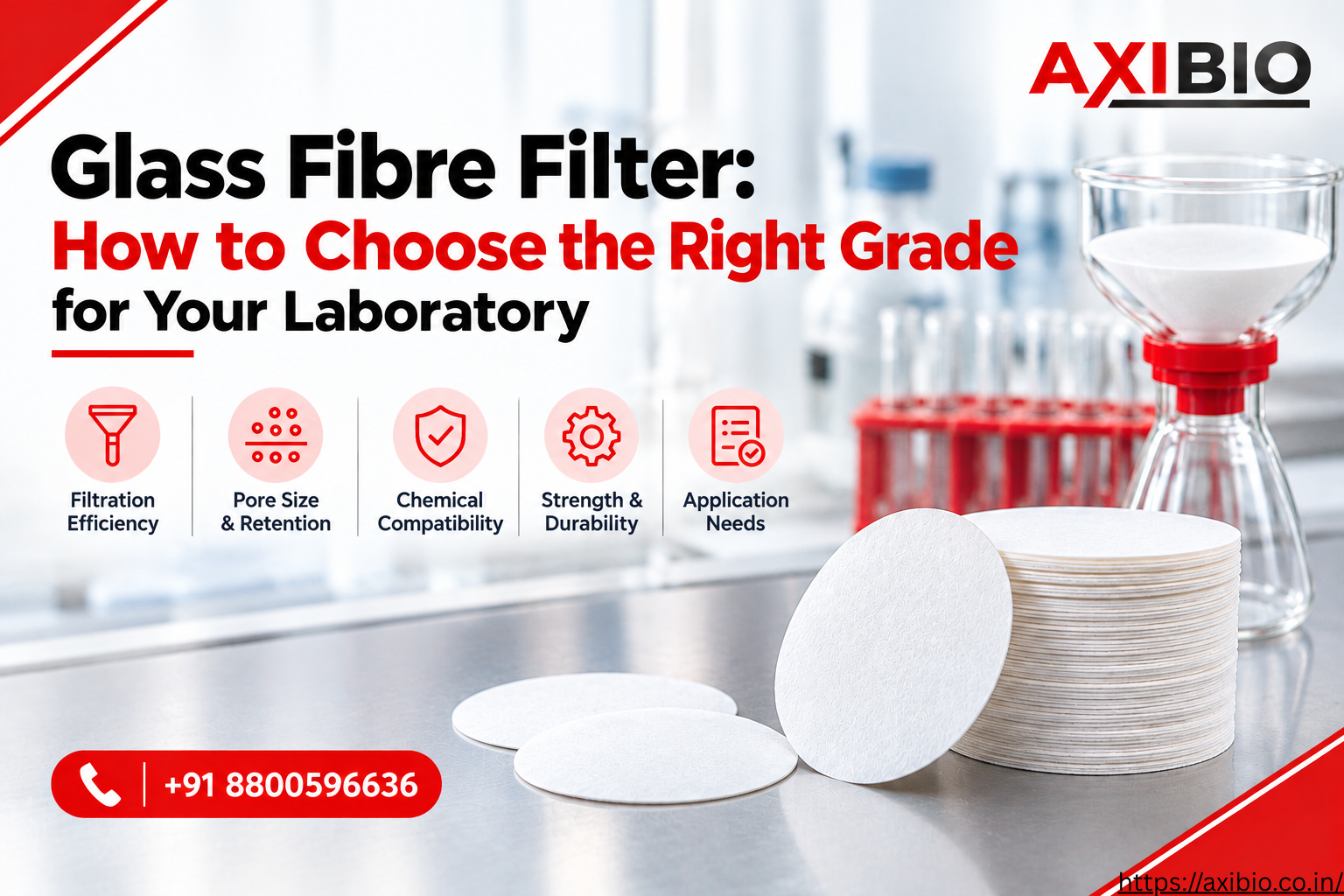
Choosing the wrong glass fibre filter results in the problems arising quickly. Filters that are too porous allow fine particles to be trapped in the filtrate. Filters that are too dense tend to clog sooner, slowing down the process and potentially affecting the results of the analysis if the sample is left to sit too long. In both cases, you waste time and might have to repeat the process.
Despite their outward similarity, GF/1F, GF/3F and GF/5F are not interchangeable. They all differ in terms of retention rating, thickness, weight and air-flow rate. The correct selection depends on the procedure used, the particles that must be isolated and the amount of sample that needs to be filtered.
Here you will find information about glass fibre filtration principles and the differences between the three types of filters using the published specifications of Axibio. We will also discuss the criteria to consider when choosing glass fibre filters from any manufacturer or glass fibre filter supplier. Axibio produces a wide range of glass fibre filters for laboratory, environmental and analytical applications.
What Is a Glass Fibre Filter?
Glass fibre filters are porous membranes consisting of very thin glass fibres, randomly oriented to form a layered structure. The liquid or gas moves through the spaces between the fibres while the particles remain trapped in the membrane. This type of filter provides quick filtration, good capacity, and much higher resistance to high temperatures than cellulose filter paper.
The product may also be referred to as glass fibre filter paper, glass microfibre filter, or glass fibre filter media. All of these names refer to essentially the same concept an artificial filter based on glass fibres rather than cellulose.
How Does Glass Fibre Filtration Work?
Glass fibre filters operate on the principle of depth filtration. Filtration of the particles takes place at all layers of the fibre web and not only on the upper surface. This explains why glass fibre filters have greater solid-holding capacity than surface filters.
Here is the process step by step:
- The sample arrives at the filter. A liquid is added, or air is pulled, across the flat filter, generally by means of gravity, vacuum, or pressure.
- Large particles remain on the surface. Larger particles than the spaces between the fibres get trapped at the surface.
- Smaller particles penetrate into the web. While passing through the webs, the particles collide with the fibres and attach, or become entangled at the junctions of the fibres.
- Particles form a cake. The particles trapped on the web form a cake, which also serves as a filter. It increases trapping efficiency but reduces the speed of filtration.
- Filtrate moves from the filter. The filtered liquid or air is removed from the filter.
Two points matter in practice:
- Retention and flow act against each other. The finer the grade for retention, the more resistant the grade is to flow.
- The sample will influence the result. Adhesive, gel-like or highly concentrated samples will be capable of clogging the surface soon enough, regardless of the open grade used.
Main Properties of Glass Fibre Filter Media
There are a few key attributes that all fiberglass filters have. Understanding each of these will assist you in interpreting a specification sheet.
Particle Retention
Particle retention gives information about the particle size that the filter is intended to remove. GF/1F is rated at 1.6 µm, GF/3F at 1.2 µm and GF/5F at 0.7 µm. These are nominal values. Nominal values mean that the majority of the particles of the stated value are removed, not all. Glass fibre filters don’t have a definite cut-off value like screens.
“DOP retention 99.9%” is what is stated for all three grades. This tests the ability of the filter to remove an aerosol in the air. It is good for air sampling, but it’s not the same test as particle retention of the liquid. Contact the manufacturer if your method relies on liquid retention value.
Filtration Speed and Air Flow
Filtration speed refers to how quickly fluid goes through the filtration system. Flow rates of the air are given in seconds for 100 ml of air going through: over 4.3 seconds for GF/1F, over 6.8 seconds for GF/3F, and over 19 seconds for GF/5F. The greater the number of seconds, the greater the resistance. This is a good indication of the flow rate of your liquid, however.
Loading (Particle-Holding) Capacity
Loading capacity is the amount of solid material that can be trapped by the filter until the flow rate decreases. Depth filtration provides high loading capacity to glass fiber. Thick and heavy materials can usually have higher loading capacity, but sometimes a fine structure may cause plugging earlier.
Thickness and Basis Weight
Thickness and basis weight (grams per square meter or gsm) measure the amount of glass present in the filter paper. GF/1F has thickness of 250-300 µm and basis weight of 50-56 gsm, GF/3F has thickness of 250-280 µm and basis weight of 50-56 gsm, while GF/5F has thickness of 410-430 µm and basis weight of 70-80 gsm.
Mechanical Handling
Glass fibre is more delicate compared to other membrane types. Flat forceps should be used along with ensuring that the membrane rests flat on a holder. Loose fibers from the membrane can alter the weight in gravimetric tests.
Temperature and Chemical Compatibility
According to the product range, the maximum allowable temperature for these filters is 500°C. Thus, they can be used in drying and igniting, provided that it is possible to do so using the selected technique. The page with the filters range states that the filters are resistant to most reagents. Yet, glass is reactive to hydrofluoric acid and alkaline solutions.
Consistency and Quality Control
The usefulness of a filter will only depend on consistency in each box. Thickness, weight, and retention should remain constant from batch to batch, thereby maintaining consistency in the blanks, times, and results of the testing process.
Common Applications of Glass Fibre Filters
Glass fibre filters find applications where quick throughput, capacity for solids and heat stability is required. Different grades will depend on the specific application requirements, hence consider the following as guide information only.
Water and Wastewater Analysis
Need: Particles separation from water samples which might be highly concentrated with silt, organic material or algae.
Verification: Retention and binder specifications of your procedure, volume of sample to be filtered and size of filter diameter used by your filtration unit.
Suspended Solids Testing (TSS)
Need: Remove suspended solids; dry and weight them.
Suspended solids methods commonly require a non-binder glass fibre filter and sometimes include a reference retention or a grade.
Verification: The exact filter specification from your method’s current edition; the oven temperature; and if the filter needs to be washed and dried before use. Don’t make any assumptions about a particular grade being acceptable unless you’ve correlated it with the method.
Laboratory Sample Preparation
Need: clarification of the extract, precipitation elimination, or protection of the membrane or instrument from particles.
Verification: compatibility of the material with the solvent being used, the potential for the filter to adsorb the analyte, and whether a combination of filters is more appropriate.
Environmental Testing and Air Sampling
Need: Collect particles from the air for gravimetric or chemical analysis. Air sampling and emission measurement are among the applications of its range.
Verification: Filter type that is required by the method and sampler you choose. Some air sampling methods may require quartz or special filters instead of borosilicate glass. There are also special quartz microfibre and pollution monitoring filters.
Glass Fibre Filters vs Membrane Filters
Glass-fibre filters act as depth filters with high flow rates and high solids retention but low efficiency. Membrane filters are thin surface filters with known pore sizes and slightly more absolute retention, although they clog up more quickly when there are particulates in the sample. It all depends on what your technique requires.
| Feature | Glass Fibre Filter | Membrane Filter |
| Material | Fine borosilicate or similar glass fibres; Axibio grades listed as binder-free | Polymer films such as PES, nylon, PTFE, PVDF or cellulose esters |
| Structure | Thick, random fibre web (depth filter) | Thin film with defined pores (surface filter) |
| Typical purpose | Collecting and weighing solids, pre-filtration, air sampling, clarification | Sterile filtration, microbiology, particle counting on a surface, fine clarification |
| Retention | Nominal: most particles at the rated size are captured | Usually rated by pore size; closer to absolute for many types |
| Flow and loading | Fast flow, high solids-holding capacity | Slower with dirty samples; can block quickly |
| Heat resistance | High (Axibio lists 500 °C for GF/1F, GF/3F, GF/5F) | Limited by the polymer; usually much lower |
| Common applications | TSS, water analysis, gravimetric air sampling, protein precipitates, pre-filters | Sterility testing, HPLC sample filtration, microbial counts, fine particle work |
| Selection focus | Method requirement, loading, heat steps, binder-free need | Exact pore size, chemical compatibility, extractables, sterility |
This is one combination that works very well, namely the glass fibre filter at the top to eliminate most of the solids, and the membrane below for the fine filtration. Do not try to substitute one for the other just because it is “finer”. If your procedure specifies a particular filter, use it.
Factors That Affect Glass Fibre Filtration Performance
The same grade can perform very differently with two different samples. These are the factors that change your result, with a practical action for each.
- Particle Size and Distribution. In case most particles are near or even smaller than the nominal particle size, there will be some passing through. Action: Test filtrate blank or turbidity if loss of fine particles is important.
- Sample Viscosity. Viscous samples flow slowly through the web. Action: Dilute sample if possible; otherwise, try larger diameter.
- Suspension Solids Concentration. Concentrated suspensions form cake rapidly. Action: Reduce sample volume; if possible, use an open pre-filter.
- Sample Volume. Large volume translates to more solids to be filtered, leading to a longer filtration time. Action: Choose a volume to give a weighing amount of residue but not block the filter.
- Filtration Time Required. Some tests put restrictions on maximum filtration time required. Action: Time filtration trials and adjust grade or diameter if necessary.
- Filter Diameter and Effective Area. A larger effective area spreads out the load and results in faster filtration. Action: Choose filter diameter according to holder size; Axibio has diameters from 25 mm to 150 mm in circles of different grades.
- Pressure/vacuum. Vacuum levels that are too high may cause fine particles to go deeper into or pass through the filter, while tearing wetted glass fiber. Step: apply only the vacuum recommended by the method.
- Chemistry of the sample. Strong alkalis and hydrofluoric acid will etch glass. Step: verify compatibility before use.
- The analytical method. The choice of the analytical method determines the specification for the filter to be used. Step: know the method first, then select the filter.
GF/1F vs GF/3F vs GF/5F: What Is the Difference?
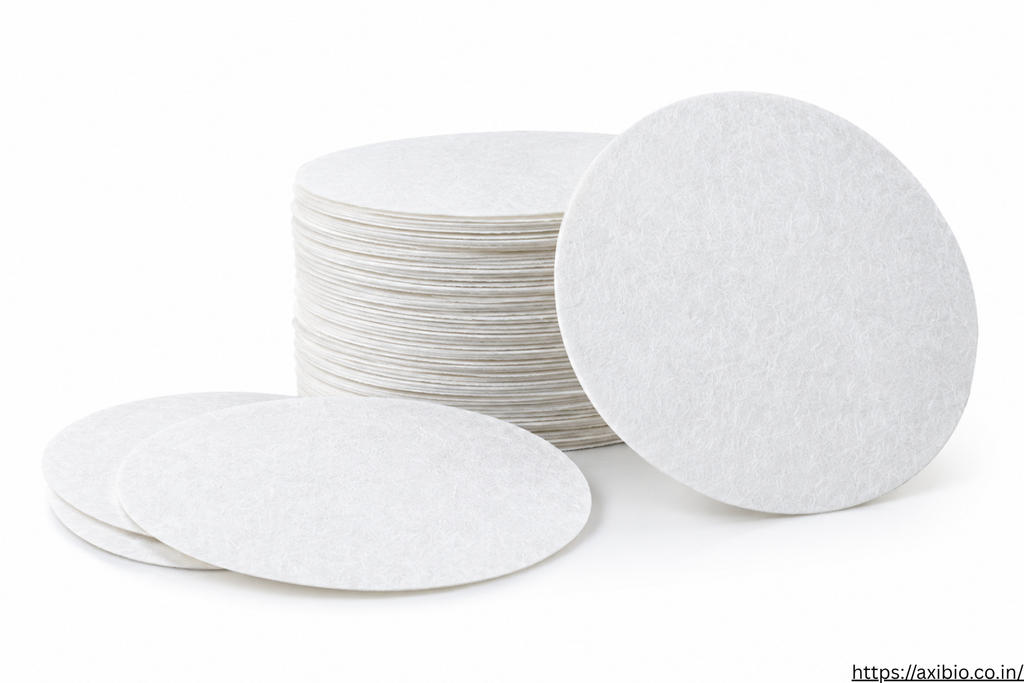
According to Axibio’s published specifications, GF/1F has a 1.6 µm retention rating, GF/3F has 1.2 µm, and GF/5F has 0.7 µm. GF/1F and GF/3F share a similar thickness and weight, while GF/5F is thicker and heavier. Published air-flow times rise from GF/1F to GF/5F, so GF/1F offers the least resistance and GF/5F the most.
GF/1F Glass Fibre Filter (1.6 µm)
Confirmed specifications: retention 1.6 µm; DOP retention 99.9%; maximum temperature 500 °C; no bonding agent; thickness 250–300 µm; base weight 50–56 gsm; air flow above 4.3 sec/100 ml/in².
Formats listed: circles of 25, 37, 42.5, 47, 51, 55, 70, 90, 110, 125 and 150 mm, plus 203 × 254 mm sheets, in packs of 100.
Filtration role: GF/1F is the most open of the three grades and has the lowest published air-flow time. It suits work where fast flow and high loading matter more than capturing the very finest particles, such as pre-filtration and general clarification of heavily loaded samples. Axibio’s grade page does not list specific applications for GF/1F, so confirm suitability for your method.
Verify before ordering: whether your method accepts a 1.6 µm nominal rating, the liquid retention test basis, and the diameter your holder needs.
GF/3F Glass Fibre Filter (1.2 µm)
Confirmed specifications: retention 1.2 µm; DOP retention 99.9%; maximum temperature 500 °C; no bonding agent; thickness 250–280 µm; basis weight 50–56 gsm; air flow above 6.8 sec/100 ml/in².
Formats listed: circles of 25, 42, 47, 55, 70, 90, 110, 125 and 150 mm; 203 × 254 mm and 460 × 570 mm sheets; and 102 × 254 mm strips (packs of 50).
Filtration role: GF/3F sits between the other two. It captures finer particles than GF/1F at a similar weight and thickness, with moderately higher flow resistance. Many water and suspended-solids methods reference filters with retention around this level, but the method text must be checked. Axibio’s grade page does not list specific applications for GF/3F.
Verify before ordering: that 1.2 µm meets your method, that the filtration time stays within limits for your sample, and that the sheet or strip size fits your equipment if you are not using circles.
GF/5F Glass Fibre Filter (0.7 µm)
Confirmed specifications: retention 0.7 µm; DOP retention 99.9%; maximum temperature 500 °C; no bonding agent; thickness 410–430 µm; basis weight 70–80 gsm; air flow above 19 sec/100 ml (as published).
Formats listed: 25 mm and 47 mm circles (100 per pack) and 90 mm circles (50 per pack).
Filtration role: GF/5F is the finest and thickest of the three. Axibio describes it as closely similar to grade GF/F and lists collection of very fine protein precipitates, clarification of chemically aggressive solutions, and TCLP (EPA Method 1311) as suitable uses. Expect slower flow than the other two grades.
Verify before ordering: whether your method requires a specific reference filter, how long filtration takes with your sample, and whether the limited diameter range fits your holder.
GF/1F, GF/3F and GF/5F Comparison Table
The table below uses only values published on Axibio’s product pages. Where no data is published, it says so.
| Grade | Verified retention / filtration specification | Performance characteristics | Confirmed applications | Selection considerations | Confirm with manufacturer |
| GF/1F | 1.6 µm; DOP 99.9%; air flow above 4.3 sec/100 ml/in² | 250–300 µm thick; 50–56 gsm; binder-free; up to 500 °C; lowest flow resistance of the three | Grade-specific uses not listed; range uses include pre-filtration, water testing, particulate sampling | Choose when flow speed and loading matter most and 1.6 µm is acceptable | Liquid retention efficiency basis; chemical compatibility; method approval |
| GF/3F | 1.2 µm; DOP 99.9%; air flow above 6.8 sec/100 ml/in² | 250–280 µm thick; 50–56 gsm; binder-free; up to 500 °C; moderate flow resistance | Grade-specific uses not listed; range uses include gravimetric measurement and water testing | Middle option for finer capture with similar weight to GF/1F | Liquid retention efficiency basis; method approval; batch data |
| GF/5F | 0.7 µm; DOP 99.9%; air flow above 19 sec/100 ml | 410–430 µm thick; 70–80 gsm; binder-free; up to 500 °C; highest flow resistance; described as closely similar to GF/F | Fine protein precipitates; chemically aggressive solutions; TCLP (EPA Method 1311) | Choose when fine particle capture matters and slower flow is acceptable | Equivalence for your specific method; available sizes beyond 25, 47, 90 mm |
Use the table to narrow your choice in three moves. First, remove any grade whose retention does not meet your method. Second, among the grades left, prefer the one with the best flow for your sample load. Third, check that the size you need is actually listed for that grade.
How to Select the Right Glass Fibre Filter Grade for Your Test
Start with the method, not the grade. Your test method tells you what the filter must do. Then match a grade to that requirement and confirm it with a trial run.
- Determine test method. Identify method title, edition, and precise description of filter in terms of retention.
- Determine retention requirements. Determine whether retention is for all solids, fine precipitate, or airborne dust. Estimate smallest particle of interest.
- Consider sample characteristics. Determine level of solids, viscosity, pH, nature of solvent and temperature of filtration.
- Determine required retention. Compare the requirements of the method with published retention rating for grade chosen. Bear in mind that rating is nominal.
- Consider flow rate and volume of filtration. Determine the largest pore size meeting retention requirements and make sure it filters volume in a reasonable time.
- Determine dimensions and compatibility with equipment. Make sure you have a suitable holder, funnel or sampler for the diameter or sheets used.
- Determine compatibility of chemicals and temperatures of filtration. Compare your reagents and drying or ignition temperatures to published specifications.
- Perform tests under operating conditions. Filter your actual sample, determine the time required and test for clarity of filtrate or blanks.
- Obtain documentation. Before ordering bulk supply, obtain specification sheet and batch certification.
Key Specifications to Check Before Purchasing
| Specification | Why it matters | What to ask or check |
| Particle retention (µm) | Decides which particles are captured | Is it nominal? At what efficiency, and in liquid or air? |
| Binder content | Binders can add organic weight or interfere with analysis | Is the filter binder-free? |
| Thickness and basis weight | Affects loading, flow and tare weight | What is the published range for each? |
| Air flow or flow rate | Indicates resistance and run time | How was it measured, and in what units? |
| Maximum temperature | Needed for drying or ignition steps | What is the stated limit? |
| Chemical compatibility | Prevents damage or contamination | Is it compatible with my acids, alkalis and solvents? |
| Diameter and format | Must fit holders and samplers | Which sizes are stocked for this grade? |
| Pack size and batch information | Supports planning and traceability | How many per pack, and is a lot number printed? |
Common Mistakes When Selecting Glass Fibre Filters
- Filter selection based on grade names. Names differ from brand to brand. Avoid this pitfall by referring to retention, thickness, and flow values.
- Misinterpretation of nominal retention. A 0.7 µm glass fibre filter does not retain all 0.7 µm particles. In case of high sharpness requirement, use membranes or double filtering.
- Neglecting the testing method. Method dictates the requirements. Read the filter description before making the list.
- Disregarding the test of compatibility. Highly concentrated strong alkali and hydrofluoric acid may be harmful for the glass. Investigate reagents first.
- Relying on filter speed. The fastest filter does not necessarily retain fine particles. Strike a balance between the two factors.
- Ignoring the diameter of the filter and the filter holder. Too small filter slips out from the filter holder while too large one folds when inserted into it. Measure the holder.
- Taking manufacturer names literally. Two filters with very close names can demonstrate different properties. Ask for the specifications.
- Placing order without previous testing. Try some packs of filters before placing a big order.
- Neglecting the filter documentation. Most of the questions can be answered in the specification sheet. Ask for it prior to purchasing.
Quality Checks Before Buying Glass Fibre Filters
Good glass fibre filtration depends on filters that behave the same way every time. Before buying, check these points:
- Specifications. Retention, thickness, weight, flow rate, and temperature should be provided explicitly for each grade.
- Batch uniformity. Find out how the supplier ensures uniformity between batches.
- Traceability. It is helpful to have a batch or lot number on the package.
- Packaging. The filters must be packaged flat and sealed to ensure that dust and moisture do not get inside.
- Storage. The filters should be stored flat and in a dry place free of dust. Filters should be handled with sterile forceps.
- Quality records. Find out which quality records are available, including specifications, and batch details.
- Grade suitability. Verify that the grade you use is suitable for your sample, not just the type of filter.
- Technical support. Make sure that technical support will be available both before and after purchase.
- Compatibility of the method. Verify that the filter is compatible with your method, and keep this record.
What to Check When Choosing a Glass Fibre Filter Manufacturer
A reliable glass fibre filter manufacturer publishes clear specifications, keeps them consistent, and can explain how they are measured. Judge the manufacturer on evidence you can check, not on marketing claims.
- Product specifications. Are figures quoted for each grade, with units and ranges? A glass fibre filter manufacturer which publishes thickness, weight, retention and flow specifications is more likely to satisfy your requirements than one which quotes grades alone.
- Grade availability. Does the range include the retention and format requirements you have today and may need tomorrow?
- Documenting and tracing the product. Can the manufacturer provide specifications and identify batches?
- Product uniformity. What checks are made between batches on thickness, weight and retention?
- Technical assistance. Is it possible to obtain from the glass fibre filter manufacturer an explanation of the test method used for retention, and the grade suitable for your method?
- Packaging and supply. Are pack sizes and number of packs stated? Will this enable repeat orders?
- Communication. Have you received clear and detailed answers in writing?
For verification, you should request the specification sheet, test one package, and compare the results with your filter. If a glass fibre filter is claimed to be equivalent to some other type by its manufacturer, you must ask for data supporting this claim and test it yourself.
How to Evaluate a Glass Fibre Filter Supplier
A good glass fibre filter supplier gets the right product to you on time, with the right documents, and answers your questions clearly. Use these points to compare suppliers:
- Product Information. Is information on the product such as catalog and specification sheets provided by the glass fibre filter supplier?
- Grades and Sizes. Can they provide the specific diameter and packaging needed?
- Samples. Can they provide samples in trial packs?
- Delivery and quantity. You should request for delivery time and the minimum order quantity in writing.
- Packaging and transportation. Filters should be delivered flat packed, unopened and undamaged.
- Technical Answers. The competent glass fibre filter supplier should be able to give technical answers or forward your inquiries to the manufacturer.
- Consistency of Supply. They should provide consistent repeat orders of the same specification.
- After Sales Communication. Who is responsible for after sales communication regarding any change of behavior in a batch?
Buying directly from a manufacturer that also acts as your glass fibre filter supplier can shorten the path between your technical question and the person who can answer it.
Why Consider Axibio for Glass Fibre Filters?
Axibio is a glass fibre filter company located in Delhi, which offers the specification levels of their products. This allows for comparison of choices by the actual levels rather than by grades.
Here is what Axibio’s product pages show:
- Three grades of glass fiber available: GF/1F (1.6 µm), GF/3F (1.2 µm) and GF/5F (0.7 µm), with their retention value stated.
- Complete technical data sheets of each grade providing DOP retention, maximum temperature, binder percentage, thickness, basis weight and air flow rates.
- Binder free and maximum temperature rating for all three grades being 500 °C.
- Many types of formats are offered: circles of diameter from 25mm to 150mm, sheets and strips, with catalogue numbers and packs quantity stated.
- Products associated with the same line: quartz microfibre filters, pollution monitoring filters and filter funnels/ filtration assemblies.
You can review the full list of available glass fibre filter grades and specifications on Axibio’s website. If you are unsure which grade fits your method, contact Axibio with your method name, sample type and holder size so the team can help you confirm the right option.
Frequently Asked Questions About Glass Fibre Filters
1. What is a glass fibre filter used for?
A glass fibre filter separates particles from the liquid or air. Applications of this filter include suspended solids analysis, liquid analysis, air and emission sampling, gravimetric determination, sample clarification, and pre-filtration before the membrane. Its high flow rate, high capacity, and heat stability allow this filter to be suitable for samples which can rapidly plug cellulose paper or membranes.
2. How does glass fibre filtration work?
Filtration using glass fibre is depth filtration. The liquid filters through the thickness of glass fibre web, and the particles are captured both on the surface and through the layers. As it captures in the entire thickness of the filter, the filter retains more solids until flow is impeded while maintaining its particle retention capability at its nominal size.
3. What is the difference between GF/1F, GF/3F and GF/5F?
GF/1F is available at 1.6 µm; GF/3F is available at 1.2 µm; and GF/5F is available at 0.7 µm retention. GF/1F and GF/3F are comparable in size and weight; whereas GF/5F is heavier than the other two. Reported air-flow times vary in such a way that GF/1F flows faster than GF/5F.
4. Which glass fibre filter grade is suitable for water analysis?
It will depend upon the methodology that you are using. Several methods for water and wastewater require the use of a glass fiber filter without the presence of any binder. Identify the grade of the filter used in the method from its description, compare it with the retention of a grade and run your sample test.
5. How do I select a glass fibre filter for suspended solids testing?
Make sure that the filter grade being used matches the requirements of your TSS method in terms of filter type, filtration and pretreatment steps. Select a filter without a binder which conforms to the published ratings of the method and can withstand the drying temperature and diameter as per the holder size.
6. Are glass fibre filters suitable for laboratory sample preparation?
Yes, in many cases. Glass fiber filters work well for clarification of extracts, precipitation collection, and to protect membranes or instrumentation from particulates. Be sure that the glass fiber filter is compatible with your solvent and will not adsorb or retain your analyte. To have a clean cut-off, use the glass fiber filter followed by the membrane.
7. What is the difference between glass fibre filters and membrane filters?
Glass fibre filters are heavy depth filters that are characterized by fast flow, high loading, and nominal retention. Membrane filters are thin surface filters with precise pores and closer-to-absolute retention, but tend to clog up much sooner when used with dirty sample. Glass fibre is also more resistant to heat. Your technique will determine the choice.
8. What does the retention rating of a glass fibre filter mean?
The retention rating is the size of the particle for which the filter was manufactured. The rating for glass fiber filters is nominal, which means that while most of those particles will be retained by the filter, a few may still pass through. You should ask the manufacturer for more information about how the rating was determined.
9. Does a finer glass fibre filter always give better results?
No. A finer mesh size will trap smaller particles, but will flow slower and will clog quicker. If your technique calls for a certain coarse mesh size, a finer mesh size will influence your results and will be method non-compliant. The ideal mesh size should comply with your technique.
10. What specifications should I check before buying a glass fibre filter?
See if the particle retention and its testing procedure were correct, binder quantity, thickness, basis weight, flow value, maximum temperature, chemical resistance, and diameter options. Also find out if there are any batch number markings on the packs and if there is an availability of any specification sheet.
Find the Right Glass Fibre Filter for Your Laboratory
Choosing the right glass fibre filter helps improve filtration efficiency, maintain consistent results, and meet your testing requirements. Axibio offers glass fibre filters for laboratory, water analysis, environmental testing, and other analytical applications.
Explore Axibio’s Glass Fibre Filters to compare product specifications and available sizes. Need help selecting the right filter? Contact Axibio with your application, sample type, and filtration requirements to find a suitable option for your laboratory.