Laboratory safety equipment plays an important role in protecting laboratory workers, preventing accidents, and maintaining a safe working environment. It includes essential protective products such as safety goggles, laboratory gloves, lab coats, face shields, and other equipment designed to reduce exposure to chemicals, biological materials, heat, and other laboratory hazards.
Using the right laboratory safety equipment helps minimize the risk of injuries, chemical splashes, contamination, and accidental exposure during experiments and routine laboratory work. Choosing suitable, reliable equipment ensures better protection and supports safe and efficient laboratory operations.
This guide explains what laboratory safety means, the hazards you need to plan for, the main types of lab safety equipment, and a step-by-step method to choose the right products. If you are ready to compare options, you can browse Axibio’s laboratory safety products alongside this guide.
What Is Laboratory Safety?
Laboratory safety refers to all procedures, instruments, and controls that are employed in the laboratory to ensure the safety of people, samples, and the facility itself from any danger present in the laboratory environment. It includes handling chemicals and biological agents, personal protective equipment, laboratory design, and emergency response.
Good laboratory safety works in layers. Safety professionals use the “hierarchy of controls”:
- Elimination or substitution – remove the hazard or replace it with something less dangerous.
- Engineering controls – fume hoods, biosafety cabinets, ventilation and safety shields.
- Administrative controls – training, written procedures, labels and signage.
- Personal protective equipment (PPE) – gloves, goggles, lab coats and respirators.
PPE is the final line of defence and not the primary one. This is why any comprehensive laboratory safety program must also include emergency safety equipment like eye wash stations, safety showers, spill kits and fire extinguishers.
Why Is Laboratory Safety Important?
Laboratory safety is important since the majority of accidents in laboratories occur during regular activities, usually when one feels most at ease. Proper planning and equipment help minimize not only the probability of the accident but also its impact.
- Protects laboratory workers. Correct PPE and emergency equipment prevent injuries due to splashes, burns, cuts, and infections.
- Prevents accidents and injuries. Proper storage, good procedure, and proper equipment prevent small errors from turning into big incidents.
- Reduces chemical exposure.Appropriate gloves, goggles, and ventilation prevent exposure to hazardous materials through touch and inhalation.
- Maintains a clean working environment. Prevention of cross-contamination is achieved through spill control and proper disposal of wastes.
- Supports reliable laboratory operations. Fewer incidents mean less downtime, fewer lost samples and more dependable results.
- Supports compliance and audits. Many accreditation bodies, regulators and clients expect documented safety measures.
What Are the Common Hazards in a Laboratory?
Chemical, biological, physical, electrical, fire and heat, and sharp hazards constitute the major risks in a laboratory. It is important to select equipment on the basis of an assessment of these risks because laboratories experience all these risks simultaneously.
- Chemical hazards:Corrosive acids and bases, poisons or carcinogens, flammable solvents and reactive chemicals. Contact can happen by means of skin exposure, eyes, inhaling, or accidental ingestion.
- Biological hazards: Bacteria, viruses, fungi, cell cultures, blood, and other bodily fluids. The danger is dependent on the risk group classification of the organism and procedures such as aerosol-producing procedures.
- Physical hazards: Pressurized gas cylinders, vacuum systems, ultraviolet radiation, lasers, loud noises, and cryogenic fluids like liquid nitrogen.
- Electrical hazards: Damaged cables, overloaded plugs, and electric devices near sources of water or flammable fumes.
- Fire and heat hazards: Bunsen burners, hotplates, ovens, furnaces, autoclaves, and flammable liquids kept close to any source of ignition.
- Broken glass and sharp objects: cracked glassware, needles, scalpels and blades that can cause cuts and, in biological labs, infections.
Common Laboratory Hazards and Required Safety Equipment
| Laboratory Hazard | Potential Risk | Relevant Safety Equipment |
| Corrosive chemicals | Skin and eye burns | Chemical splash goggles, face shield, chemical-resistant gloves, apron, eyewash station |
| Volatile or toxic chemicals | Inhalation, poisoning | Fume hood, suitable respirator, nitrile or other compatible gloves |
| Biological agents | Infection, contamination | Disposable gloves, lab coat or gown, face protection, biosafety cabinet, disinfectants |
| Flammable liquids | Fire, explosion | Flammable storage cabinet, fire extinguisher, fire blanket, flame-resistant lab coat |
| Hot surfaces and equipment | Burns | Heat-resistant gloves, tongs, lab coat |
| Cryogenic liquids | Cold burns, splashes | Insulated cryogenic gloves, face shield, goggles |
| Broken glass and sharps | Cuts, puncture wounds | Cut-resistant gloves, sharps containers, broken-glass disposal box |
| Chemical spills | Exposure, slips, fire | Chemical spill kit, absorbents, safety signage |
What Are the Different Types of Laboratory Safety Equipment?
Laboratory safety equipment is divided into two types: personal protective equipment that everyone wears, and safety equipment that is common to the laboratory. In the following, each type will be defined in terms of what it is, its uses, where it is needed, and what to look for before purchasing.
Personal Protective Equipment (PPE)
- What it is: Any protective clothing that is intended to limit exposure to the risk of injury or illness, including gloves, eye protection, jackets, face shields, and respirators.
- Protects against: Splashes, contact with chemicals or bio-hazards, particles and heat.
- Where required: Almost anywhere in the lab. The PPE depends on the work being done.
- Buying tips: Use a written hazard evaluation when choosing PPE. Have multiple sizes available to ensure that all individuals can be properly outfitted.
Laboratory Gloves
- What they are: Disposable or reusable gloves that are manufactured using nitrile, latex, neoprene, butyl, vinyl or special-purpose materials.
- Protects against: Chemical exposure, biological hazards, cuts, heat or cold depending on their design.
- Where required: When hands need to come into contact with hazardous chemicals, samples, hot or cold objects.
- Buying tips: There is no glove that protects against all chemicals. Review the manufacturer’s table on chemical resistance and breakthrough times. For chemical protection, ensure that the gloves have been tested according to EN ISO 374-1 standard that categorizes them as Type A, B or C.
Safety Goggles and Protective Eyewear
- What it is: Safety glasses with side shields, or sealed goggles that fit closely around the eyes.
- Protects against: Flying particles, chemical splashes and, with the right lenses, UV or laser light.
- Where required: In nearly all labs. Choose splash goggles, not open safety glasses, when handling liquids that can splash.
- Buying tips: Check marking to a recognised standard such as ANSI/ISEA Z87.1 or EN 166. Look for anti-fog coating, indirect venting for splash goggles and compatibility with prescription glasses.
Laboratory Coats and Protective Clothing
- What it is: Lab coats, disposable gowns, aprons and coveralls.
- Protects against: Splashes and spills on skin and personal clothing, and contamination carried outside the lab.
- Where required: In all chemical, biological and clinical labs.
- Buying tips: Choose the fabric for the hazard. Cotton or polyester-cotton suits general work, flame-resistant coats suit work with flammable liquids, and fluid-resistant or disposable gowns suit biological work. Check sleeve cuffs, closures, sizing and how the coat will be laundered.
Face Shields
- What it is: A clear visor that covers the full face.
- Protects against: Large splashes, sprays, flying fragments and cryogenic liquid splashes.
- Where required: When pouring large volumes of corrosives, handling cryogenics or working with pressurised or reactive systems.
- Buying tips: A face shield is worn over goggles, not instead of them. Check visor material, chemical resistance, adjustable headgear and replacement visor availability.
Respiratory Protection
- What it is: Filtering facepiece masks, half-face and full-face respirators with filters or cartridges.
- Protects against: Airborne particles, aerosols, vapours and gases.
- Where required: Only when engineering controls such as fume hoods cannot reduce exposure enough, or during spill clean-up.
- Buying tips: Match the filter or cartridge to the contaminant. Particle filters do not stop chemical vapours. Look for recognised certification, such as NIOSH approval or EN 149 FFP ratings. Fit-testing and training are essential for tight-fitting respirators.
Chemical Spill Kits
- What it is: A ready-to-use kit with absorbents, neutralisers, PPE, scoops and disposal bags.
- Protects against: The spread of spilled chemicals, exposure, slips and fire.
- Where required: Any lab that stores or handles hazardous liquids.
- Buying tips: Choose kits for the spill type: universal, acid, base, solvent or mercury. Size the kit for the largest container used. Place kits near the hazard and keep them sealed and restocked.
Fire Safety Equipment
- What it is: Fire extinguishers, fire blankets, smoke detectors and flammable storage cabinets.
- Protects against: The start and spread of fires and burns to people.
- Where required: Every laboratory, especially those using burners, heaters or flammable solvents.
- Buying tips: Match the extinguisher type to the fire class. CO2 or suitable dry powder units are common for electrical and flammable liquid fires, while reactive metal fires need special Class D agents. Mount equipment visibly and follow local fire authority requirements.
Emergency Eyewash Stations
- What it is: Plumbed or self-contained units that flush the eyes with clean water or solution.
- Protects against: Lasting eye damage after a chemical or particle splash.
- Where required: Wherever corrosive or harmful substances can reach the eyes.
- Buying tips: ANSI/ISEA Z358.1, a widely used standard, calls for flushing both eyes at about 1.5 litres per minute (0.4 gpm) for at least 15 minutes, with tepid water. Units should be reachable within about 10 seconds of the hazard. Small squeeze bottles help as a first response but do not replace a full eyewash station.
Safety Showers
- What it is: An overhead drench shower, often combined with an eyewash unit.
- Protects against: Large chemical splashes or clothing contamination over the body.
- Where required: Labs handling large volumes of corrosive, toxic or flammable liquids.
- Buying tips: Under ANSI/ISEA Z358.1, showers should deliver at least 75.7 litres per minute (20 gpm) for 15 minutes. Check water supply, drainage, valve design, signage and an unobstructed path.
First-Aid Equipment
- What it is: First-aid kits with dressings, burn gels, eye pads, gloves and basic supplies.
- Protects against: Worsening of minor injuries before medical help arrives.
- Where required: Every laboratory, with contents suited to the lab’s hazards.
- Buying tips: Choose kits with refill packs, check expiry dates and add burn and eye care items for chemical labs.
Chemical Storage and Handling Safety Products
- What it is: Flammable and corrosive storage cabinets, spill trays, safety cans, bottle carriers, labels and sharps containers.
- Protects against: Leaks, reactions between incompatible chemicals, breakage during transport and fires.
- Where required: Any lab that stores chemicals or generates sharps waste.
- Buying tips: Separate incompatible chemicals, such as acids and bases or oxidisers and flammables. Check cabinet material, ventilation options, secondary containment and labelling.
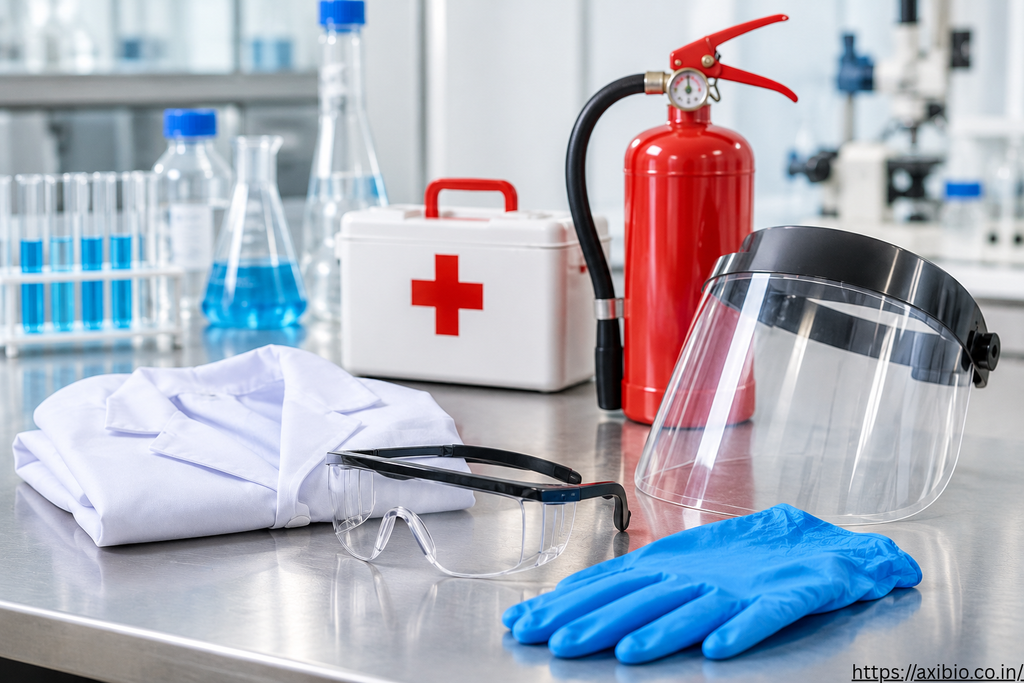
Types of Laboratory Safety Equipment and Their Uses
| Equipment | Primary Purpose | Protection Provided |
| Laboratory gloves | Protect hands | Chemicals, biological material, cuts, heat or cold |
| Safety goggles | Protect eyes | Splashes, flying particles |
| Lab coats and gowns | Protect skin and clothing | Splashes, spills, contamination |
| Face shields | Protect full face | Large splashes, fragments |
| Respirators | Protect lungs | Particles, aerosols, vapours |
| Spill kits | Contain spills | Exposure, spread, slips |
| Fire extinguishers and blankets | Control fires | Burns, fire spread |
| Eyewash stations | Flush eyes | Chemical eye injuries |
| Safety showers | Flush the body | Large chemical splashes |
| First-aid kits | Immediate care | Minor injuries |
| Storage cabinets and containers | Safe storage | Leaks, reactions, fire |
What Are the Essential Laboratory Safety Practices?
The equipment will function only when used the right way. This ensures that the money you put into it is not wasted on something useless.
Personal protection
- PPE must be worn as per the task performed and replaced as soon as possible.
- Gloves and lab coats should be removed from the lab before handling phones, door knobs and key boards.
- No eating, drinking or applying cosmetics inside the laboratory.
Chemical handling
- Review the Safety Data Sheet (SDS) prior to working with a new substance.
- Use volatile or toxic substances in a fume hood.
- Do not pipette by mouth.
Proper storage
- Clearly label each container with its contents and potential dangers.
- Organize chemicals according to their compatibility, not the alphabet.
- Flammable chemicals should be kept in proper cabinets, far from any source of heat.
Equipment inspection
- Inspect gloves, glasses and respirators for any damage before usage.
- Check the plumbed eye washes once a week and safety showers regularly.
- Inspect fire extinguishers on a monthly basis and get them serviced according to local regulations.
Waste disposal
- Segregation of chemical, biological, sharps and general wastes.
- Use appropriately labelled leak-proof containers and sharps disposal boxes.
- Apply relevant standards like Indian Bio-Medical Waste Management Rules, 2016 for segregation of biological wastes.
Emergency preparedness
- Ensure that everyone is familiar with the locations of the eye wash stations, showers, fire extinguishers, spill kits and exits.
- Have emergency contact information clearly displayed.
- Conduct regular drills and training for spills.
Laboratory cleanliness
- Maintain a clear environment for benches, aisles, and emergency equipment.
- Disinfect all surfaces after each use.
- Clean up any spills right away.
What Laboratory Safety Standards and Guidelines Should Buyers Know?
The laboratory safety standards are classified into three categories: mandatory, product standards and good practice standards. The applicability of these standards varies from one country, industry, or job to another. Thus, all the standards discussed below may not apply to every laboratory.
Regulatory requirements (legally binding where they apply)
- In India, the occupational safety and health responsibilities of employers will depend on the nature of the business and may arise from the provisions in the Factory Act, 1948 and the Occupational Safety, Health and Working Conditions Code, 2020.
- The Bio-medical Waste Management Rules, 2016 deal with biological and laboratory wastes that include pre-treatment of laboratory and highly infectious waste.
- Hazardous chemical storage and handling might be subject to requirements in the Manufacture, Storage and Import of Hazardous Chemical Rules, 1989.
- In the United States, the Laboratory Standard (29 CFR 1910.1450) by OSHA requires the Chemical Hygiene Plan.
Product and industry standards (used to test and certify equipment)
- EN ISO 374-1 and EN ISO 374-5: chemical and micro-organism protective gloves.
- ANSI/ISEA Z87.1 and EN 166: eye and face protection.
- ANSI/ISEA Z358.1: emergency eyewash and shower equipment. This is a voluntary consensus standard, but it is widely used as a benchmark.
- NIOSH approval and EN 149: respiratory protection.
Quality, accreditation and best-practice guidance
- ISO/IEC 17025 (testing and calibration labs) and ISO 15189 (medical labs), used for NABL accreditation in India, expect safe and controlled working conditions.
- ISO 15190 covers safety requirements for medical laboratories.
- Good Manufacturing Practice (Schedule M) applies to pharmaceutical quality control labs.
- WHO Laboratory Biosafety Manual and ICMR and DBT biosafety guidelines support biological risk management.
When buying, ask suppliers which standard a product has been tested to and request supporting documents. A product label alone is not always enough.
How to Choose the Right Laboratory Safety Equipment
When selecting laboratory safety equipment, one should first consider the hazards present in the lab and then match each hazard with safety equipment that is tested for that hazard, suitable for users and reliable. This process follows the following guidelines.
1. Identify laboratory-specific hazards. Write down every chemical substance, biological agent, piece of equipment, and process that will be needed. Read the Safety Data Sheet and write down the hazard classification for every chemical substance.
2. Understand the type of laboratory work. Think about volume, frequency, and duration. The act of handling 50 ml of an acid solution may require more PPE than handling multiple liters of that acid on a daily basis.
3. Determine the required protection level. Determine whether the job requires low-level protection in the form of safety goggles and nitrile gloves or high-level protection including splash goggles, a face shield, and chemical gloves. Bear in mind that engineering controls must be your first consideration.
4. Check product material and construction quality. Consider materials used for gloves, thickness of gloves, material of lenses, fabric weight, and construction. Bad quality products tend to rip, fog up, or leak, thus encouraging people to give them up.
5. Verify compatibility with chemicals and working conditions. Refer to the manufacturer’s data on chemical resistance compatibility to ensure that the product is compatible with the chemicals used. Take into consideration the temperature and humidity conditions, as well as autoclaving.
6. Check relevant certifications and standards. Ask which standard each product meets, such as EN ISO 374-1 for gloves or EN 166 or ANSI/ISEA Z87.1 for eyewear. Request test reports or declarations where available.
7. Consider comfort and ease of use. Uncomfortable PPE is often removed or skipped. Offer multiple sizes, check fit with prescription glasses and choose lightweight, breathable options for long shifts.
8. Evaluate durability and maintenance. For reusable items, check cleaning methods, replacement parts and expected lifespan. For emergency equipment, check inspection and servicing needs.
9. Compare product specifications. Compare like for like, including thickness, length, size range, standard, pack quantity and shelf life. Ask for technical data sheets instead of relying on product titles.
10. Consider budget and long-term value. The cheapest glove may tear more often and cost more over time. Calculate cost per use and weigh it against the cost of a single injury or lost batch.
11. Check supplier reliability and product availability. Make sure the products you standardise on are available in steady supply. Switching gloves or goggles often means retraining and new compatibility checks.
What Factors Should You Consider Before Buying Lab Safety Equipment?
Hazard match, standards verification, chemical compatibility, fit and comfort, durability, overall cost and availability are the main criteria that should be considered before purchasing any lab safety equipment. The following table illustrates these criteria.
Factors to Consider Before Buying Laboratory Safety Equipment
| Buying Factor | What to Check | Why It Matters |
| Hazard match | Product suits the specific chemical, biological or physical risk | Wrong product gives a false sense of safety |
| Standards and testing | Marked standard, test reports, declarations | Confirms tested performance |
| Chemical compatibility | Resistance charts, breakthrough times | Prevents permeation and degradation |
| Material quality | Thickness, fabric, lens and seam quality | Affects protection and lifespan |
| Fit and comfort | Size range, weight, anti-fog, breathability | Users keep wearing comfortable PPE |
| Durability and maintenance | Reusability, cleaning, spare parts | Lowers long-term cost |
| Specifications | Data sheets, dimensions, pack sizes | Allows fair comparison |
| Total cost | Cost per use, not only unit price | Shows true value |
| Supply and support | Stock levels, lead times, technical help | Keeps the lab running without gaps |
A few further tips for procurement teams:
- Standardise where possible. Fewer product lines simplify training, storage and reordering.
- Trial before bulk buying. Ask users to test samples in real tasks.
- Check shelf life. Disposable gloves, spill kit absorbents and eyewash solutions can expire.
- Plan stock levels. Keep buffer stock of high-use items such as gloves and coats.
- Keep records. Document product specifications and batch details for audits.
Which Laboratory Safety Equipment Is Required for Different Laboratory Needs?
Safety equipment needed in laboratories varies according to the dangers and functions carried out in that specific laboratory rather than the name of the laboratory. In this case, both a small instructional laboratory and a big chemical laboratory may both be chemistry laboratories but have totally different safety needs.
- Chemical laboratories: Face shields, splash goggles, gloves resistant to chemicals, lab coats/aprons, fume hoods, spill kits, cabinets for storage of corrosives/flammables, eyewash stations and safety showers.
- Research laboratories: PPE that is highly diverse due to variability of work tasks. Gloves of various materials, goggles, coats and special-purpose equipment like cryogenic gloves should be kept on hand.
- Educational laboratories:Safe and user-friendly safety spectacles or goggles for students, lab coats, basic protective gloves, fire blankets, fire extinguishers, and first aid kits. Proper signage and supervision is mandatory.
- Pharmaceutical laboratories: PPE suited to potent compounds and solvents, low-lint garments where contamination control matters, spill kits and documented equipment for GMP compliance.
- Biotechnology laboratories: Disposable gloves, fluid-resistant gowns, eye and face protection, biosafety cabinets, disinfectants, sharps containers and biological spill kits.
- Testing and quality control laboratories: Consistent, repeatable PPE for routine tests, chemical-resistant gloves, goggles, spill control and good chemical storage for reagents.
Laboratory Safety Equipment for Different Laboratory Types
| Laboratory Type | Common Safety Requirements | Important Purchasing Considerations |
| Chemical | Splash goggles, chemical gloves, spill kits, eyewash, showers | Chemical compatibility, storage cabinets |
| Research | Varied PPE, cryogenic and heat protection | Flexible range, small pack sizes |
| Educational | Safety glasses, coats, fire blankets, first aid | Durability, student sizes, cost |
| Pharmaceutical | Solvent-resistant PPE, low-lint garments, spill control | Documentation, GMP needs |
| Biotechnology | Disposable gloves, gowns, biosafety cabinets, sharps boxes | Biological protection, disinfection |
| Testing and QC | Routine PPE, chemical storage, spill kits | Consistent supply, standardisation |
How to Identify a Reliable Laboratory Safety Equipment Manufacturer
A reliable laboratory safety equipment manufacturer provides clear specifications, consistent quality and steady supply, and can back its product claims with documents. Use these checks when evaluating any manufacturer.
- Product range: A broad range across PPE, spill control and storage makes it easier to source from fewer partners. Check that the range covers the hazards in your lab.
- Material quality: Ask what materials are used and how they perform. Request samples to check thickness, finish and fit.
- Product specifications: Good manufacturers publish technical details such as sizes, dimensions, materials and pack quantities, not just product names.
- Quality assurance: Ask how products are inspected and whether batch or lot numbers are traceable.
- Relevant certifications: Ask for proof of claimed standards, such as test reports or declarations of conformity, and confirm they match the specific product.
- Technical information: Look for chemical resistance charts, user instructions, storage advice and shelf-life details.
- Supply capacity: Confirm the manufacturer can handle your volumes and repeat orders without long gaps.
- Customer support: Check how quickly they respond to questions, complaints and technical queries.
- Consistent product availability: Ask whether product specifications stay the same between batches. Unexpected changes can affect protection.
Be cautious with any laboratory safety products manufacturer that makes absolute claims such as “100% protection” without supporting data.
Why Is Choosing the Right Lab Safety Equipment Supplier Important?
The right lab safety equipment vendor will make sure that you get the authentic and appropriately designed equipment, delivered on time. This is because even if products are of high quality, their misuse due to poor information can create trouble for you.
- Reliable product sourcing: A dependable supplier sources from known manufacturers, reducing the risk of substandard or counterfeit items.
- Product quality: Consistent quality between orders means the protection your team relies on does not change unexpectedly.
- Clear specifications: Accurate data sheets help you compare products and confirm suitability before buying.
- Consistent supply: Regular availability avoids last-minute substitutes that may not suit your hazards.
- Technical assistance: A knowledgeable supplier can help match gloves to chemicals or suggest the right spill kit.
- After-sales support: Help with replacements, defects and reorders saves time for lab managers.
- Competitive purchasing value: Fair pricing, bulk options and clear terms help labs stay within budget without cutting protection.
For buyers looking for a laboratory safety equipment supplier in India, local availability can also shorten lead times and simplify reordering.
Frequently Asked Questions
1. What is laboratory safety?
Laboratory safety refers to those methods that are employed to ensure that there are no dangers to both the people who work in the laboratories and to the samples and facilities in the laboratories. The methods include the right way of using personal protective gear, safe handling of chemicals and biological substances. Laboratory safety depends on training, engineering control, and protective gear.
2. What are the essential laboratory safety equipment items?
Safety gear to be worn in the laboratory includes gloves, safety goggles, lab coat, face shield in case there is a risk of splashing, and respirator when necessary. The shared safety gear includes fire extinguisher, fire blanket, first aid kit, chemical spill kit, and eye wash station. There should also be a safety shower wherever necessary.
3. Why is laboratory safety equipment important?
Laboratory safety apparatus minimizes the risk of harm caused by chemicals, pathogens, heat, glass, and fire. Contamination of specimens is prevented as well as maintaining the precision of results. Other advantages of using laboratory safety equipment include meeting regulatory standards and satisfying clients.
4. What are the four main types of laboratory hazards?
There are basically four categories of laboratory hazards: chemical, biological, physical, and ergonomic. Sometimes the fourth category is not ergonomic, but rather radiation hazards. Some sources even separate fire and electrical hazards into distinct categories due to their frequent presence in laboratories. Your hazard assessment will include all the above categories.
5. How do I choose the right laboratory safety equipment?
Begin by assessing the risks associated with each activity before determining the degree of protection required. Select items that have been tested in accordance with known standards, assess chemical compatibility from manufacturer’s information, and ensure that the items are comfortable to wear. Lastly, do a comparative assessment of total costs.
6. What PPE is required in a laboratory?
Most laboratories will need at least a lab coat, gloves, eye protection and closed toed footwear. Additional protective gear may include splash goggles, face shields, chemical aprons, flame resistant jackets, cryogenic gloves or respirators. The proper personal protective equipment should be determined from a written hazard assessment.
7. What should I check before buying lab safety equipment?
Check that the product matches your hazard, carries a relevant standard and comes with technical data. Review material quality, sizing, comfort, shelf life and cleaning needs. Also confirm cost per use, pack sizes, lead times and the supplier’s ability to support repeat orders.
8. How do I find a reliable laboratory safety equipment manufacturer?
Look for a laboratory safety equipment manufacturer that publishes clear specifications, provides proof of claimed standards and offers traceable batches. Request samples, ask about quality checks and confirm supply capacity. Responsive customer and technical support is another strong sign of reliability.
9. What should I look for in a lab safety equipment supplier?
A good lab safety equipment supplier offers genuine products, accurate specifications, steady stock and helpful technical advice. They should handle replacements and complaints promptly and offer fair pricing for regular orders. Local availability can also reduce lead times.
10. How often should laboratory safety equipment be inspected?
Personal Protective Equipment (PPE) like gloves, goggles and masks must be tested before each use. The ANSI/ISEA Z358.1 standard recommends testing plumbed eyewashes and safety showers on a weekly basis and conducting a full inspection of them annually. The fire extinguishers generally get visual inspections monthly and maintenance in line with local fire code requirements, while the spill and first aid kits must be checked regularly.
11. What safety equipment is required in a chemical laboratory?
A chemical laboratory typically needs splash goggles, face shields, chemical-resistant gloves, lab coats or aprons and fume hoods. It also needs chemical spill kits, eyewash stations, safety showers where corrosives are handled, fire extinguishers and approved cabinets for flammable and corrosive chemicals. Exact needs depend on the chemicals and quantities used.
12. Where can I buy laboratory safety equipment in India?
You can buy laboratory safety equipment in India from specialised laboratory suppliers and manufacturers. Axibio lists a range of laboratory safety products that you can review online. Whichever supplier you choose, compare specifications and standards carefully before ordering.
Looking for the Right Laboratory Safety Equipment? Explore Axibio
Choosing the right laboratory safety equipment is essential for maintaining a safe and well-equipped laboratory. Whether you need personal protective equipment, laboratory safety accessories or other essential safety products, selecting reliable products helps support safer and more efficient lab operations.
Explore Axibio’s Laboratory Safety Products to discover available products and their specifications. For product details, pricing, bulk orders or assistance with your requirements, contact the Axibio team today.