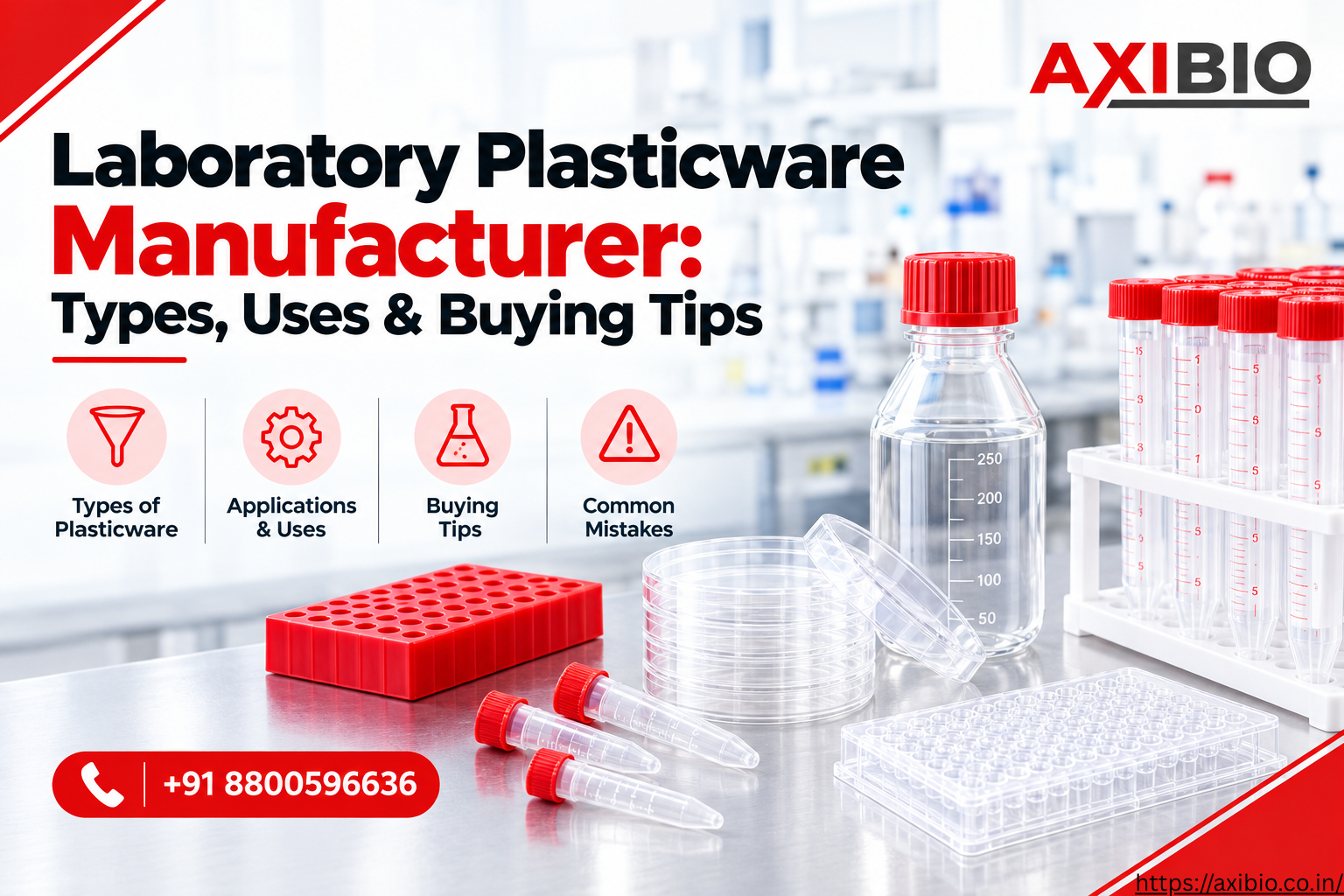
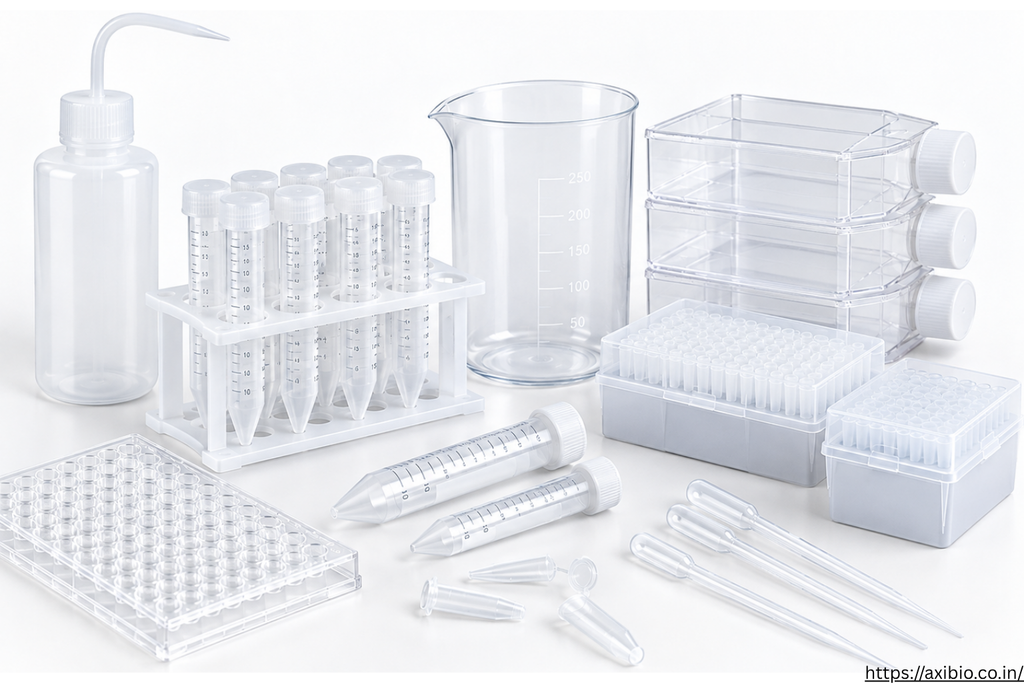
Laboratory plasticware is the collective term for the plastic tubes, bottles, pipette tips, dishes, plates, and other containers used in labs to store, transfer, culture, or store materials and reagents. It has replaced glass in many lab functions due to being lightweight, difficult to break, and usually supplied in disposable packs.
The choice of a suitable item is more important than most customers realize. Leakage, crackage, or reaction of an item could spoil the sample, cause spillage, or distort results. Each of these defects also incurs extra costs and wasted time.
This article outlines the various types of laboratory plasticware and the types of plastic used for each. It also covers what checks should be done before purchasing such an item. In addition, the article explains how to evaluate a laboratory plasticware manufacturer or supplier objectively. Axibio categorizes these items under the Laboratory Plasticware category, and we link related pages whenever possible.
What Is Laboratory Plasticware?
Laboratory plasticware refers to any plastic materials used in laboratories, including tubes, pipette tips, petri dishes, bottles, sample vessels, and microplates. It is used in the collection, measurement, mixing, culturing, centrifuging, and storing of samples. The suitability of a plasticware for a particular activity depends on the type of plastic, design, closure, and cleanliness level.
During laboratory activities, the same sample may be moved from one plasticware to another. The sample will be collected using a collection vessel, transferred to a different location using a pipette tip, then centrifuged in a centrifuge tube, then frozen in a cryovial. The various stages have varying requirements concerning the handling of heat and chemical substances.
Compared to glass, plastic is lighter and more difficult to break. Glass is usually more resistant to high heat and solvents and is more reusable after thorough cleaning. None of the two materials is superior in all circumstances. As one lab supply guide suggests, the proper material to use depends on the heating, measuring, mixing, or storage needs.
Four factors decide whether a plastic product is suitable:
- Plastic and its grade
- Chemicals that will be in contact with the plastic, and for what duration
- Temperature and sterilization requirement
- Design requirements such as the closure, wall thickness, and gradation precision
Why Is Laboratory Plasticware Used in Laboratories?
Plastic labware is chosen due to its lightness, reduced tendency to breakage, and disposability. However, these advantages depend on material, design, and application of the products. They do not hold true for all types of items.
- Lightweight. Plastic bottles and carboys are lighter to handle and store compared to their glass counterparts.
- Minimal breakages. Less broken products reduce injuries and contamination from cuts, spills, and losing samples, particularly in educational and busy labs.
- Disposable products. Disposable pipette tips, dishes, and tubes eliminate the cleaning process and reduce the likelihood of cross-contamination.
- Easier handling. Features like snap-caps, screw-caps, and stacking make the work faster.
- Purpose-specific design. Polystyrene dishes can be coated for cell culture growth while polypropylene tubes are ideal for freezing and spinning.
- Workflow and costs. Packs ready for use could save work effort, though the lowest priced product may not be the least expensive.
There are also limitations of plastic. Some plastics may become soft on exposure to heat; some may crack when exposed to certain solvents; and some may react with chemicals. The product should always suit the job.
Types of Laboratory Plasticware
The following ten categories represent most of the plasticware purchased by laboratories. Each category provides information about the purpose, materials used, inspection before purchase, and a typical mistake. Information on the materials is given in a general sense, but verify the specific properties from the datasheet.
1. Test Tubes
- Application: Mixing and reaction purposes as well as for temporary storage.
- Properties: PP is more resistant and can handle high temperatures. PS is clearer but fragile and cannot be heated.
- Things to check: The diameter and length of the tube, resistance of its edge, ability to use it with a cap, and the maximum temperature mentioned.
- A typical mistake: Heating the PS tube resembling a glass one.
2. Centrifuge Tubes
- Application for: Separation of cells, particles, or liquids by spinning, and storage in general. Conical bottom tubes are widely used.
- Material properties: PP material is widely used. Other plastic materials may be used in some cases for transparency or other restrictions.
- Consider before purchase: Maximum speed rating, compatibility with rotor/adapter, sealing, and chemical contact.
- Typical mistake: Operating at a speed exceeding the speed rating, or using solvents which weaken the tube walls.
3. Microcentrifuge Tubes
- Use for: Small volume applications such as preparation of DNA and proteins, quick centrifugation, and storage of samples.
- Material considerations: Mostly PP. Consider wall transparency, lid design, and lid locking.
- Consider before purchasing: Volume (e.g., 0.5, 1.5, or 2.0 mL), locking of the lid when heated, sterility, and nuclease-free if required.
- Common pitfall: Use of a regular lid in a heat block because steam may cause popping of the lid.
4. Pipette Tips
- For what purpose: Pipetting precise quantities of liquid using a pipette.
- Points to consider: Typically made of PP. Filtered tips prevent aerosols, while low retention tips decrease residual liquid on the tip.
- Before purchasing check: Compatible with your pipette type and model, capacity, filter, and sterility or absence of nucleases.
- Typical error: Thinking all tips are compatible with all pipettes.
The accuracy of pipettes is addressed in ISO 8655, which provides general requirements for piston-operated volumetric apparatus. An ill-fitting tip will jeopardize this accuracy. Refer to the Axibio’s Micro Pipette Tips and Liquid Handling sections.
5. Petri Dishes
- Uses: Growth of microorganisms and cell cultures in agar or media.
- Properties of material: Polystyrene, which is clear and strong. The majority of dishes are sterilized using gamma radiation or ethylene oxide prior to sale.
- Before purchasing: Check the diameter, lid type, stackability, sterility, and, in the case of cell culture, surface properties.
- Common error: Autoclaving polystyrene dishes, which melt.
6. Reagent Bottles
- Used for: Storing buffers, media, solvents, and chemicals.
- Material points: High-density polyethylene (HDPE), PP, polycarbonate (PC), and others, each with different chemical and heat limits.
- Check before buying: Bottle and cap materials, mouth width, cap liner, volume, and compatibility with the stored chemical.
- Common mistake: Choosing a bottle by look and size, then storing a solvent that attacks it.
Types of Laboratory Plasticware and Their Uses
| Laboratory Plasticware Type | Primary Use | Common Material | Important Selection Check |
| Test tubes | Mixing, reactions, short-term holding | PP, PS | Temperature limit and cap fit |
| Centrifuge tubes | Spinning and storing samples | PP | Maximum rated force and rotor fit |
| Microcentrifuge tubes | Small-volume molecular work | PP | Lid lock, sterility, nuclease-free status |
| Pipette tips | Accurate liquid transfer | PP | Fit with pipette model, filter option |
| Petri dishes | Culturing microbes and cells | PS | Sterility, vented lid, surface treatment |
| Reagent bottles | Storing chemicals and media | HDPE, PP, PC | Chemical compatibility of bottle and cap |
| Sample containers | Collecting and storing samples | PP, PE, PS | Seal quality and sterile status |
| Graduated ware | Approximate volume measurement | PP, PMP | Tolerance class and graduation clarity |
| Funnels and filtration | Transfer and filtration | PP, PS | Vacuum rating and membrane compatibility |
| Microplates | Assays, PCR, cell culture | PS, PP | Format and instrument fit |
Common Plastics Used in Laboratory Plasticware
Lab plastic wares are made up of plastics that belong to a few types only. Each type has its pros and cons. The resistance properties like chemical resistance, autoclavability, impact resistance, and heat resistance are dependent on the grade, type of the product, exposure conditions, and specification by the manufacturer.
Polypropylene (PP)
Polypropylene is the most commonly used lab plastic. As per the material guide from Thermo Fisher, it is selected where there are requirements for strength, autoclavability, and resistance to stress cracks, but its resistance to UV rays is good but not excellent. Polypropylene closures are common even for bottles made of other plastics.
- Application: Centrifuge tubes, micro-centrifuge tubes, pipette tips, bottles, cryogenic vials, beakers, PCR plates.
- Drawbacks: It has fair UV stability. Some solvents and oxidizers may attack this material. Please follow the manufacturer’s instructions on autoclaving.
Polyethylene (PE and HDPE)
Polyethylene is flexible and inexpensive. High-density polyethylene (HDPE) is rigid and widely used in bottles and carboys. The care and usage instructions for Nalgene specify that low density and high-density polyethylene are not autoclavable.
- Uses: Reagents and rinse bottles, closures, storage bottles.
- Verify: Chemical resistance table, bottle thickness, closure tightness. Do not assume that autoclaving is permitted.
Polystyrene (PS)
Polystyrene is stiff and transparent with good dimensional stability. According to Thermo Fisher, polystyrene shows good resistance to aqueous solutions but limited solvent resistance, brittleness at room temperature, and is non-autoclavable. It is available as a pre-sterilized product by gamma radiation or ethylene oxide sterilization.
- Typical uses: Petri dishes, tissue culture plates and flasks, serological pipettes, cuvettes.
- Limits: Brittle, poor UV resistance, and weak against many organic solvents.
Polycarbonate (PC)
Polycarbonate is colorless, rigid, and tough. According to the Polycarbonate guidelines by Thermo Fisher, polycarbonate is autoclavable but becomes weaker after multiple cycles of autoclaving. In the guideline for containers by the manufacturer, exposure to strong bases, DMSO, halogenated and aromatic hydrocarbons, esters, ethers, ketones, and amines should be avoided.
- Typical uses: Clear carboys, bottles, centrifuge ware, desiccators, storage boxes.
- Limits: Sensitive to alkaline cleaners and many organic solvents. Trace bisphenol A (BPA) is present in polycarbonate, so check whether this matters for your work.
Other Relevant Materials
- Polymethylpentene (PMP): A clear, autoclavable plastic used for graduated ware.
- PETG: Clear bottles, often sold pre-sterilized. It is not autoclavable at PP-rated temperatures.
- Fluoropolymers (FEP, PFA): Used where very high chemical resistance and inertness are needed, usually at higher cost.
Only use these where the datasheet confirms the property you need.
How to Choose the Right Laboratory Plasticware
Begin with the task, then filter by chemicals, temperature, sterility, size, and manufacturer. Follow the ten steps listed below in sequence. The steps are quick and will ensure that no purchasing mistakes are made.
1. Intended Laboratory Application
What the sample will be used for should be written down. Whether it needs to store, centrifuge, culture, heat, freeze, or be measured. The requirements for storing a sample are different from those of a sample which will be spun.
2. Material and Chemical Compatibility
List all of the chemicals that will come into contact with the item in question, including concentrations and duration of contact. Afterward, consult a manufacturer’s compatibility chart. Resistance varies depending on the temperature, duration of exposure, and stress conditions like centrifugation, so a single rating does not apply to all scenarios.
3. Temperature Requirements
Monitor extremes in temperature, from freezing to thawing and heating. Extreme fluctuations could cause plastics to crack or loosen their caps. Make sure that cryogenic work uses suitable products.
4. Sterilization Requirements
Ensure the product is right for your method. For instance, a typical steam sterilization protocol is 121 °C at 15 psig for 20 minutes, as per Nalgene’s recommendations. Not all plastics can handle this, and lids must be loosened prior to sterilizing. If you cannot autoclave the product, either purchase it sterile or choose another means.
5. Capacity, Size, and Dimensions
Inspect volume, diameter, height, and the closure mechanism. Ensure compatibility between tubes and racks/rotors, tips and pipettes, and plates and reader/thermal cycler. Allow enough headspace for expansion and mixing.
6. Sample Protection and Contamination Control
Ensure that you match the cleanliness requirement to the activity performed. DNase-free, RNase-free, or pyrogen-free materials are required in molecular biology, whereas cell culture may require endotoxin controlled products. You should only believe these claims when they appear on the packaging or the data sheet provided.
7. Product Quality and Consistency
Search for snug fits, flawless moldings without flash and rough edges, secure caps that seal each time, clear printing, and a specification sheet. Variation in the batch leads to leaks, improper fit, and repeated testing.
8. Packaging and Storage
Ensure that packs are sealed and not damaged and that lot numbers and expiration dates are indicated. Ensure that plastic ware is stored away from the sun as most plastics lack resistance to UV light.
9. Budget and Total Cost
Don’t look at cost per unit; compare cost per piece that works. Include the cost of defective batches, spills, rework, and reorder. Spending a little more to get a proven closure or closer tolerance pays off in the end.
10. Supplier Support and Availability
Check that datasheets are available, orders are shipped in time, and technical queries have someone to handle them. Supply constraints make labs change their products in the middle of research studies.
Laboratory Plasticware Buying Checklist
| Buying Factor | What to Check | Why It Matters |
| Application | Task, volume, equipment used | Prevents buying the wrong format |
| Chemical compatibility | Chemicals, concentration, contact time, chart rating | Avoids cracking, swelling, and leaching |
| Temperature | Minimum and maximum, freeze-thaw, heating | Prevents warping, cracking, and loose caps |
| Sterilization | Autoclave, gamma, or ethylene oxide support | Avoids melted or weakened items |
| Dimensions and fit | Size, closure, rotor, rack, instrument fit | Stops leaks and poor handling |
| Contamination control | Sterile, DNase-free, RNase-free, endotoxin status | Protects samples and results |
| Documentation | Datasheet, certificate of analysis, lot number | Supports traceability and audits |
| Packaging | Seals, damage, storage conditions, expiry | Keeps products clean and usable |
| Supplier reliability | Lead time, stock, support, complaint handling | Prevents delays and product switches |
How to Evaluate a Laboratory Plasticware Manufacturer or Supplier
The lab plastic products are produced by a lab plastic ware producer. The lab plastic ware distributor may be a producer of these products or not. There may be firms that perform both activities. Therefore, you should find out which products are manufactured and which are purchased.
Both searches “best laboratory plasticware manufacturer” and “top laboratory plasticware manufacturer” produce numerous company profiles and their self-proclaimed statements. There is no unbiased rating of such companies, so take these pages as an initial list. Determine the quality of the best laboratory plasticware supplier based on the criteria given below.
- Product range and suitability. Is the range suitable for your tubing, tips, plates, and bottles, and does it meet your sterility requirements?
- Material and technical specification. Ask for the plastic, grade, temperature range, and chemical specification of each product.
- Quality management and certification. Ask for certificates, certification body, scope and expiry date. Never accept the mere presence of a logo.
- Lot number and traceability. The lot number should be on the pack, and the supplier should trace a lot.
- Documentation and test reports. If applicable, ask for analysis certificates, sterility certificates and datasheets or other relevant documents.
- Product consistency. Ask for a trial pack and test it for fit, sealing and function with several lots.
- Packaging and storage. Inspect pack type and shelf life, and confirm proper storage conditions.
- Minimum order size and lead time. Confirm minimum order size, inventory, and delivery time for your city.
- Technical assistance. Check if the personnel answers compatibility questions.
- Pricing policy. Quotations should state prices and shipping costs with validity period.
- Returns and complaints. Ask how damaged or wrong goods are processed and time needed.
- Long-term supply. How does the company ensure continuity and inform about changes in its products?
The website of Axibio describes the firm as a supplier of filtration products, plastics and equipment for molecular biology with more than 30 years of experience. The firm also offers you a certification page, a catalog of products and a technical guide available for download. As in any other business, we recommend our customers to ask for the documentation and samples corresponding to their needs.
Common Mistakes to Avoid When Buying Laboratory Plasticware
- Selection of products only on the basis of their prices. Cheaper goods that tend to leak or break will require additional expense due to their repetition. Consider the cost per successful use of the product.
- Failure to consider compatibility between chemical and the product used. Using an inappropriate plastic will cause swelling, crazing, or leaching of the sample. Ensure that each chemical is considered on the chart provided.
- Expecting all plastic goods to withstand autoclaving process. Goods made from polystyrene and polyethylene plastics tend to melt or become warped. Make sure that you verify this first.
- Selecting inappropriate size of tubes, bottles or containers. Overfilling or using oversized containers will cause spillage and inadequate mixing. Match volume of the container with the experiment required.
- Ignoring compatibility of closures. Closure from one product may fail to seal other products. Buy compatible closures and verify the sealability.
- Confusing clean products with sterile products. Clean is an absence of visible contamination. Sterile is an absence of viable microorganisms. See the label.
- Neglecting contamination control issues. Molecular and cell work could require nuclease-free or endotoxin-controlled products. Include that in your order.
- Neglecting packaging damage or missing paperwork. Torn packages and lot numbers missing compromise traceability. Inspect when you receive it and reject it if necessary.
- Ordering in large quantities without checking specifications. Test the trial pack first because reversing a mistake on a bulk order is costly.
- Not confirming availability or shipping schedules. Make sure in writing that it is in stock and will be delivered to avoid delays.
Frequently Asked Questions
1. What is laboratory plasticware?
It is plastic lab ware for laboratory use, including tubes, tips, dishes, bottles, vessels, and plates. It is used in handling, culturing, and storage of samples and reagents. The appropriateness depends on the type of plastic and its purity.
2. What are the most common types of laboratory plasticware?
Types include centrifuge tubes, microcentrifuge tubes, pipette tips, Petri dishes, reagent bottles, sample tubes, and microplates. Graduated equipment and filter products are equally common.
3. Which plastic is commonly used for laboratory products?
Most used polymer is Polypropylene as it is tough and also autoclavable in most grades. Polystyrene is used in dishes and plates, while Polyethylene is used in bottles. Polycarbonate is used in cases where transparency is required.
4. Is polypropylene suitable for laboratory use?
Yes, but only for some applications. It is ideal for tubing, tips, bottles, and cryovials, and its chemical resistance is very good. However, there are also disadvantages, such as limited UV stability. Therefore, be sure to check the specific grade.
5. How do I choose laboratory plasticware for chemical handling?
Identify each chemical, its concentration, temperature, and exposure period. See if there is a chemical resistance chart for that particular plastic and cap from the manufacturer. In case there is no information, perform a compatibility test first.
6. Can laboratory plasticware be autoclaved?
Others yes, but not all. Polypropylene and polymethylpentene are usually autoclavable, while polystyrene is not. Read the manufacturer’s instructions carefully, loosen any caps, and place an unwashed item in a clean container.
7. What is the difference between sterile and non-sterile plasticware?
The sterilized products go through a process that usually includes either gamma rays or ethylene oxide so that no viable microbes are present in them and they come in sealed packages. The non-sterilized materials can be clean but not necessarily sterile.
8. How can I reduce contamination when using plastic laboratory products?
Employ sealed, labeled pouches. Seal tubes and tips. Employ filter tips when aerosols are relevant. Employ gloves and prevent contact with internal surfaces. Employ nuclease-free or endotoxin-free reagents for experiments where this is required.
9. What should I check before selecting a laboratory plasticware manufacturer?
Make sure to check the product line, material composition, quality certification details and scope, batch tracking, paperwork, availability of samples, and complaint handling. Make sure to know whether the company manufactures these products themselves.
10. How do I compare laboratory plasticware suppliers?
Consider them on the same list of products. Compare costs, delivery time, inventory, packing, documentation, technical support, and returns. Request samples and written quotations to see the differences.
Choose the Right Laboratory Plasticware Manufacturer for Your Needs
Looking for reliable laboratory plasticware for your research, testing, or daily laboratory operations? Choosing the right products can help improve workflow efficiency, support sample handling, and reduce common laboratory issues.
Axibio offers a range of laboratory products to meet different laboratory requirements. Explore our Laboratory Plasticware collection to find suitable products for your applications. For product specifications, bulk orders, or assistance in selecting the right laboratory plasticware, contact our team to discuss your requirements and find the right options for your laboratory.