
PCR tubes are small, heat-resistant laboratory vessels designed to hold PCR reaction mixtures during repeated heating and cooling cycles in a thermal cycler. Although they may look like simple plastic consumables, their material, wall thickness, cap design, sealing ability, and fit with the thermal cycler can affect heat transfer, evaporation, and reaction consistency.
This practical guide explains how PCR tubes work, what types are available, common problems laboratories encounter, and how to choose the right PCR tubes based on reaction volume, thermal cycler compatibility, tube profile, cap design, material quality, and application. It also explains what laboratories should look for when selecting a dependable PCR tubes manufacturer or supplier, including where PCR Tubes fit into these considerations.
What Are PCR Tubes?
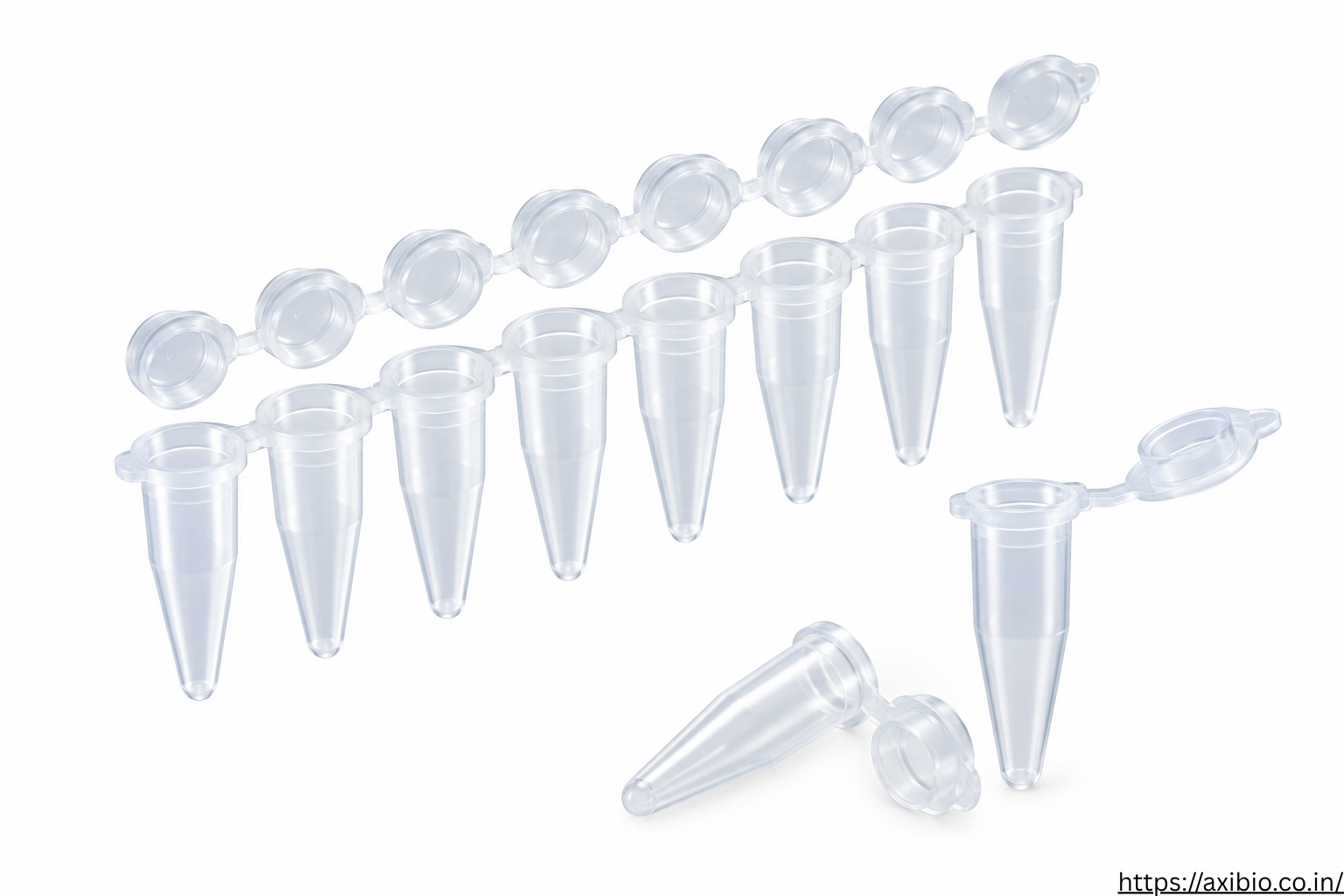
PCR tubes are thin-walled, transparent, small-volume plastic containers fabricated from biologically safe polypropylene material that contain the reaction mixture while being amplified using the polymerase chain reaction. They are manufactured to ensure optimal fitting inside the thermal cycler to allow quick and even heating and cooling through the walls of the tube during the denaturation, annealing, and extension phases.
Unlike a standard microcentrifuge tube, a PCR tube is a specially-designed product able to endure several dozen temperature cycles in the range from around 4°C to 98°C without any deformations, leakage or evaporation of the sample content. Such thermal resistance, tight sealing of the lid and optimal fitting in the thermal cycler make PCR tubes distinct from common laboratory equipment.
PCR tubes find wide application in all areas where DNA/RNA amplification is required including molecular biology, diagnostics, genomics, forensics, agriculture, and academic studies.
Why PCR Tube Selection Matters
It’s tempting to think of PCR tubes as a commodity item as long as it holds liquid and fits the block, it should work. In practice, tube quality affects several parts of the PCR workflow at once:
- Heat transfer. An irregular or excessively thick wall of the tube reduces the speed of reaching the necessary temperature in each cycle of the reaction.
- Evaporation. An insufficiently tight cap results in the evaporation of water during the elevated temperature stages, causing the concentration of the reaction and changing the proportions of primers, templates, and enzymes.
- Sealing and leakage. An improper seal of the cap may lead to the contamination of different wells or samples’ losses.
- Contamination. Microscopic amounts of RNases, DNases, or PCR inhibitors on the surface of the plastic material can damage the DNA template or inhibit the activity of the polymerase enzyme.
- Reproducibility. Inconsistent dimensions of the tubes within one batch or across different batches can cause unpredictable variability without affecting the quality of the reaction components and protocols.
- Compatibility. A tube that does not fit into the block of the thermal cycler will create air pockets in the system.
All these things alone may not be enough to cause a PCR reaction to fail; however, put together, they give the reason for which a PCR tube selection is not a trivial issue to laboratory experts.
Common PCR Tube Problems Laboratories Face
Most PCR tube-related issues fall into a handful of recurring categories. Here’s what typically causes them, how they show up in your results, and what to check.
1. Sample Evaporation
Cause: Loosely fitting caps, weak or deformed cap seals, or frequent opening and closing which wears out the seal. Effect: Decreased final volume of the reaction mixture, increased concentration of reagents, and inconsistent Ct values for qPCR. What should be inspected: Ensure that the cap forms an airtight seal when capped and that the tube and cap are sized compatibly (incompatible tube/cap pairing from other suppliers is a common cause).
2. Leakage or Poor Sealing
Cause: Caps with geometries that do not fit the tubes’ rims, or those that do not seal correctly. Consequence: Sample loss, cross-contamination of the samples in adjacent wells, and inaccurate replication data. To verify: Check a sample batch of tubes through closure, inversion, and compression before making the purchase.
3. Poor Thermal Transfer
Cause: Thicker, uneven, or non-uniform walls of the tube. Effect: Slow heating/cooling process and possible increase in the duration of the cycle, as well as decrease in efficiency of amplification. Design aspect: The thin-walled PCR tubes with even walls are made for this purpose.
4. Thermal Cycler Incompatibility
Cause: Mismatch between the size of the tube (its height, diameter, cap shape) and the wells of the thermal cycler you have. Consequences: Gaps between the tube and the block; poor contact; unequal temperature conditions during the run. Checking whether this applies to your case: Look at the tube specifications by its maker and check the fit of a few samples.
5. Tube Deformation
Cause: Sub-standard or reprocessed plastics that soften or distort due to temperature cycling. Effect: Poor seating and sealing of tubing or caps, along with higher chances of leaking during a run. What to look out for: Use only high-purity virgin polypropylene tubing, not any recycled or mixed resins.
6. Contamination
Cause: Leftover RNase, DNase, PCR inhibitors, or trace metals present due to production. Effect: Degradation of template, PCR inhibition, or a false-negative test result particularly important for diagnostic and forensic processes. Requirements for purity: Make sure that the tube is verified as being RNase-free, DNase-free, and PCR inhibitor-free.
7. Inconsistent Results Between Reactions
Potential consumption-based issues: Batch variations in wall thickness, cap size, or purity of plastic. What should be checked: Inquire about the supplier’s consistency in manufacturing and quality control process, and run a pilot batch before changing suppliers of PCR tubes.
8. Optical Problems in qPCR
Why it’s important: In qPCR, the thermal cycler’s optical detection system measures the fluorescence by shining light through the wall or cap of the tube itself. Any cloudiness, scratches, or imperfections in the plastic material will scatter and interfere with the fluorescence measurement. What to look for: For qPCR experiments, use tubes that have clear caps made for real-time measurements, not ordinary PCR tubes.
There’s one thing that needs to be said: The tubes themselves aren’t often the source of a failed experiment. Primer design, the quality of the template DNA, the performance of the polymerase, and calibration of the machine all affect the outcome. The tubes themselves are one of the few things that are completely controllable before optimizing the chemistry of the reaction, which is exactly why they matter.
Types of PCR Tubes
Not all PCR tubes are built for the same job. Understanding the common formats makes it easier to match the right tube to your workflow.
- Single-use PCR tubes – independent, individual 0.1 mL, 0.2 mL, or 0.5 mL PCR tubes, useful for lower throughput or individual reactions.
- PCR strips of tubes – sets of tubes assembled into strips with 8 or 12 individual tubes which fit into multichannel pipette tips and are optimized for standard 96-well thermal cyclers, useful for higher throughput applications.
- Standard profile tubes – tubes designed for use in regular thermal cycler blocks with standard depth of block wells; use of standard profile tube in low profile block (and vice versa) may result in inefficient contact and heating.
- Clear tubes – allow for inspection of sample volume and clarity, useful for both standard and quantitative PCR.
- Optical clear caps – special caps produced to provide consistent transmission of light through the cap, critical for qPCR/real-time PCR fluorescence measurement.
- Flat cap tubes – sitting flush with the block, these tubes are typically preferred for qPCR as they provide predictable interaction with the optical system.
- Domed cap tubes – rounded cap design is the most common for standard (non-optical) PCR tubes.
The right choice depends on your throughput, your thermal cycler’s block format, and whether the workflow includes real-time fluorescence detection.
PCR Tube Type Comparison
| PCR Tube Type | Typical Use | Main Advantage | Important Selection Consideration |
| Individual PCR tubes | Low-throughput or single-sample PCR | Simple handling, easy to label individually | Slower to fill for large batches |
| PCR strip tubes (8 or 12) | Medium- to high-throughput PCR and qPCR | Compatible with multichannel pipettes, matches 96-well layouts | Strips must fit thermal cycler block spacing precisely |
| Standard-profile tubes | General PCR on standard thermal cyclers | Broad compatibility with common block designs | Confirm block depth matches tube height |
| Low-profile tubes | Thermal cyclers with shallow block wells | Better block contact in low-profile instruments | Not interchangeable with standard-profile blocks |
| Domed-cap tubes | Standard (non-optical) PCR | Secure, familiar seal for routine amplification | Not ideal where fluorescence reading is required |
| Flat, optically clear cap tubes | qPCR / real-time PCR | Consistent light transmission for fluorescence detection | Cap clarity and flatness affect signal accuracy |
How to Choose the Right PCR Tubes
Selecting PCR tubes is easier when you work through it as a checklist rather than trying to evaluate everything at once. Here’s a practical, step-by-step approach.
- Reaction volume. The tube volume (typically 0.1 mL, 0.2 mL, or 0.5 mL) should be compatible with the amount of your reaction volume.
- Thermal cycler compatibility. Verify compatibility of the tube height, cap shape, and well depth of the block with your particular model of the thermal cycler.
- Profile. Make the choice between standard profile and low profile PCR tubes in accordance with the configuration of the block of your equipment.
- Cap type. Select an optically clear cap for qPCR; flat or domed caps can usually be used for PCR.
- Sealing. Find a cap that provides a reliable hermetic sealing of the tube without excessive tightening force.
- Heat conductivity. Prefer thin-wall and equal-wall thickness PCR tubes.
- Material. Make sure that the tubes are fabricated from virgin polypropylene and not recycled plastic.
- Optical specifications. If used for qPCR, make sure that the cap is designed for real-time fluorescence detection.
- Purity specifications. Look for RNase-free, DNase-free, pyrogen-free and PCR inhibitor-free certifications, in particular for highly specialized diagnostics or scientific research purposes.
- Process throughput and workflow. You may use individual tubes for low volume and strip tubes for higher throughput, multichannel applications.
- Packaging. Ensure that the tube’s packaging is designed to protect tubes from contamination by dust.
- Consistency of the supplier. It is important whether the manufacturer is able to provide you with the batch-to-batch consistency in dimensioning and purity. This aspect becomes increasingly important with time compared to a specification sheet.
Working through this list before you order PCR tubes in bulk will catch most of the compatibility and quality issues before they show up as a failed run.
Standard PCR vs qPCR: What Changes?
There are different requirements put on PCR tubes in conventional PCR and qPCR. The difference is that while conventional PCR is based only on amplification, qPCR involves monitoring of fluorescent signal, and thus needs a thermal cycler with an optical system capable of reading fluorescence through the tube during cycling, rather than at its end. While in conventional PCR, the main function of the tube is thermal, in qPCR, it should also have some optical properties.
Key differences to consider when choosing PCR tubes:
- Optical detection. qPCR machines detect the fluorescence signal by looking through the cap (or even through the tube wall itself), which means cap clarity and flatness have an impact on the quality of the optical signal.
- Cap characteristics. Flat optically clear caps are preferred for qPCR reactions; domed caps are more frequently used in standard PCR.
- Volume. qPCR reactions are often smaller, thus, the ratio of tube and cap size to volume becomes more critical.
- Consistency of tubes. As qPCR depends on the comparison of the optical signals, tube and cap consistency becomes important, more so than in standard PCR.
- Compatibility with the machine. Each qPCR machine detects the fluorescence differently, thus, the tube and cap compatibility need to be checked with the manual of the particular instrument – there is no universal type of tube needed for all the qPCR machines.
If your lab runs both standard PCR and qPCR, it’s common to stock two tube formats rather than assume one type of PCR tube will serve both purposes equally well.
PCR Tube Selection Checklist
| What to Check | Why It Matters | What the Laboratory Should Verify |
| Volume (0.1 mL / 0.2 mL / 0.5 mL) | Must match reaction volume and thermal cycler block | Tube capacity matches your standard protocol |
| Material | Affects thermal stability and chemical inertness | Virgin, medical-grade polypropylene, not recycled resin |
| Wall design | Determines speed and evenness of heat transfer | Thin, uniform wall thickness throughout the tube |
| Cap type | Affects sealing and, for qPCR, optical performance | Flat/optically clear for qPCR; domed or flat for standard PCR |
| Sealing | Prevents evaporation and cross-contamination | Cap creates a secure, hermetic seal when closed |
| Thermal cycler compatibility | Ensures even contact with the block | Tube height and cap profile match your instrument |
| Optical compatibility | Critical for accurate qPCR fluorescence readings | Cap is rated for real-time PCR applications, if applicable |
| Purity | Prevents inhibition, degradation, or contamination | RNase-free, DNase-free, pyrogen-free, PCR-inhibitor-free |
| Packaging | Protects tubes from contamination before use | Sealed, labeled packaging with batch/lot information |
| Supplier/manufacturer consistency | Reduces well-to-well and run-to-run variability | Documented quality control and consistent batch performance |
What Makes a Reliable PCR Tubes Manufacturer?
Choosing a PCR tubes manufacturer is, in many ways, a bigger decision than choosing a single product, because it determines the consistency you can expect order after order. When evaluating a PCR tubes manufacturer or PCR tubes supplier, laboratories generally look at:
- Quality of raw materials. If the company uses new polypropylene or mixes some of recycled plastic in its composition.
- Manufacturing process stability. The precision of wall thickness, tube height, and cap dimensions control throughout the manufacturing process.
- Uniformity of tube dimensions. If tubes of the same order have the same dimensions for thermal cyclers; if they do not vary from loose fitting to tight ones.
- Uniform wall thickness. Same wall thickness of all tubes, not just an average value of the sampled ones.
- Consistency of caps fitting. The same reliable seal between a tube and a cap throughout the whole batch, not only during quality control.
- Evidence of sealing. Evidence of effective evaporation-proofing during real thermal cycling process.
- Controls of purity. Proven measures to keep tubes RNase-free, DNase-free, and free of any PCR inhibitors.
- Reproducibility. Consistency of product performance from batch to batch, not only within the same batch.
- Documentation. Accessibility of lot numbers and specification sheets upon request.
- Packaging. The packaging used to ensure protection of tubes from dust and contamination during storage and transportation.
- Quality control procedures. Whether testing is done by the manufacturer for accuracy in dimensions, purity, and sealing.
- Technical support. If the supplier can provide answers for compatibility issues and specifications.
- Supply consistency. The ability of the supplier to provide reliable supply to prevent labs from having to change PCR tubes in midstream.
In general, a PCR tubes supplier that excels in these aspects will be able to minimize the number of consumable factors the laboratory needs to figure out, which is basically what all researchers are after when they use PCR tubes suppliers.
Here is also where the role of Axibio comes in as a PCR tubes manufacturer who specializes in providing materials with the features mentioned above.
Why Consider Axibio for PCR Tubes?
Axibio produces PCR tubes according to the very criteria that are relevant in the framework of selection above: material purity, thermal performance, sealing, and optical suitability for qPCR.
According to the PCR Tubes page on the Axibio website, Axibio PCR tubes are made of very pure virgin medical grade polypropylene with thin walls for even heat distribution throughout thermal cycling process. In addition, they are snap-caps designed to avoid any evaporation and leakage, and offer optically clear flat caps suitable for real-time PCR (qPCR).
Regarding purity, Axibio PCR tubes are described as RNase-free, DNase-free, pyrogen-free, and without PCR inhibitors as well as metal-free and leach-proof – qualities that are important to have in sensitive amplification and diagnostics.
As a producer and supplier of PCR tubes, Axibio offers their products based on those specifications and not on generalized features, just like any laboratory should evaluate any PCR tubes provider by.
How Axibio PCR Tubes Address Common Laboratory Concerns
Connecting the common problems covered earlier to the documented features of Axibio’s PCR tubes:
- Evaporation and leakage: The snap-cap system is supposed to provide a tight and leakage-resistant seal, which would help to prevent one of the most prevalent factors that cause evaporation when thermally cycling.
- Poor thermal transfer: Thinning walls uniformly in the tubes is meant to ensure efficient thermal conductivity and minimize possible discrepancies in the thermal processing of the batch.
- Contamination: Requirements for RNase-free, DNase-free, pyrogen-free, and PCR inhibitor-free are meant to ensure protection from contamination of the template or its inhibition by the consumable.
- Optical problems in qPCR: The optically clear flat caps are designed especially for fluorescence-based qPCR reactions.
- Material degradation: Using medical grade virgin polypropylene instead of recycled plastic is supposed to ensure the stability of tubes in thermocycling.
It is important to reiterate that no PCR tube, whether from any particular manufacturer, can guarantee amplification by itself. The quality of reagents, template, primers, and even calibration of thermal cycler are still relevant. All that a good PCR tube can ensure is the elimination of variability introduced by the consumable which is what Axibio’s PCR tubes aim at.
Conclusion
The PCR tubes themselves can be considered more than just an encapsulating device for the reactions the materials, wall thickness, cap structure and dimension fit all affect heat exchange, sealing, evaporation and optics used for qPCR. Problems that laboratories encounter most frequently evaporation, leakage, bad thermal exchange, thermal cycler incompatibility and inconsistencies have mostly something to do with the above listed parameters.
When working out the reaction volume, thermal cycler compatibility, tube shape, cap structure, material quality and optical needs in advance before ordering gives a practical approach to choosing PCR tubes that will suit your process, rather than simply ordering whatever you find most affordable and familiar. And since consistent consumable performance builds up through time, the producer of PCR tubes turns out to be equally important as a specification sheet of any particular item.
If you are considering different PCR tubes for your laboratory, you may want to review Axibio’s PCR Tubes according to the check list provided in the guide above virgin polypropylene construction, uniform thin walls, snap-cap sealing, optically clear cap for qPCR are the very criteria laboratories should consider when approaching any PCR tubes producer.
Frequently Asked Questions About PCR Tubes
1. What are PCR Tubes used for?
The PCR tubes contain the reaction mixture comprising the template DNA, primers, polymerase enzyme, and buffer solution used in PCR and qPCR reactions to amplify the samples through cycles of heating and cooling.
2. What material is commonly used for PCR Tubes?
Most PCR tubes are made up of polypropylene that is of medical grade and has the ability to withstand cycles of heating and cooling.
3. How do I choose the right PCR Tube?
Choose the right tube volume and shape depending on the thermal cycler you own, check that the cap is suitable for your experiment (PCR or qPCR), and ensure that the purity level is certified.
4. What is the difference between standard and low-profile PCR Tubes?
Conventional tubes have a standard profile which is long, while low-profile tubes are shorter, meaning that the two types cannot be used interchangeably since they are made to be compatible with different thermal cycler blocks.
5. Are all PCR Tubes compatible with every thermal cycler?
No. PCR tubes may differ in size and design depending on the manufacturer; therefore, not all PCR tubes will fit any given thermal cycler block. You must check for compatibility first prior to making an order.
6. Why do PCR Tubes evaporate?
Evaporation commonly takes place because the seal formed by the cap is not complete, mainly because of bad fit between the cap and the tube, or due to the deterioration of the cap itself.
7. Why is cap sealing important?
Poor sealing of the tubes leads to evaporation of samples in high temperatures, resulting in concentrated reactions that may produce inconsistent results, and increases the probability of contamination of adjacent tubes.
8. Can PCR Tubes be used for qPCR?
While standard PCR tubes may be capable of holding the qPCR reaction, special optical clear caps are required to perform fluorescence detection, as some PCR tubes lack such optical clarity.
9. What should I check when buying PCR Tubes?
Consider the volume of the tube, its compatibility with the thermal cycler, cap type, sealability, wall thickness, purity of the material (RNase/DNase/pyrogen-free), and optics for qPCR.
10. How do I choose a PCR Tubes manufacturer?
A PCR tubes supplier should use virgin polypropylene, have documented quality control, be able to offer consistent dimensional tolerance from batch to batch, provide purity certification, and help with compatibility issues by providing technical documentation.