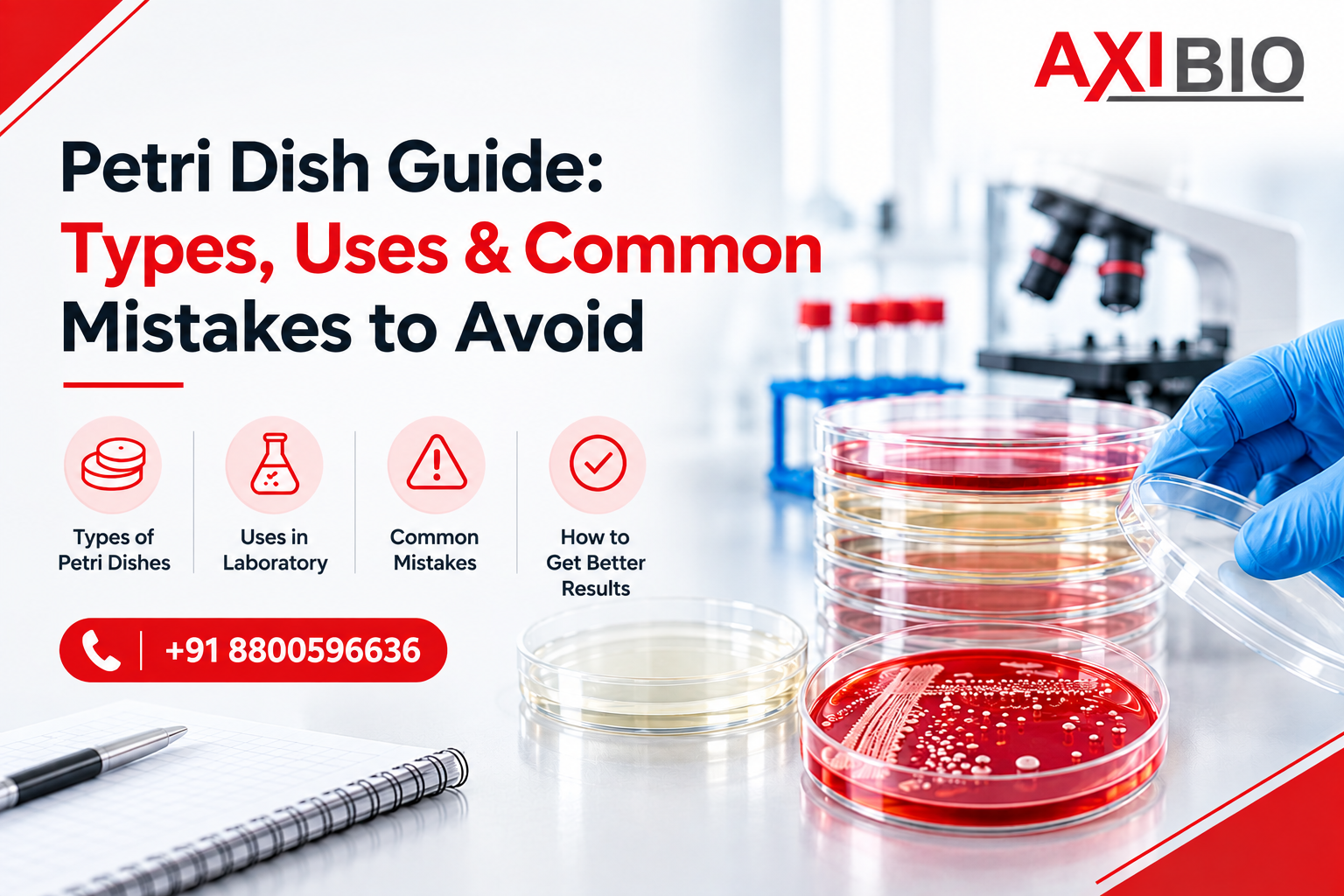
A Petri dish is a flat, circular laboratory dish that is primarily used for growing cultures by holding culture medium. The Petri dish is widely applied in microbiology, biotechnological, pharmaceutical studies, food testing, and teaching laboratories.
Despite being an easy-to-use object, even small mistakes may lead to problems during working with a Petri dish. Incorrect handling, contamination, inappropriate material, incorrect lid or vent design, as well as choosing an improper Petri dish, may cause contaminated cultures, uneven growth, sample damage, or waste of culture medium.
The purpose of this guide is to help you choose the proper Petri dish according to your laboratory purposes.
What Is a Petri Dish?
The Petri dish (Petri plate, culture plate, culture dish) is a small, clear, circular, unglazed dish, usually made of plastic, glass or other synthetic materials, having a cover and intended for the cultivation of bacteria or other microorganisms in an artificial growth medium.
This apparatus was invented in 1887 by German microbiologist Julius Richard Petri, assistant to Robert Koch, who improved upon his former glass slide technique of cultivating bacteria. The Petri dish has remained almost unchanged since then a shallow circular base filled with the growth medium, and a slightly larger lid covering it.
Three design features define every Petri dish, regardless of material:
- Shallow and flat bottom provides the culture medium with a large surface area, promoting even formation of colonies and visibility during inspection.
- Loose-fitting lid rests on top of the bottom but does not seal it, enabling gas exchange (entry of oxygen and exit of carbon dioxide) without letting dust and other microorganisms settle on the medium.
- Transparency the petri dish is either made of glass or plastic, allowing observation without lifting the lid.
Standard diameters run from about 30 mm to 200 mm, with 90 mm being the most common size for routine microbiology work in most laboratories.
What Are Petri Dishes Used For?
Petri dishes can be used for growing, isolating, and studying microorganisms or cells in a culture medium that is usually solid or semisolid in nature and is mostly agar.
Their core applications include:
- Bacterial Culture & Isolation: Cultivation of bacteria, fungi, yeasts and molds from clinical, food, water and environmental specimens.
- Antibiotic sensitivity tests: disc diffusion (Kirby-Bauer method) testing involves placing the antibiotic discs on an inoculated plate; if there is a clear zone around the disc, it means that the antibiotic has inhibited bacterial growth.
- Cell/tissue culture: cultivation of mammalian, plant, insect or other animal cells for research purposes using a treated surface of the petri dish for optimal cell adherence.
- Environmental/surface testing: settling and contact plates test the quality of air or surface in cleanrooms, food processing areas, hospitals.
- Food/water testing: plating of the samples to check for contaminants like E. coli, Salmonella, coliforms.
- Plant tissue culture & seed germination studies: studies in early stages of development under controlled, sterile conditions.
- General laboratory use: evaporation of solvents, drying of precipitates or temporary storage of samples because of the wide open surface of the petri dish.
Each of these applications depends on the same underlying design: a wide, even surface that stays observable and stays clean.
Types of Petri Dishes
Petri dishes can be categorized based on materials, sterility, and design considerations including ventilation and partitions. It is the right choice among these three categories that ultimately makes your dish suitable for your requirements.
By material
- Glass Petri dishes are made of borosilicate glass, reusable, and sterilized either by autoclaving or dry heating before each use.
- Plastic Petri dishes are made of polystyrene plastic; rarely made of polypropylene; are disposable and sterilized at the time of manufacture.
By sterility and packaging
- Sterile, individually packaged for aseptic microbiological experiments where any risk of contamination should be kept to a minimum.
- Sterile, bulk packaged (sleeves) for high-volume usage where each dish is not required to be packaged individually.
- Non-sterile for learning, regular purposes, or uses that require sterilization in-house.
By venting
- Non-vented lack of gaps or notches for ventilation; employed when anaerobic activity or lengthy culture periods are planned, in which minimal gas and water exchange is required.
- Single vented a few gaps or notches to permit some gas exchange; a medium solution for routine aerobic activities.
- Multi-vented multiple gaps for ventilation around the circumference to enhance gas exchange.
By surface treatment (cell culture)
- Tissue culture (TC) treated surface chemically or physically altered for better cell attachment; ideal for mammalian and other adherent cells.
- Non-treated / hydrophilic for microbiological culture as the cells do not need to adhere to the surface of the plate.
By format
- The standard circular plates which are used in almost all routine tests.
- The compartmentalized (bi, tri or quad) plates segmented into 2 to 4 compartments in order to test two or more media/samples on one plate.
- Square or rectangular plates used in some automated or high-throughput testing.
Glass vs Plastic Petri Dish: Which Is Right for Your Lab?
However, the essential distinction lies in the reusability and sterilization technique; glass Petri dishes are autoclaved or dry-heat sterilized for repeated use, while plastic Petri dishes are pre-sterilized, disposable products used only once. Aside from this distinction, the real differences become evident when it comes to usage:
- Sterilization: Glass allows sterilization by dry heat up to 160°C or autoclaving up to 121°C, so it can be re-sterilized hundreds of times if treated with care. Plastic plates are sterilized with gamma or ETO radiation once during manufacturing and cannot withstand autoclaving since they would be melted or warped.
- Contamination: Every new usage of a glass dish involves a risk of contamination due to imperfect cleaning and sterilization. Plastic plates are delivered sterile and can be used once only, eliminating one potential source of contamination completely that is why all diagnostic and clinical laboratories use plastic plates by default.
- Pattern of costs: The initial cost of glass dishes is higher but it is cheaper per usage if the laboratory is able to autoclave or heat air ovens and uses many dishes; plastic plates are cheaper per piece but have recurring cost because every plate is used only once.
- Optical clarity: Both glass and polystyrene have sufficient clarity, however, polystyrene is chosen especially for its clarity and rigidity.
- Chemical resistance: Glass will have better resistance to organic solvents and strong chemicals, while polystyrene may have some solubility in certain organic solvents, an issue that arises if the dish is not used only for aqueous culture media.
| Type / Material | Typical Characteristics | Reusability | Sterilization | Common Applications | Key Advantage | Key Limitation |
| Glass (borosilicate) | Rigid, chemically inert, heat-resistant | Reusable (autoclave/dry heat) | Autoclave (121°C) or dry heat (160°C) | Teaching labs, long-term research, chemical-resistant work | Durable, lower per-use cost over time | Higher upfront cost; breakage risk; needs washing/sterilizing infrastructure |
| Plastic (polystyrene) | Lightweight, optically clear, rigid | Single-use, disposable | Pre-sterilized (gamma or ETO) at manufacture | Diagnostics, routine microbiology, food/water testing | Ready to use, consistent sterility, no cleaning labor | Recurring consumable cost; not autoclavable |
| Plastic (polypropylene) | More heat- and chemical-resistant than polystyrene | Usually single-use | Pre-sterilized or autoclavable variants exist | Applications needing solvent or heat tolerance | Better chemical resistance than polystyrene | Slightly less optical clarity than polystyrene |
| TC-treated plastic | Surface-modified for cell adhesion | Single-use | Pre-sterilized | Mammalian/plant cell and tissue culture | Improves cell attachment and growth | Not needed (and costs more) for standard microbial culture |
How to Choose the Right Petri Dish
The right Petri dish depends on your application, required sterility level, material compatibility, and how the lab is set up to sterilize or dispose of dishes — not on price alone.
Work through these factors in order:
- Application microbial culture, cell/tissue culture, environmental monitoring and food testing all benefit from different surface treatment and venting options.
- Material glass in case of reliable autoclaving capabilities and reuse; plastic for guaranteed one-time sterility without having to clean.
- Size 90 mm suffices for basic microbiology; smaller dishes (35-60 mm) are better suited for cell culture or samples; larger dishes (100-150 mm) fit for environmental monitoring and higher surface area needs.
- Sterility verify if you need individually packed sterile Petri dishes (aseptic technique) or bulk packed sterile Petri dishes (routine work).
- Venting non-venting for anaerobic or long incubation processes; venting for basic aerobic culture which requires air circulation.
- Reusability/disposability consider washing, autoclaving and waste management capabilities of your laboratory, and not just the cost per dish.
- Packaging large packaging volume lowers cost per unit for high-throughput laboratories, while small packaging helps in minimizing waste for less frequent use.
- Compatibility verify that the size of the dish fits into your incubators, automated platers or imaging devices if you use them.
- Quality documentation for regulated and accredited laboratories, make sure that the supplier can supply you with batch traceability and corresponding quality documentation.
Common Petri Dish Mistakes and How to Avoid Them
Most Petri dish issues arise due to several recurring mistakes in technique rather than flaws in the dishes themselves, and resolving these often fixes the issue of “why is my dish failing” without having to switch vendors.
Right-side-up incubation. Always ensure that your plates are incubated in an upside-down position (with the lid on the bottom). This prevents condensation that occurs during the heating of the agar from collecting on the lid and dripping down on top of the colonies, blurring results. Flip the plates just after inoculation, before incubation begins.
Poured at the wrong temperature. Pouring of agar that is too hot can harm heat-sensitive compounds like blood and create excess condensation in the lid while poured at the wrong temperature means that the agar solidifies before spreading. Warm the agar to about 45 to 50°C using a water bath before pouring.
Marking the lid rather than the base of the dish. Lids are interchangeable with different dishes during normal handling of the equipment, thus a marked lid may end up with a mismatched base. Always mark the base of the dish; do not mark the lid.
Use of incorrect type of vent. A multiple vent dish used in anaerobic or extended incubation will allow for excess entry of oxygen and moisture loss compared to that expected. Always match vent type to your application; use non-vent for anaerobic or extended incubation, and use vent for normal aerobic growth.
Reuse of glass dishes without proper sterilization. Failure to resterilize the glass dish before each reuse may lead to carry-over of any previous contamination in the cultures. Ensure that you always properly resterilize glass dishes (dry heat 160°C for 120 minutes, or autoclave at 121°C).
Pouring an excess or insufficient amount of medium in the plate. An excess of the medium increases chances of the cover coming into contact with the surface of the agar while too little will provide a thin layer which dries up fast causing an irregular colony size. Ensure you pour a constant amount, normally 20-25 ml per 90 mm plate.
Storing too many plates on top of each other while incubating. Storing too many plates causes inadequate circulation of air among the plates in a stack and thus inconsistent temperatures among them. Ensure that your plates do not exceed the recommendations of the incubator manufacturer.
| Common Mistake | Why It Happens | Practical Solution |
| Incubating plates right-side up | Condensation drips onto colonies and smears growth | Always invert plates (lid down) before incubation |
| Pouring agar too hot or too cold | Poor temperature control before pouring | Temper agar to 45–50°C in a water bath before pouring |
| Labeling the lid instead of the base | Lids get swapped between dishes during handling | Label the base only, every time |
| Wrong vent type for the application | Vent type not matched to aerobic/anaerobic needs | Choose non-vented for anaerobic/long incubation, vented for routine aerobic work |
| Reusing glass dishes without full resterilization | Rushed or skipped autoclave/dry-heat cycle | Follow a fixed sterilization protocol for every reuse |
| Over- or under-filling with medium | Inconsistent pouring volume | Pour a consistent, measured volume (~20–25 mL for 90 mm dishes) |
| Over-stacking during incubation | Trying to save incubator space | Respect incubator stacking limits to preserve airflow |
What Affects Petri Dish Price?
Petri dish price varies based on material, sterility, packaging format, and order volume — not on a single fixed rate, which is why quotes differ so much between suppliers and product lines.
Legitimate factors that influence price include:
- Material – Glass is usually expensive per unit as compared to plastic, but it is a reusable product.
- Size – The cost per unit increases for larger diameter dishes as compared to smaller diameter dishes since larger dishes consume more materials.
- Reusability – Reusable glass dishes are initially expensive while disposable plastic dishes are less expensive per unit but will need to be purchased repeatedly.
- Sterilization – Sterile dishes are more expensive because of additional processes like gamma sterilization and ETO sterilization.
- Package format – Individually wrapped dishes usually tend to be priced higher than bulk-packaged dishes in sleeves due to increased cost in terms of materials and labor.
- Special attributes – Ventilation, compartmentalization, TC treatment or grid bottom increase cost in manufacturing and affect price.
- Quantity ordered – Larger quantities ordered mean lower per item cost and is important for high volume diagnostics and food testing laboratories.
- Application specific requirements – A regulated environment such as pharmaceuticals or clinical diagnostics may need additional quality certification, which increases cost compared to the standard educational grade dish.
- Supplier and manufacturer location – Manufacturers charge different prices for identical products depending on their manufacturing capacity and distribution system.
Due to the number of factors that influence price, a better way of comparing is to go by the specification of the dish. It is possible for two dishes, even when they have drastically different prices, to not be equivalent in any way.
What Should You Look for in a Petri Dish Manufacturer?
A dependable Petri dish manufacturer should be able to clearly document material composition, dimensional consistency, sterility method, and packaging and should support your order with consistent supply and responsive technical communication.
When comparing manufacturers or suppliers, check for:
- Material Information: Determine the material composition of the dishes (polystyrene, polypropylene, or borosilicate glass), as well as non-cytotoxicity of plastic where appropriate for the use of the dishes.
- Dimensional uniformity: Dishes need to have a consistent diameter and height within each lot because variations result in inconsistent agar thickness and make comparisons between colonies difficult.
- Optical clarity: Important if the dish will be used for colony enumeration by sight or microscopy.
- Sterility information: For sterile dishes, the manufacturer must indicate which type of sterilization was used (usually either gamma or ETO sterilization of plastic) and verify that it in their technical documents.
- Packaging: Individually packaged, sleeve packed, single wrapped, or double wrapped needs to correspond to the handling of dishes in practice.
- Traceability and documentation: Becomes more important as regulatory or accreditation demands increase.
- Suitability for intended application: Verify that the dishes are validated or intended for the particular use (microbiology, cell culture, environmental testing).
- Consistency of supply: for laboratories doing regular tests, the consistency of supply of the supplier becomes as important as the specification of the product.
- Technical support and quick responses: it is better to have a manufacturer who can respond to your queries on specifications than a company that just sells via catalogues.
- Customizations: some laboratories require vent customization or compartment customizations or pack size customizations. Check if they are available.
How Axibio Can Help With Laboratory Product Requirements
Axibio is a manufacturer of laboratory consumable products that include laboratory equipment like Petri dishes which are offered in gamma-sterile as well as ETO-sterile options.
The Petri dishes by Axibio are made up of polystyrene to provide optical clarity. The range of Petri dishes by Axibio comes in various sizes that are commonly used. In addition, Axibio offers a variety of vents configurations in the Petri dishes that include no-vent, single-vent, and multi-vent.
Whereas your needs go beyond Petri dishes in your laboratory, the complete range of products from Axibio will include additional types of laboratory consumables, which would include filter papers and filtration kits, cell and tissue culture flasks, dishes, and plates, among others important microbiology consumables like sampling containers, inoculation loops, and spreaders, which could come in handy in case you need to standardize the consumables for a microbiology or cell culture protocol.
Should you need more details on specifications, samples, or bulk pricing, feel free to contact the Axibio staff.
Final Takeaway
Though a Petri dish appears to be uncomplicated, getting consistent results requires proper alignment of the material, sterility, and ventilation of the dish with the requirements of a particular task, as well as refraining from using it in an inverted position, ensuring the right pour temperature, labeling the bottom part, and resterilizing reusable dishes.
The cost of Petri dishes differs based on several valid reasons (material, sterility, packing, and quantity of the items bought), so specification matching becomes far more important than seeking for the lowest bid. When the time comes to compare different offers, examining a supplier’s material data sheet, sterilization technique, and supply reliability becomes much more productive than comparing prices only.
Frequently Asked Questions
1. What is a Petri dish?
Petri Dish refers to a flat glass or plastic container, which is transparent, that contains an amount of gel substance called agar to grow or culture microorganisms. Petri dish was invented in 1887 by Dr. Julius Richard Petri.
2. What are Petri dishes used for?
Petri dishes are utilized in the cultivation and isolation of bacteria, yeasts, and fungi; for performing antibiotic sensitivity testing; culturing mammalian, plant, or insect cells; testing for the presence of contamination in the environment; and testing for food and waterborne pathogens.
3. What is the difference between a Petri dish and a Petri plate?
There is no distinction in functionality both “Petri dish” and “Petri plate” are synonyms for the same thing. “Petri dish” usually implies the empty vessel, whereas “Petri plate” implies the vessel which has been poured with the growth medium and has a culture on it.
4. What is the difference between glass and plastic Petri dishes?
Glass Petri dishes are reusable and sterilized using autoclaving or dry heat prior to reuse. Plastic Petri dishes, generally polystyrene, are usually sterilized upon manufacture (gamma or ETO) and then discarded after being used once.
5. Are Petri dishes reusable?
Glass Petri dishes can be reused many times provided that they are handled and sterilized properly. On the other hand, plastic Petri dishes are meant to be used once only and cannot be reused.
6. What factors affect Petri dish price?
Factors such as material, size, sterilization process, packing type (individual wrapping or bulk packaging), unique qualities such as ventilation or compartmentalizing, and quantity ordered influence cost, and there is no one standardized price for any item.
7. How do I choose the right Petri dish?
Start with matching the plate with your particular use (microbiology, cell culture, environmental sampling), then check the materials used, the diameter, the sterilization level, and whether it has a vent or not.
8. What should I look for in a Petri dish manufacturer?
Search for materials and sterility verification, dimensional uniformity, packaging alternatives, traceability, and customer technical support – not merely the cheapest price.
9. Why is the Petri dish covered with a lid that doesn’t seal tightly?
The wide-lidded opening enables gas exchange, which is essential for the survival of aerobic bacteria, while the extended lip and stagnant air space prevent aerial contamination from entering the medium. A completely closed dish will suffocate the aerobic organisms.
10. What are common Petri dish handling mistakes?
The most common errors include incubation of plates upside down rather than upside up, use of incorrect agar temperature, marking the wrong plate (the lid), the use of inappropriate vents for the intended application, and re-use of glass dishes that have not been fully sterilized.