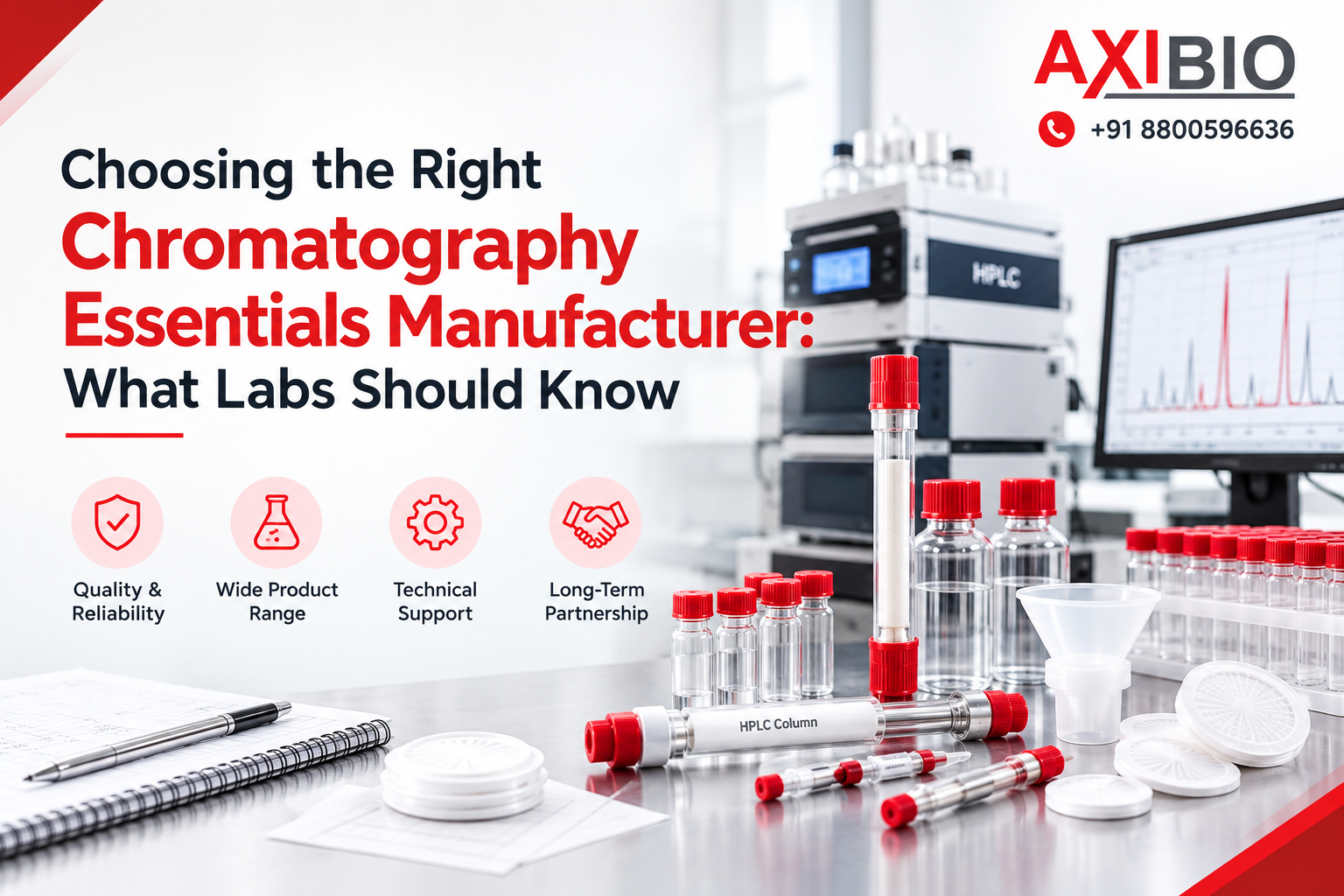
The selection of the right chromatography essentials manufacturer is not a mere purchasing process; it influences sample integrity, peak reproducibility, and time spent on troubleshooting. Chromatography essentials include vials, closures, filters, and other materials that come in contact with the samples before their detection, hence, the wrong choice will be harmful to the whole process.
These are small components, but their effect on results is far from small. A single incompatible septum or an inconsistent vial batch can quietly distort data that looks correct at first glance. Laboratories that overlook this step often trace recurring analytical problems back to a supplier decision made without enough scrutiny.
This is where sourcing decisions quietly become scientific decisions. A pharmaceutical QC lab running HPLC batches every day has different requirements than an academic lab running occasional GC analysis, but both depend on the same basic thing: consumables that perform the same way, every time, batch after batch. Manufacturers like Axibio, which produces chromatography essentials alongside filtration and laboratory plasticware, are one part of a wider supplier landscape labs need to evaluate carefully.
What Are Chromatography Essentials?
The basics of chromatography refer to the expendable products and tools used to process and protect the sample during its analysis via chromatography. These are not the actual analytical instrument; rather, they are all of its supporting elements.
In a typical laboratory, chromatography essentials commonly include:
- Sample vials – sample vials including 2 mL analytical vials with screw/crimp cap closure, HPLC grade sample vials, and GC Headspace vials
- Vial closures & septa – caps, seals, and septa forming a hermetically sealed environment
- Syringe filters & membrane filters – syringe filters and membrane filters including PTFE and nylon membranes for eliminating particles from solutions prior to injections
- Specialty vials – TOC/EPA vials and other application-specific vials
- Solvent safety caps & accessories – components for solvent bottles protecting them from evaporation and/or exposure
They are generally made from chemically-inert borosilicate glass or high purity polypropylene, which have been specially selected to reduce extractable residues and not interfere with analysis. Since chromatographic methods, such as HPLC, GC, UHPLC, and mass spectrometry, are able to detect even minute contamination levels, any discrepancy within these consumables may compromise data integrity.
What Are Chromatography Essentials Used For?
The whole point of chromatography involves making sure that the samples remain intact from their preparation through to reaching the detector. They are used in sample preparation, sample preservation, contamination prevention, and proper introduction of samples into the analytical instrument.
More specifically, laboratories rely on chromatography essentials for:
- Sample Preparation – filtration of particulates and preparation of clean samples for injection
- Sample Storage and Transport – vials and closures that ensure no evaporation, leakage or contamination before analysis
- Chromatography/ Separation and Analysis – providing optimal performance support in HPLC, GC, UHPLC, LC-MS, GC-MS analyses
- Purification – assistance in isolating compounds in complex mixtures prior to and after chromatography separation
- Detection – providing purity of samples to reach the detector without interfering with particulates or leachable materials
- Quality Control (QC) Testing – assisting to provide reproducible and compliant results in regulated pharmaceuticals and industries testing
- Research and Method Development – providing consumables consistently to develop methods
These materials are used in all samples processed by the instrument, meaning their quality has a cumulative impact on the reliability of the data collected, which is why selecting a chromatography essentials manufacturer is even more important than it seems at first.
Why Does Choosing the Right Chromatography Essentials Manufacturer Matter?
Depending on the manufacturer you select, you will either have predictable consumables or an unknown source of errors. Selecting a bad manufacturer is more likely to result in persistent and difficult-to-identify problems than a single noticeable problem.
Common consequences of choosing the wrong supplier include:
- Unpredictable quality of the product – vials or septa which change from one batch to another, resulting in unexplainable peaks shifts and contaminations
- Compatibility problems – closures or membrane that is incompatible with solvents or samples and thus produces artifacts during analysis
- Supply disruptions – lack of some important consumables right in the middle of the project due to the inability of the supplier to keep its stock
- Inappropriate consumables – general products presented as universal and not compatible with your instruments, method, or sample
- Vague product specifications – insufficient information about the products, which makes verification impossible before ordering
- No technical assistance – there is no one to ask about unexpected behavior of a product or new applications of it
- Additional expenses – hidden extra cost resulting from reruns, waste of samples and instrument down time
It is not about going for the highest price; it is all about going for a supplier who can show consistency, documentation, and suitability for your particular application. The following section shows you what exactly to look out for.
Things to Check Before Choosing a Chromatography Essentials Manufacturer
1. Product Quality and Consistency
Quality refers to how consistently the product performs each time you use it. Make sure that the vendor provides technical specifications or certificates of analysis of the particular batch or lot you will be purchasing. It’s a red flag if the vendor cannot explain their quality assurance system between batches.
2. Product Specifications
The vial diameter, thread type on caps, septum material, and filter pore size should be identical to your instrumentation and methodology. Check your autosampler and method prior to making an order, rather than after. Listings that are not specific regarding these factors can be considered a warning sign.
3. Material and Construction
Material of construction of a vial, septum or filter impacts its chemical compatibility and extractables. One must look out for specific information regarding type of glass used (for example borosilicate glass) and type of polymer used (for example polypropylene or PTFE). If a vendor does not specify the material used, then ask prior to purchase.
4. Application Suitability
A product that is applicable in headspace analysis by GC does not necessarily mean that the same product will work in HPLC analysis. Similarly, a membrane filter that works well with aqueous samples does not necessarily mean that it will work well with organic solvents. You should confirm whether a product is validated for your particular method (HPLC, GC, UHPLC, or Mass Spectrometry).
5. Product Range
A supplier that can provide an extensive range of products, such as vials, closures, septa, filters, and associated supplies, normally suggests more experience in manufacturing compared to a supplier of limited product range. An extensive list of chromatography essentials will reduce the number of suppliers.
6. Batch-to-Batch Consistency
Inquire about how they control differences between production runs. A reputable company will have a detailed response in regard to their quality system, whether in-process inspection or at the end of the line. If a supplier does not want to answer or provides a generic statement, it is an indication.
7. Availability and Supply Reliability
Even if the product is very good, it becomes problematic if there is an inventory shortage of the product on most occasions. Make inquiries on what the average lead time is and how the manufacturer deals with high-demand periods.
Chromatography Essentials Manufacturer vs. General Laboratory Supplier
All laboratory suppliers do not necessarily make what they sell. There are suppliers who are specialized manufacturers of chromatography essentials and have total control over manufacturing processes, while there are some that are distributors selling various brands of equipment.
| Factor | What to Check | Why It Matters | Red Flags |
| Manufacturing control | Does the company manufacture the product or resell it? | Manufacturers can usually answer detailed technical and quality questions directly; resellers may need to forward questions to a third party | Vague answers about “who actually makes this” |
| Specialization | Does the supplier focus on chromatography and related lab consumables, or sell a broad, unrelated catalog? | Specialized manufacturers tend to have deeper application knowledge for chromatography-specific problems | Generalist suppliers with little chromatography-specific technical detail |
| Documentation | Are data sheets, certifications, and catalogues available on request or published online? | Documentation supports audits, method validation, and regulatory compliance | No data sheets, or documentation only “available on request” with long delays |
| Batch traceability | Can the supplier trace a specific product back to its production batch? | Traceability matters for troubleshooting and regulated environments | No batch or lot information provided with shipments |
| Support depth | Is technical support handled by someone who understands chromatography applications? | Faster, more accurate troubleshooting when problems occur | Support limited to order status only |
| Supply consistency | Does the supplier maintain stock of core items consistently? | Supply gaps disrupt ongoing analytical work | Frequent “out of stock” notices on standard items |
Even a generic laboratory vendor may be suitable for one-off orders where convenient packaging outweighs the requirement for specialized technical expertise. A manufacturer that controls production in-house is often an easier company to qualify when ordering reoccurring, application-dependent products such as vials, septa, and filters.
How to Match Chromatography Essentials to Your Laboratory Application
No one chromatography product is correct for all needs; the choice always depends on the intended use of the product. Proper matching minimizes any chances of incompatibilities and waste.
Work through these factors before ordering:
- Determine which type of analytical technique is being used. HPLC, GC, UHPLC, and Mass Spectrometry have different requirements for vials, septa, and filters.
- Determine the nature of the sample that is being tested. Aqueous, organic solvents, biological or environmental samples may all have different requirements when it comes to filter membrane chemistry and vials materials.
- Determine compatibility with the instrument. The dimensions and caps that will be used for an autosampler vial should be compatible with your instrument.
- Correlate with required performance. Trace level analysis (pharmaceutical impurity testing, for example) usually requires low extractable material compared to screening.
- Correlate with workflow. High-throughput laboratories may prefer standardization of packaging while low-throughput laboratories may prefer flexibility of ordering.
- Consider frequency of usage. Frequent items require more attention to vendor qualification and larger quantity purchasing.
Once these factors are clear, cross-reference them against the manufacturer’s technical documentation rather than relying on product names or marketing descriptions alone.
Common Mistakes Laboratories Make When Buying Chromatography Essentials
Mistake: Using unit cost as the sole basis of selection. Fix: Consider total cost of ownership, which includes the cost associated with rework, machine downtime, and repeat runs resulting from variability of the product not simply its unit cost.
Mistake: Not paying attention to specifications. Fix: Match the vial dimensions, cap type, septum material, and filter pore size to your instrument and methodology prior to purchase.
Mistake: Not evaluating chemical compatibility. Fix: Ensure that the septum, closure, and filter membrane are chemically compatible with your solvent matrix and sample matrix.
Mistake: Purchasing without regard to the application. Fix: Ensure that the item is validated for your specific methodology (either GC, HPLC, UHPLC, or MS).
Mistake: Ignoring supply continuity. Fix: Discuss availability and lead time considerations with your vendor before making a purchasing commitment.
Mistake: Not comparing the documentation. Fix: Ask for documentation from each vendor under review and compare the actual content – not just the promise.
Mistake: Selecting a vendor without evaluating the support capabilities. Fix: Evaluate their support by asking a technical question before committing to a purchase.
Mistake: Ignoring future needs. Fix: Select a vendor with a wide enough product offering so you can adjust methods or sample volume and will not need to qualify another vendor down the road.
How to Compare Chromatography Essentials Manufacturers Before Buying
A structured comparison makes it easier to evaluate multiple manufacturers fairly, rather than defaulting to whichever quote arrives first.
| Evaluation Factor | Questions to Ask | What a Good Supplier Should Provide | Priority |
| Specifications | Can you provide exact dimensions, materials, and compatibility details? | Detailed technical data sheets for each product | High |
| Quality consistency | How do you control variation between batches? | A clear, specific description of quality checks | High |
| Application fit | Is this product validated for my analytical technique and sample type? | Direct, technique-specific confirmation | High |
| Documentation | Can I get certifications or a product catalogue for audit purposes? | Accessible certifications, catalogues, or technical guides | Medium-High |
| Supply reliability | What are typical lead times, and how do you handle high demand? | A realistic, specific answer with delivery timelines | Medium-High |
| Technical support | Who do I contact if I have a compatibility or troubleshooting question? | A named technical or sales contact, not just a general inbox | Medium |
| Pricing structure | Are there bulk or recurring order options for regularly used items? | Transparent pricing tied to volume or frequency | Medium |
| Track record | How long has the company operated, and in which industries? | A clear, verifiable answer | Medium |
This table can serve as your checklist during discussions with potential suppliers via telephonic interviews or even email correspondences – a vendor who gives you a satisfactory answer to the majority of these questions would usually be easy to qualify.
Why Axibio Can Be Considered for Laboratory Supply Requirements
Axibio’s range of products is suitable for labs that conduct research into chromatography and laboratory equipment for chromatography. Axibio produces chromatography consumables such as 2 mL analytical vials and closures, GC headspace vials and crimp caps, TOC/EPA vials and closures, as well as solvent safety caps which ensure that solvent bottles are protected from contamination when stored.
The above-mentioned items are made of inert borosilicate glass and polypropylene of high quality to guarantee leak-proof seal, low levels of extractables and autosampler compatibility in HPLC, GC, UHPLC, and MS applications.
Apart from basic chromatography supplies, Axibio also makes filters and filter assemblies, such as filter papers, glass fiber filters, and filter funnel assemblies – useful for labs that use both filtration and chromatography supplies from a single supplier. Other supplies include lab plastics, general lab supplies, and benchtop instruments that may be helpful to laboratories looking to consolidate their consumable requirements under one roof.
A few points worth knowing before evaluating Axibio as a chromatography essentials supplier:
- Axibio claims that it has been operating for more than 30 years, with both a manufacturing facility and its own technical staff, as per its About Us section.
- Axibio’s clients in the pharmaceutical, research institutes, and testing laboratories can be found on its web portal.
- Technical documentation and product certifications can be found on its certification page and downloadable technical manuals.
Like all manufacturers, labs need to make sure, independently, that certain vial sizes and cap types and materials are compatible with their instrument and method specifications before purchasing, and the criteria mentioned above are just as applicable for this assessment as for any other vendor.
A Practical Checklist Before You Place Your Order
Use this checklist as a final step before confirming a purchase order for chromatography essentials:
- Validate the particular method of analysis (HPLC, GC, UHPLC, or Mass Spectrometry)
- Validate the dimensions of the vial and type of cap/septum used with the autosampler
- Validate the chemical compatibility of the solvent/sample matrix
- Study available documents – data sheets, certificates and catalogues
- Validate the quality control between batches from different vendors
- Validate the availability and delivery time frame
- Pose a technical question and validate the response from support personnel
- Validate the total cost not just the per piece cost
- Evaluate if the vendor’s product line can meet future needs
Conclusion
The selection of the best chromatography consumables provider depends on the assessment of quality, specifications, applicability, uniformity of batches, reliability of delivery, and overall value versus cost alone. The systematic approach to the assessment of the provider, described in the checklists in this article, allows laboratories to consistently assess any particular supplier before purchasing.
Laboratories which are investigating various possibilities of vials, closures, filters, and other lab equipment can look into the range of chromatography essentials from Axibio and see if it meets the selection criteria described above.
Frequently Asked Questions
1. What are chromatography essentials?
Chromatography consumables refer to the consumable items that are used in preparing the samples for chromatographic analysis and are usually made of inert materials like borosilicate glass and polypropylene. These items include analytical vials, caps, closures, septa, and filters.
2. What are chromatography essentials used for?
Some applications of chromatography consumables include sample preparation, sample storage, filtration, and safe introduction of samples into analytical instrumentation such as HPLC, GC, UHPLC, and mass spectrometry.
3. How do I choose a chromatography essentials manufacturer?
Selecting a chromatography essentials manufacturer entails consideration of such factors as product specifications, quality of materials, consistency of batches, suitability for applications, reliability of supply, technical support, and documentation, rather than basing the selection process on the price factor alone. The use of an objective checklist facilitates this process.
4. What should I check before buying chromatography essentials?
Make sure that your vials have the correct sizes, caps, and septa material compatible with your instrument and your solvents to avoid any problems. Make sure you check the technical information provided by the company producing the vials.
5. Is the cheapest chromatography supplier always the best option?
No. Because of the risk of re-shoots and non-uniformity in performance, the lowest-cost alternative may actually be more costly in the long run after all costs are taken into account. Price is only one of several considerations.
6. What makes a reliable chromatography essentials manufacturer?
A trusted manufacturer is one whose products meet consistent quality standards, provides documentation on technical specifications, ensures availability of stock, and provides timely technical support. A reputation can be easily proved through documentation and asking questions.
7. Can chromatography essentials be used across different laboratory applications?
Though some key chromatography components, like particular types of vials and caps, can be used in more than one technique, it does not mean that they would be applicable in all cases; compatibility would depend on the particular machine, sample, and technique.
8. Why is product consistency important in chromatography?
The consistency in the product ensures that the vial, septum, and filter all react in the same manner each time an analysis is conducted. Inconsistent consumables may introduce variability into the equation that cannot easily be traced to its origin.